What Is Synthetic Market Research? A Buyer's Guide to the Method and Its Limits
Synthetic market research conditions AI personas on demographic and behavioral inputs, then uses them to model the way a defined consumer or B2B audience might react to a survey, a concept test, ad creative, or messaging variants. The participants are modeled rather than recruited: a team describes the audience, configures the personas, and runs the session against a language model.
The method is also called AI market research, simulated market research, or virtual market research. The real decision it raises for a research or marketing leader isn't whether the method works. It's where in a research pipeline a simulated answer is good enough, and where the cost of being wrong requires a controlled experiment on real people before money moves.
Where the method comes from
The intellectual lineage is academic. In a 2023 study, Argyle et al. showed that a language model conditioned on a real survey respondent's demographic backstory could generate opinions whose spread lined up closely with how real Americans had actually answered benchmark surveys such as the ANES (Political Analysis, Cambridge University Press). That paper established silicon sampling as a viable technique, and commercial platforms packaged it into personas, panels, and workflows for marketing, product, and insight teams.
What a synthetic-first workflow looks like
A typical simulated study breaks into five steps:
- Define the audience. Age range, geography, household income, job role, industry, attitudes, prior brand exposure. Define attributes relevant to the decision, then check coverage, sensitivity, and held-out fidelity for that audience.
- Configure personas. Choose the composition and task count for the modeled audience and inspect sensitivity to the setup. Check fidelity using held-out data; the number of generated personas alone is not a measure of effective human sample size.
- Design the research instrument. The same survey, concept-test brief, or ad-pretest stimulus a team would field traditionally.
- Run the session. Each persona answers in natural language. Closed questions produce structured output; open prompts produce responses a team can read and theme.
- Synthesize and decide. Compare segments, identify a leading concept or message, and decide whether the finalists need a real-respondent check before the team commits budget.
A method is only as useful as the boundary published next to it. The loop produces a directional simulated result. It does not produce evidence of actual behavior.
When directional screening is useful
Five situations, drawn from how research and marketing teams use the method:
- Directional narrowing. Cutting a dozen concepts down to a shortlist before commissioning real-respondent work.
- Iterative exploration. Applying the same instrument to successive concepts while treating the output as directional.
- Specialized audiences. Modeling hypotheses about senior B2B buyers, regulated professionals, or niche geographies before validating the decision on real people.
- Cross-market comparison. Applying the same instrument across several country definitions and comparing directional differences under a consistent setup.
- Sensitive topics. Exploring hypotheses about health, finance, or employment before designing research involving real participants.
Where correlation stops answering the question
A correlation score by itself is a marketing claim; the boundary around it is what makes it usable. A simulated response can track what a real audience tends to say. It does not, by itself, tell a team what happens when a specific input changes: a price, a headline, a feature. That is a causal question, and a correlation between simulated and real answers on past surveys is not evidence about a causal effect the team hasn't tested yet.
Naming these failure modes is what lets a buyer check the method against them before budget moves. Three limits follow from that gap:
- Statistical validation. A simulated study does not produce a population estimate with a defensible confidence interval on its own.
- Novel settings. A model may extrapolate to a new product, but plausible output does not establish reliable transfer. Gather evidence for the actual audience and endpoint.
- Final go/no-go calls. Capital allocation, regulatory filings, and public claims should not rest on simulated data alone.
The cost of skipping this step shows up later: a team that commits budget on the strength of a simulated correlation, without checking it against real holdout behavior, finds out the difference only after the launch.
Moving from directional screening to a causal test
A hybrid design can use simulation to propose comparisons, then test the relevant endpoint with human participants. Subconscious can support that transition. State whether the outcome is a recruited stated choice or observed behavior, and report uncertainty and design limits; an interval does not guarantee external validity.
| Stage of the decision | Question being asked | Right tool |
|---|---|---|
| Directional screening | Which of many concepts looks promising? | Simulated iteration |
| Concept narrowing | Which one to three options deserve real budget? | Simulated iteration, then a shortlist |
| Real-world validation | Does the shortlisted option cause the outcome we want? | A randomized, controlled experiment on real people |
| Go/no-go decision | Do we commit budget? | Relevant human effect estimates, uncertainty, economics, constraints, and decision risk |
What Subconscious claims sits on the public record next to what it declines to claim. Subconscious does not replace direct observation of real behavior, and it does not claim any specific accuracy percentage against real respondents.
Privacy and compliance
Generated respondents do not make calibration inputs anonymous. Check whether the workflow uses aggregate, anonymous, or identifiable customer records, interviews, and supplier data, and agree permitted processing, retention, and access. Any privacy benefit depends on those actual inputs and controls rather than the respondent label.
Adjacent terms, clarified
- Synthetic data. Artificial datasets built to train models, or to pad out a real sample that's too small. A related but different problem.
- AI personas. The individual unit inside a simulated research panel. The persona is the agent; synthetic market research is the method built around it.
- AI focus groups. The qualitative format of simulated research, where personas respond as a group rather than individually.
- Multi-turn persona research. A newer extension where AI personas act and react to follow-up stimuli rather than only answering a fixed instrument.
Frequently asked questions
What is synthetic market research?
A method where AI-generated personas stand in for a defined consumer or B2B audience, so a team can gauge how that audience might react to surveys, concepts, ads, or messaging. Each persona is conditioned on demographic, psychographic, and behavioral inputs and queried in natural language, without the recruitment and fielding a traditional study requires.
When should a team use simulation versus a controlled experiment on real people?
Use simulation for directional input: early concept testing, ad pretesting, messaging iteration, specialized B2B audiences, and multi-market comparisons. Use a controlled experiment on real people for the claims that carry the launch decision, where a causal effect and a confidence interval, not a correlated guess, need to back the call.
Does simulation replace research on real people?
Simulation supports provisional iteration. Use relevant human evidence for consequential claims, retaining a baseline and credible alternatives when synthetic screening could be wrong. A suitable experiment estimates its tested effect with uncertainty rather than proving every downstream outcome.
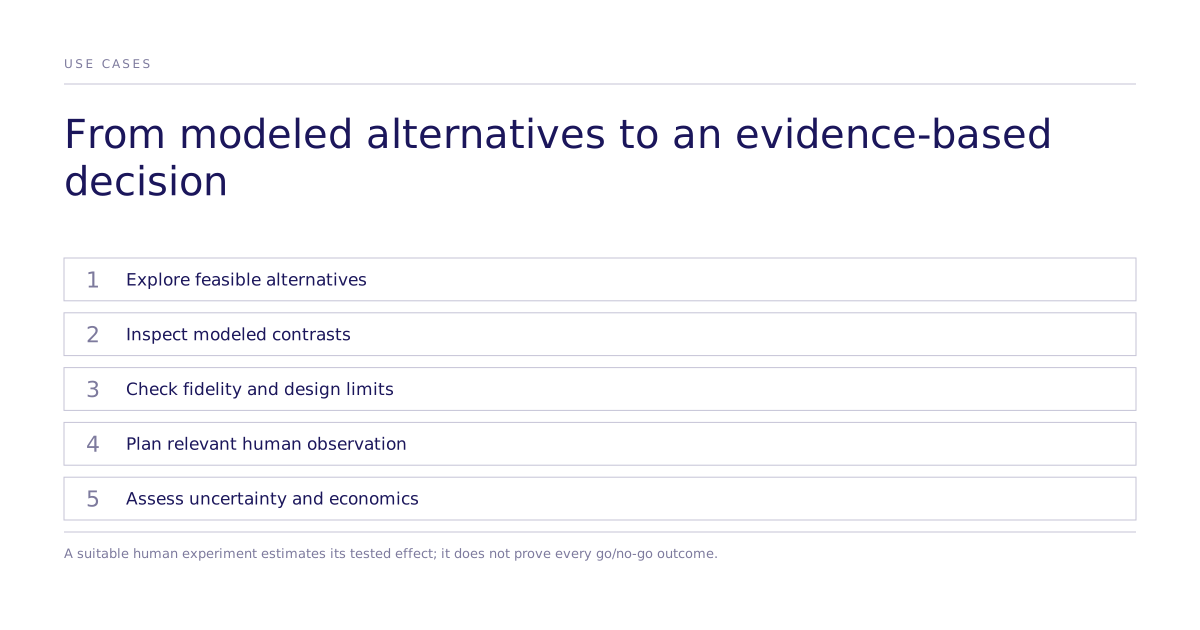
Choose the evidence needed for each stage of the decision. Review aggregate replication evidence and limits, inspect applied case examples, and scope a study using the actual alternatives, audience, and endpoint.