What Is a Synthetic Persona?
A synthetic persona is a model configured to respond as a customer segment, buyer role, expert, or stakeholder. Demographics, context, and attitudes condition the conversation. One open-ended answer is a hypothesis to investigate; it does not itself supply a controlled contrast, quantified uncertainty, or evidence of human fidelity. Persona responses can also be used within an explicitly designed experiment.
What you're actually talking to
A persona configuration bundles five inputs: demographics (age, location, income, profession), psychographics (values, attitudes, personality), role context (job, industry, decision authority), behavioral traits (buying patterns, frustrations, goals), and a communication style. Once set, the model answers in character: reacting to a price increase, objecting to a pitch, or reading a headline.
That differs from a static research persona document, written once and referenced in a slide deck. A persona chat is interactive: ask it a question, get a response, then follow up.
Why do teams use a synthetic persona before a decision?
Marketing, product, and sales teams use persona chat the same way: to generate hypotheses before a launch, a price change, or a message goes live. Typical uses: probing early product concepts, drafting and testing campaign copy, rehearsing objection handling before a sales call, and sharpening a positioning idea before it reaches a deck.
The value of the exercise is exploration. A single conversation surfaces objections and framing a team hadn't considered, without recruiting a focus group.
Where does a single persona answer break down?
One configured conversation is not a validated population. Xiao and colleagues examine homogenization on personality, moral-dilemma, and self-introduction tasks across models. Hu and colleagues study alignment of persona populations to human distributions. Compare diverse personas with matched human data to assess population variation; repeated answers from one persona assess a different kind of reliability. Batzner and colleagues review specification and transparency in synthetic-persona studies.
None of that makes the exercise useless. It means one chat session answers "what might this buyer say," not "what will this segment do."
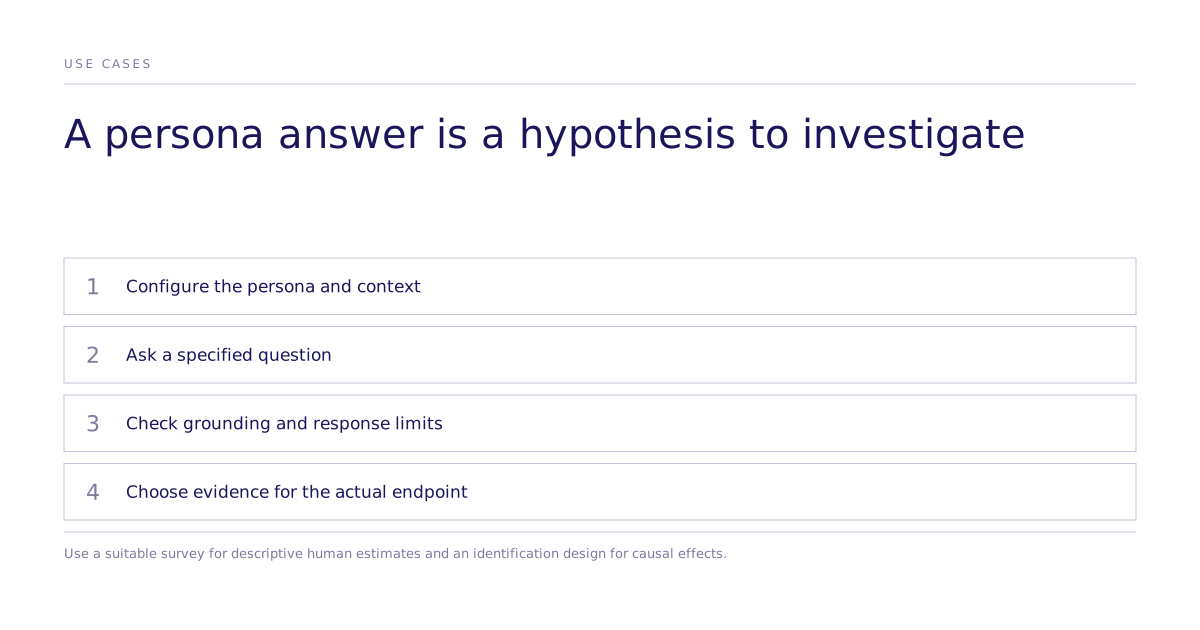
Turning an answer into a hypothesis worth testing
Use persona chat to propose angles, objections, and questions. For a preference comparison, a discrete-choice design can estimate attribute contrasts and design-supported uncertainty in generated choices. That uncertainty still needs a separate fidelity check. Choose a suitable survey, experiment, or observation for the actual human endpoint rather than requiring a DCE for every research question.
Subconscious compares specified alternatives on a modeled population and can support a human study of the same question. State whether the result is generated choice, recruited stated choice, or observed action. Confirmation can change the conclusion; it does not turn every hypothesis into a guaranteed market outcome.
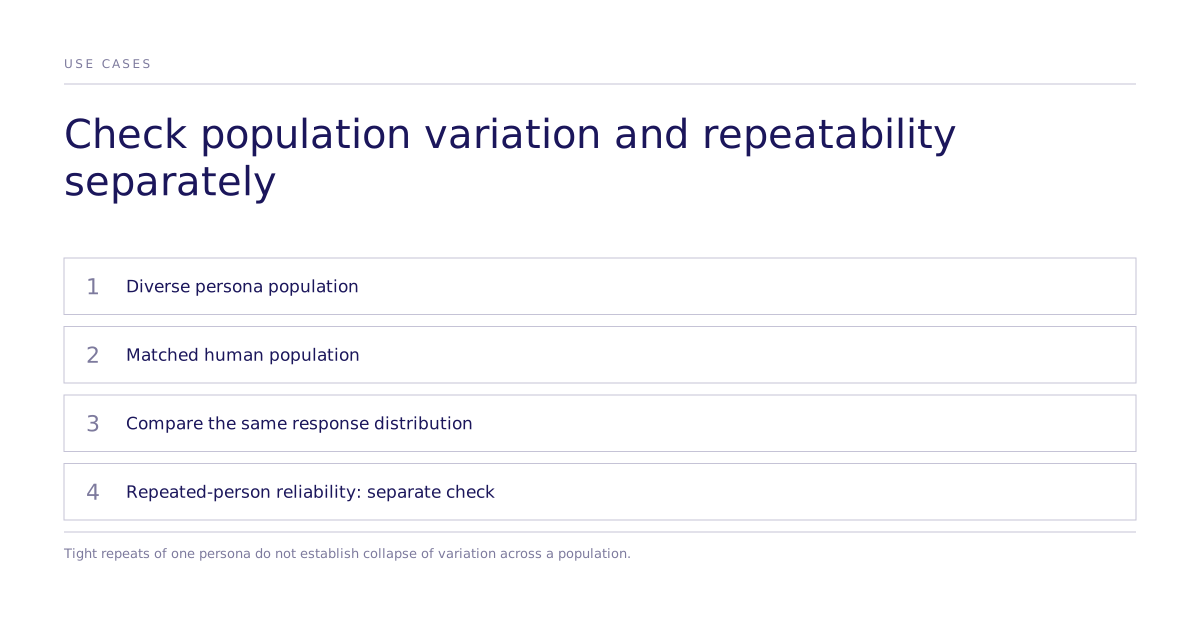
Which method fits which estimate?
A suitable human survey can estimate a distribution of stated choices with uncertainty; causal contrasts require an identification design such as random assignment. Generated responses also require fidelity checks. Choose the method by the endpoint rather than assuming every numerical estimate requires an experiment.