When a Chat With a Simulated Target Group Is Enough, and When It Isn't
A marketing, product, or insights leader evaluating a target group before a launch, a message, or a feature faces the same question: is a fast, open-ended conversation with a simulated audience enough evidence to commit budget, or does the decision need a controlled experiment against defined alternatives? The answer depends on what the decision costs if it goes wrong, not how convincing the conversation felt.
What an open-ended conversation with a simulated audience actually gives you
A category of platforms now lets a team build a simulated version of a target group and chat with it directly, reading back a fluent, human-sounding response the same day instead of waiting three to four weeks for a recruited focus group to convene. That speed is real: for early-stage exploration, sharpening a hypothesis or drafting a message before real feedback, a directional read from that conversation is a legitimate, low-cost step.
The output is still a single aggregated impression from one conversation, not a measured comparison. It shows what a simulated respondent said when asked; it does not show how a defined population's choice shifts when one specific variable, a price, a headline, a feature, changes and everything else holds constant.
Where the directional read stops being enough
This failure mode is stated plainly here so a buyer can check for it before spending against it. The cost of treating that impression as decision-grade shows up after the money is spent: a team reads a fluent, confident-sounding answer, commits launch or campaign budget on the strength of it, and only later discovers the answer was never tested against measured variation in the population, because it was never designed to be.
That gap matters most where the stakes are highest: a launch decision, a pricing change, a message that will run at spend. In each case the real question is not "what does this audience say when asked," it is "which of these specific alternatives does this audience prefer, and by how much." A conversational impression cannot answer the second question, no matter how many simulated respondents take part or how natural the responses sound.
| Open-ended conversation with a simulated audience | Controlled discrete-choice experiment | |
|---|---|---|
| What it produces | One aggregated impression per question asked | A measured preference between defined alternatives |
| Statistical output | None, a qualitative read | Causal effects with confidence intervals |
| Best used for | Early hypothesis sharpening, message drafting | Launch, pricing, and messaging decisions with budget behind them |
| What "wrong" costs | Little, it is a first pass | Real, spend already committed on the answer |
How does Subconscious test the decision?
Where an open-ended conversation produces a single reaction, Subconscious runs a controlled discrete choice experiment: it presents a precisely defined population with the actual alternatives on the table, this price against that one, this message against that one, and returns the causal effect of choosing one over the other, with confidence intervals attached. Discrete choice experiments are an established method for isolating which attribute of a decision drives the outcome, not just which one respondents mention first (Organizational Research Methods, SAGE).
For a team evaluating a target group at consumer scale, that experiment can run against a person-level audience graph covering 800 million real people, rather than a smaller convenience sample built for one conversation. See the replication leaderboard for how these experiments are structured and validated.
When the decision needs a real human, not just a defined comparison
The method's edges are named here on purpose, next to what it does well, so the scope is easy to verify. A controlled experiment answers "which alternative wins and by how much" for a defined population. It does not replace early customer discovery, moderated qualitative research, or watching what happens once something ships. For a launch decision large enough to justify it, Subconscious can also test or validate a study with real human participants, the same causal question, run again against people rather than a simulation, without redesigning the experiment to do it. That step matters when the cost of being wrong in market is larger than the cost of a second round of testing; it is not needed just to sharpen a message draft.
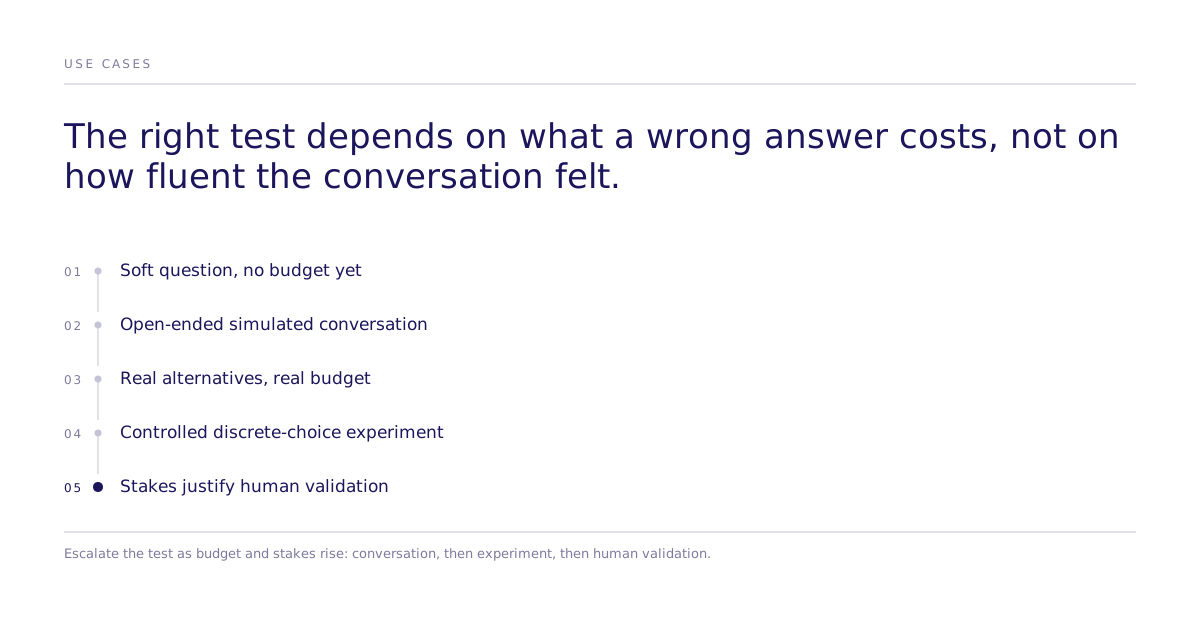
How do you choose between the two?
Start with the open-ended conversation when the question is still soft, a first pass at a message, a hypothesis worth sharpening before anyone commits money to it. Move to a controlled experiment once real alternatives and real budget are both on the table, and add real-human validation when the decision is big enough that an in-market surprise would cost more than the extra round of testing. Teams ready to test a specific decision against defined alternatives can see how the method works on a live case at /demo or review the underlying approach at /how-we-work.