When a Directional Message Read Is Enough, and When It Isn't
A brand strategist rarely loses the argument over which message is best. The argument gets lost earlier, when the loudest internal opinion picks a line before anyone tests it against the target customer. The decision that actually needs protecting is narrower than "which message wins": it is which message variant advances to creative production, and whether a fast directional read is enough evidence or the choice is expensive enough to need real-human validation first.
The Decision Brand Strategists Actually Own
The question is not whether AI can generate a message. Drafting is now cheap. The question is whether the team can tell, before the message reaches a stakeholder deck or a production budget, which variant is more likely to change how the target customer responds. Getting that wrong has a specific cost: production spend and campaign budget committed to a message chosen on internal preference rather than audience response, plus the credibility cost of presenting an untested read as proof once a stakeholder asks how it was validated.
Market research work is not disappearing under this pressure. Employment for market research analysts and marketing specialists is projected to grow from 2024 to 2034, according to the U.S. Bureau of Labor Statistics outlook for the role. What is changing is where the strategist's judgment adds value: less in producing the first draft of an analysis, more in defining the decision, choosing the right evidence, and knowing when a fast read is sufficient and when it is not.
Two Ways This Goes Wrong
Putting a failure mode on the record is what lets a team catch it before it repeats. The first failure mode is the one AI makes worse before it makes anything better: the team ranks message options by internal preference and calls it done. A fluent draft or a quick reaction round can feel like evidence when it is really just another opinion, generated faster.
The second failure mode is newer and easier to miss. A team runs a quick directional comparison, gets a clear-sounding preference between two messages, and presents that preference to stakeholders as proof rather than as a hypothesis. Both failures share the same root cause: nothing in the workflow forces a distinction between a directional signal and a result built to isolate cause from noise.
How Do You Run a Controlled Experiment Instead of a Preference Poll?
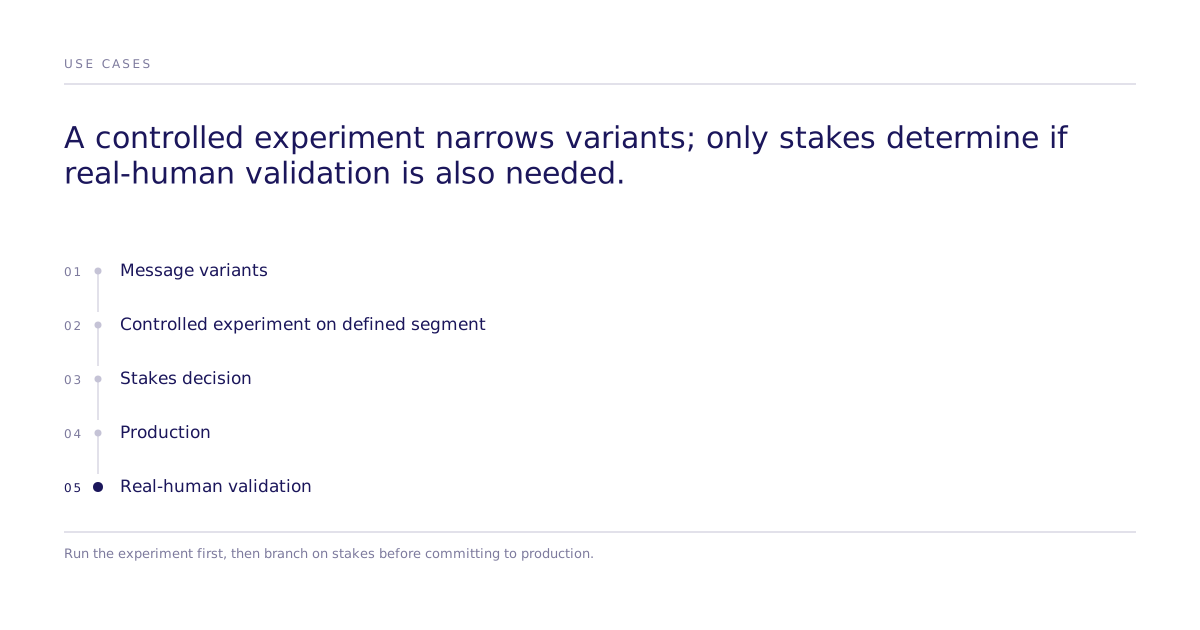
A controlled experiment starts from the decision, not from the message. Before touching any wording, write down what changes in the plan if the test points one way instead of another, then define the target-customer segment the message has to move: their current behavior, their alternatives, and the outcome the message is supposed to shift.
From there, the workflow compares message variants against that defined segment under conditions that hold everything else constant, so a difference in response can be attributed to the wording rather than to who happened to see which version. The output is a comparison of which variant is more likely to move the intended outcome, with confidence or uncertainty language attached where the study design supports it. That is a different claim than a preference ranking, which says people liked one message more.
Where Each Method Fits
| Method | What it tells you | Where it's weak | When to use it |
|---|---|---|---|
| Internal opinion or stakeholder preference | Which message the room likes | No connection to how the target customer will actually respond | Never, as the sole basis for a decision |
| Controlled experiment on a simulated market | Which variant is more likely to move the intended outcome for a defined segment, with uncertainty where supported | Still a controlled-study population, not a recruited real-world panel | Before creative production, to narrow options and catch a weak message early |
| Real-human validation | Confirms the causal read against real respondents or fielded behavior | Slower and more expensive; not needed for every decision | When the decision is expensive, public, or high-stakes enough to require it |
What Can and Can't This Method Settle?
A controlled experiment on a simulated market tells a brand strategist which message variant is more likely to move a defined audience, before the message reaches creative polish or a media budget. It does not replace the strategist's read of stakeholder dynamics, or human judgment about which decisions are consequential enough to require a further step.
That further step is real-human validation: testing or validating the same question with real people once the decision is expensive or public enough to warrant it. The practical advantage is that a team can move from the simulated comparison to real-human validation without changing the underlying causal question, so the two steps build on each other rather than starting over. Naming this distinction is what lets a buyer check the result against what it actually covers. The simulated population used for the first comparison is a controlled-study population, not a recruitable real-world panel, and treating it as one would misstate what the test can prove.
A Workflow to Start This Week
The change does not require rebuilding the whole research process at once. It requires one visible discipline, applied to one real decision:
- Write the business decision in one sentence: which message advances, and what happens next if it's wrong.
- Define the target-customer segment and how expensive a wrong answer would be.
- Run a controlled comparison across the candidate message variants against that segment.
- Read the result for direction and uncertainty, not just for which option "won."
- Decide, explicitly, whether this decision needs real-human validation before it moves to creative production.
- Present the result labeled honestly: what was tested, what the result supports, and what still needs validation.
As a planning example, one workable cadence is testing five message options and rewriting the top two based on the audience's objections, then repeating that once a week for a month. Treat those numbers as a starting point to adapt, not a fixed rule.
Repeated across a few decisions, this produces something more durable than a faster first draft: a record of which messages moved which segments, and why, that the next decision can build on instead of starting from opinion again.
Next Step
Teams that want to see how a controlled message experiment is structured can review the research methodology behind the approach, read how the process fits into an existing workflow, or look at case evidence from other consequential decisions. To test a specific set of message variants against a defined audience, start with a demo.