Why Release Notes Need a Pre-Publish Read Test
Release notes written from the product team’s perspective may confuse some readers or hide a consequential change. Choose the review from the actual release risk and observed comprehension or support problems. A minor patch may need a factual edit; a security, permissions, or billing change may need deeper review.
The decision: test the draft or ship it cold
The Head of Product or Product Marketing Manager who owns the changelog faces a repeated choice: run a structured comprehension check against defined reader segments before every release, or keep relying on ad hoc internal review. A note that reads clearly to the person who wrote it can still confuse its intended reader.
Why do release notes carry more risk than they look?
Release notes do several jobs at once, and a single draft rarely does all of them well.
- Discovery: a reader scanning to find out whether anything they care about changed, wants scannable headers and a clear signal of new versus updated versus fixed.
- Adoption: explain the feature, the task it supports, and how to try it. Whether that explanation changes actual use requires behavioral evidence.
- Trust: give accurate details about fixes and remaining limits. Check how readers interpret the note rather than assuming a specific style automatically builds trust.
- Archive: a reader months or years later, support staff, a new hire, someone tracing when a security behavior changed. A note clear on launch day can become unusable after six months if it leaned on jargon from a forgotten release.
Yang and colleagues’ Google Play study analyzed releases and reviews from 2016–2019 and surveyed developers. It reported associations of note length and update frequency with ratings. That does not establish that more informative notes cause adoption or higher ratings.
Reader segments worth testing separately
The most common failure is writing from the product's perspective instead of the reader's: "added support for nested tags" instead of "organize tags into folders for cleaner navigation." That failure shows up differently depending on who is reading, which is why one draft misses more than one reader type.
| Reader type | What they're doing | What breaks for them |
|---|---|---|
| Long-tenured, frequent reader | Reads every note as it drops, tracks the workflows they use closely | Gets irritated when something already shipped months ago is framed as new |
| Infrequent reader | Logs in occasionally, uses the notes to catch up on what was missed | Jargon from an earlier release reads as meaningless without context |
| Recent signup | Reads notes while still learning the product, not as a changelog | A feature name with no explanation or link is a dead end |
| Account owner or approver | Responsible for the account but doesn't use it daily; scans for compliance, security, and billing-adjacent changes | A permissions, export, or retention change buried in the middle gets missed entirely, then turns into a support ticket |
A pre-publish sequence, not a single review pass
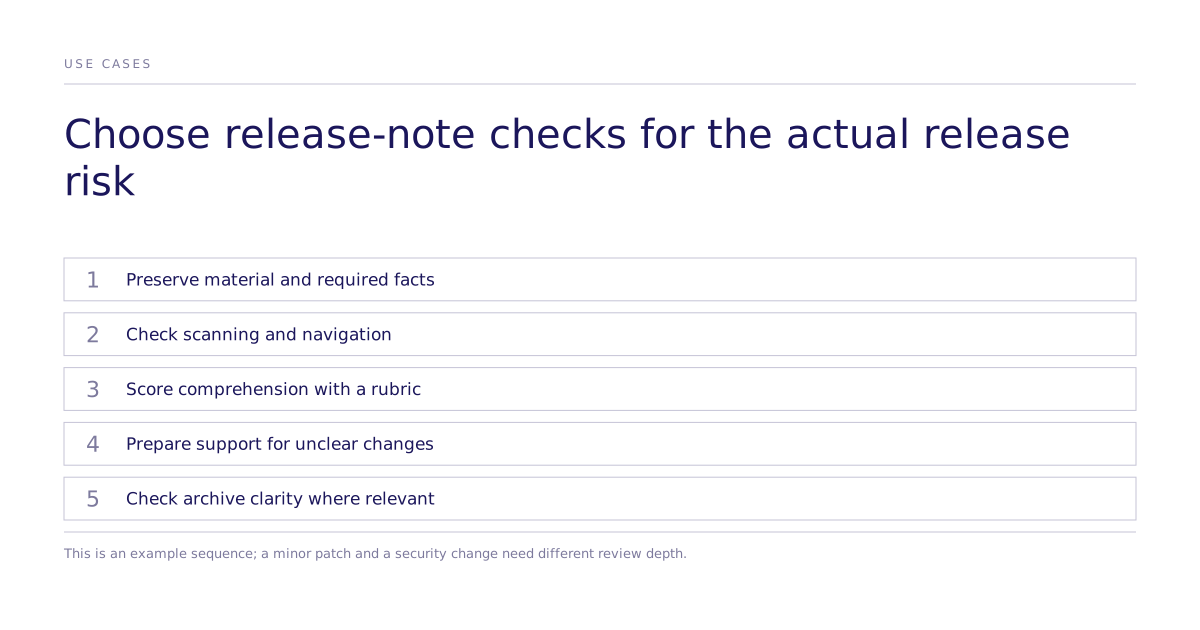
One possible sequence separates several checks. Use the subset warranted by the release’s complexity and risk:
- Prioritization, before the draft. Preserve accurate, material, and required security, permissions, billing, and migration information in every layout. Use reader feedback to improve navigation and explanation, not to decide which necessary facts go into fine print.
- Scan test, on the first draft. Ask what the single most important thing in the release is, on a short skim. If different reader types land on different answers, that's expected. If a segment can't identify anything, the headers and lead lines need rework.
- Comprehension test, on a fuller draft. For each item: do I understand what changed, why it matters, and what to do next.
- Support-load test, before publish. Ask which items are most likely to generate a support ticket, so the note can answer those questions preemptively or support can prepare before the email goes out.
- Archive test, after publish. Read the notes as a reader arriving months later searching for a specific change. Notes clear at launch are often opaque without edits for self-containment.
Where does a causal test fit into this decision?
For release notes, a proposed Subconscious messaging comparison can present truthful wording variants to configured reader profiles and score generated answers against a prespecified comprehension rubric. This measures modeled understanding and stated next action. Confirm consequential understanding with actual users and the appropriate factual or specialist review; it does not observe adoption. See the research approach.
Where the question turns on something a simulated read can't fully settle, an ambiguous security or billing change, for instance, a team can move from a simulated comparison to real-human validation without changing the underlying question.
What does this not replace?
A structured pre-publish test does not turn release notes into a support triage system, and it doesn't substitute for the engineering work of writing an accurate changelog. It narrows the gap between what the team believes it wrote and what the reader takes away, before that gap becomes a ticket queue. It's a way to catch a miss before the send button, not a promise every release reads perfectly.
Next step
Release notes are a recurring, low-stakes-per-instance decision that compounds across a year of shipping. Teams can review examples from other launch and messaging decisions or set up a scoped test against an upcoming release.