Will Your US Product Positioning Work in Germany?
Test whether German buyers respond differently to the same message, price, and feature emphasis before committing the localization budget. The result should tell an international growth leader what to preserve, what to adapt, and what still needs an in-market pilot.
A historical planning example put full mobile-app localization at $30,000 to $150,000 depending on complexity. It modeled the late-discovery problem as 12 percent conversion in the US, 4 percent after a German launch, and three months before the gap became visible. Those figures are inherited planning examples, not current market benchmarks or Subconscious results.
Start with the launch decision
The decision is not whether German buyers are broadly different from US buyers. It is whether a specific product action changes stated choice or conversion intent differently across the two market segments.
Privacy is one reason to test instead of generalize. A BullGuard-commissioned study reported country-level differences between privacy concerns and actual behavior among consumers in the United States, the United Kingdom, and Germany (BullGuard-commissioned study). That finding supports testing privacy framing, not that every German buyer values the same message.
Define the launch question in operational terms:
- Which value proposition changes choice?
- Which trust statement changes conversion intent?
- Does the price frame work equally well in both markets?
- Which feature should lead the German offer?
A historical pricing example used a $9.99/month subscription to illustrate how the same price can occupy a different place in each market's value frame. Treat the amount as a test input, not a recommended price.
Build a cross-market experiment around actions
Subconscious can run controlled studies against a person-level audience graph covering 800 million real people. The graph supports audience definition and segmentation. It is not a recruitable group of 800 million study participants.
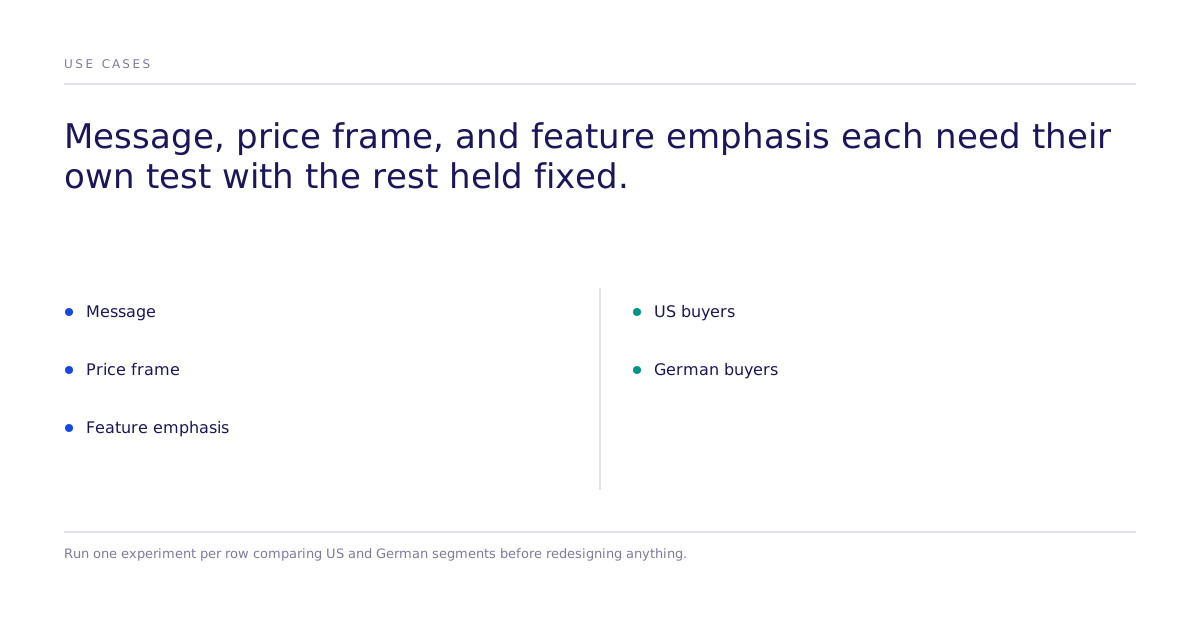
The experiment holds the product context steady, changes one action at a time, and compares the effect across US and German buyer segments. A useful design separates three decisions that often get bundled into one localization project:
| Buyer decision | What stays fixed | What changes | What to measure |
|---|---|---|---|
| Message | Product, offer, and price | Value proposition or trust framing | Difference in stated choice |
| Price frame | Product and core message | Price point, billing frame, or trial terms | Difference in conversion intent |
| Feature emphasis | Product concept and price | Which capability leads the offer | Difference in preferred option |
As a planning example, the source material split enterprise buyers into three segments: an Operations Director watching cost, an IT Manager focused on compliance, and a CIO weighing strategy. Those roles remain useful only when they match the actual buying committee, not as a universal German-market template.
The output is a directional comparison across actions. Report uncertainty qualitatively unless the configured study supports a confidence interval. A country-segment difference can justify a copy revision or a pilot, not that nationality alone caused the response.
How do you read the difference without stereotyping the market?
A useful result distinguishes between a market effect and an artifact of the test.
First, check whether the same intervention moves the outcome in both segments. If it does, localization may require translation and legal review without a new positioning strategy. If the effect changes direction or size, the team has a concrete adaptation to examine.
Second, look for differences within each market segment. Aggregate agreement can hide disagreement between buyer roles, industries, or purchasing contexts. The study design should match the actual buyer population closely enough for the launch decision.
Third, test the explanation. A weaker response to a time-saving claim does not automatically mean German buyers reject convenience. Compare it with a cost, control, quality, or risk-reduction frame while holding the rest of the offer constant.
This turns three inherited categories into an actionable localization brief:
- Critical gaps that could block adoption.
- Cultural adaptations that require rewriting rather than literal translation.
- Feature or positioning changes that alter the offer itself.
Set the launch gate before the result
Decide in advance what evidence would trigger each action:
- Preserve the US positioning when the treatment effect is directionally consistent across both segments.
- Adapt the German version when a specific alternative performs better for that segment.
- Run an in-market pilot when the difference is material but cultural, linguistic, or operational uncertainty remains.
When the decision requires human confirmation, Subconscious can test or validate studies with real human participants without changing the causal question. The simulated experiment and human study should compare the same actions and measure the same outcome.
This process does not replace an in-market pilot, German legal and regulatory review, GDPR review, or a full localization quality pass. Cultural and linguistic nuance still needs human review before launch. A historical agency-planning example used 6 to 10 weeks for one round of concept research, not a current agency benchmark or a Subconscious delivery commitment.
What should you carry into localization?
The final artifact should be a decision brief, not a market stereotype. Record the winning action by segment, the uncertainty, the evidence that would reverse the choice, and the issues reserved for human review or an in-market pilot.
Bring the actual US message, pricing frame, and feature alternatives to a scoped demo. The experiment can then answer the launch question before those assumptions are embedded in translated product and campaign materials.