Winning RFPs: Pre-Test Your Angle Before You Submit
An RFP response can miss an important reader’s concern even when another stakeholder likes it. Examine actual loss reviews, scoring criteria, and client feedback before ranking that among the causes of lost bids.
Identify the actual RFP evaluators and scoring criteria. Procurement, marketing, executive, and finance readers may assess different concerns. A team can write toward one reader while overlooking others, so confirm participation rather than assuming every committee has the same four roles.
The decision that actually costs money
For example, a pitch team may lock a strategic angle, narrative, and pricing frame before the client committee sees them. An overlooked procurement constraint or finance concern can then force revision or contribute to rejection. Use actual loss reviews to establish what mattered for the account.
The fix is not writing a better deck. It is testing the angle, the narrative, and the price against the specific readers who will kill or advance the response, before the team commits to one version of each.
Four possible reader roles and concerns
| Example reader | Possible review focus | Concern to check |
|---|---|---|
| Procurement lead | Scope clarity, pricing defensibility, comparability against other bids | Anything vague enough that they can't defend it internally |
| Brand director / marketing lead | Who they'll actually work with, day-to-day chemistry, tone | A response that reads as generic or impersonal |
| CMO / senior stakeholder | The first few and last few pages, a sharp point of view | A strategic frame that could be copy-pasted onto a competitor's client |
| CFO / finance reviewer | Unit economics of the engagement, cost of scope change | A pricing slide that can't explain why the number is what it is |
A response tuned for the CMO's point of view can still lose because the procurement lead couldn't defend the pricing internally. That's a reader-modeling problem, not a creative one, and it's testable in advance once the team defines these readers as distinct buyer segments.
What's the test sequence before an RFP response locks?
Test each decision against the defined reader segments before it becomes final, rather than debating internally and picking one version.
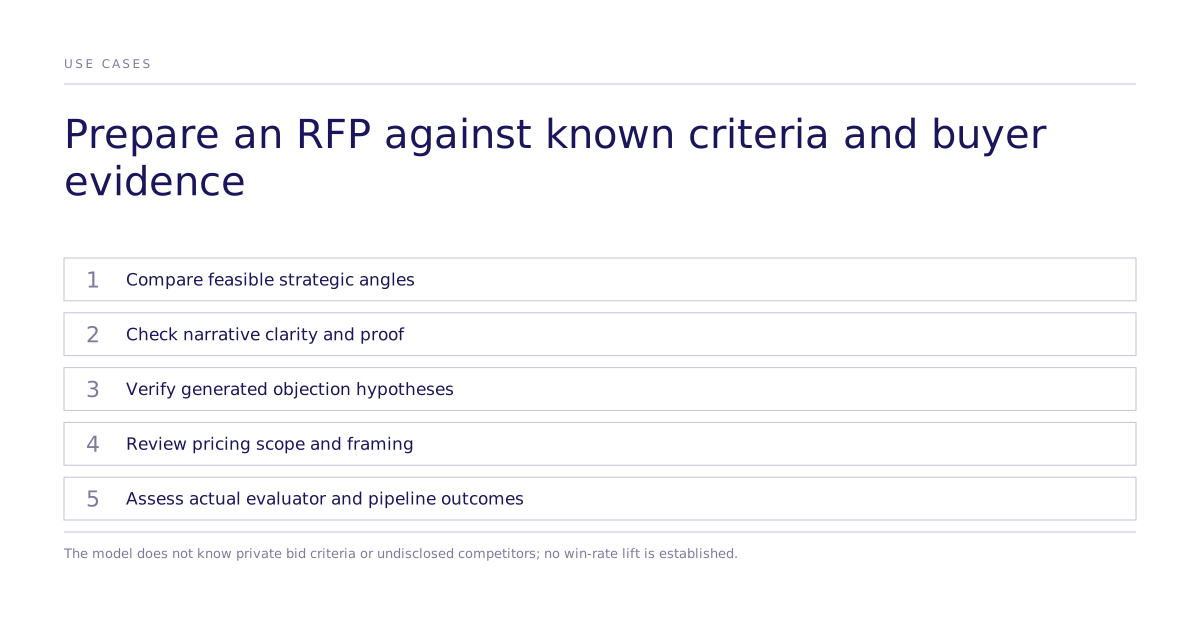
- Test the angle first. Compare the two or three contenders the team is debating against the procurement, brand, CMO, and CFO segments. Read which one shifts stated preference and for which reader, not which one the internal team likes best.
- Test the narrative once it's drafted. Run the draft response against the same segments and ask a pointed question of each: what's the top concern from a procurement read, what's compelling from a brand-director read, what earns a meeting from a CMO read.
- Check objections before submission. Use documented scoring criteria, client questions, and known alternatives to propose concerns for each role. Generated objections are hypotheses; verify important facts and competitive comparisons with subject-matter or available client evidence.
- Test the pricing framing separately. A fixed fee, a retainer, and an outcome-based structure read differently to a procurement lead than to a CFO. Compare the framings against those two segments specifically, rather than defaulting to whatever the account lead drafted in isolation.
The point of running these as four separate comparisons, rather than one holistic gut check, is that each removes a different untested assumption.
How does Subconscious run this as a controlled comparison?
For this simple comparison, define the buyer-role segments, hold the stated facts and scope fixed, and assign alternative angles, narratives, or pricing framings one element at a time. The result is a contrast in generated stated preference under those conditions. Other questions may need a factorial design that varies several elements and estimates interactions.
Subconscious can compare generated stated preferences between defined RFP framings on configured buyer-role segments. Scope the evidence to that modeled task and check calibration for the actual category. A matched human check can test the same question, but neither a general replication score nor simulated approval establishes RFP win-rate lift. Measure proposal decisions and pipeline outcomes separately.
Loopio’s 2026 RFP trends draw on its vendor survey of more than 1,500 response teams. Reported relationships between process and performance are observational and self-reported; they do not establish that this simulated comparison improves win rates or that the result applies specifically to agencies.
What doesn't this method prove?
This comparison does not know a named procurement officer’s private priorities or undisclosed competing bids. It measures generated stated preference in configured role segments, separate from actual evaluator scoring. No RFP-specific lift result is supplied here. Scope recruitment and real-human checks explicitly, and assess any efficiency or win-rate change in the actual pipeline.
Before the next RFP goes out
Before the next RFP, confirm the client’s evaluators and criteria, compare feasible framings, and verify important objection hypotheses. Review the research approach, aggregate replication evidence and limits, and applied case examples. To scope the actual response and buyer roles, book time with the team.