AI for Market Researchers: A Professional Guide
AI is changing what market-research expertise is applied to. It can help with early exploration, instrument review, text analysis, and experiment design. Researchers still own validity, interpretation, disclosure, and the choice of method.
Researchers who come out ahead will know where to deploy AI, what it produces, where it fails, and how to combine it with traditional methods. The core question: where can software reduce repetitive work without pretending simulated responses are human evidence?
The main tool classes
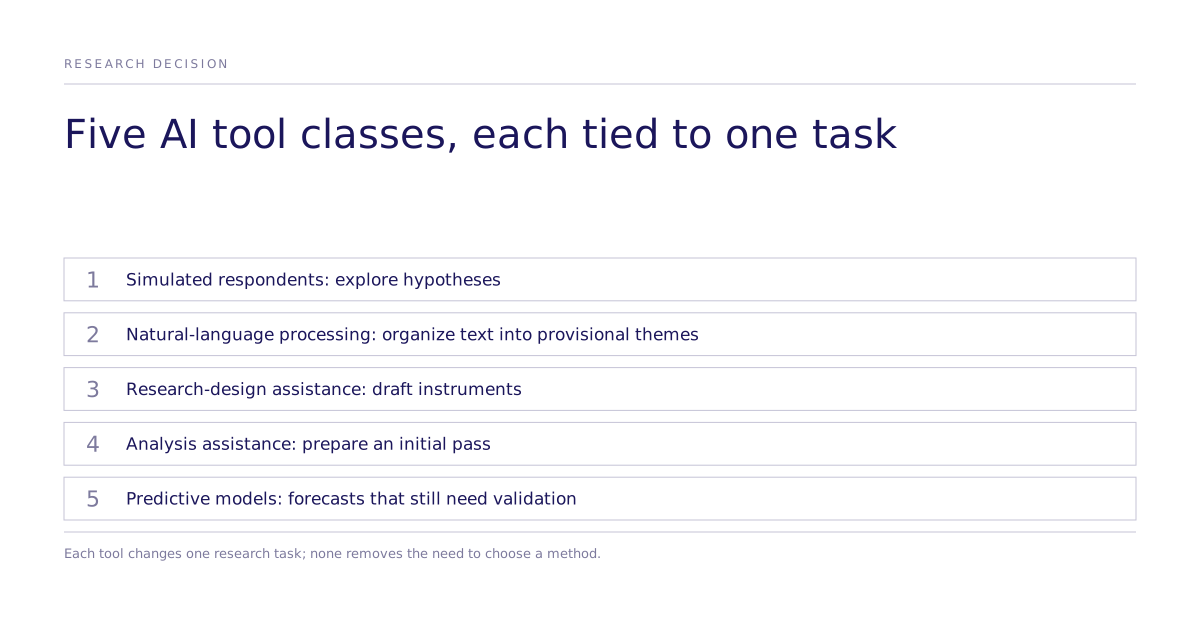
Simulated respondents produce directional responses for defined audience profiles. Use them for hypothesis generation and early screening, not as a substitute for validated quantitative research.
Natural-language processing can organize open-ended responses and interview transcripts into provisional themes.
Research-design assistance can draft questionnaires, flag possible wording problems, and propose discussion-guide structure.
Analysis assistance can prepare an initial thematic pass, sentiment grouping, or draft summary.
Predictive models can compare how segments may respond to an action. Their value depends on the data, design, calibration, and validation behind the prediction. A forecast needs that validation. The model does not supply it.
Each tool changes a research task. None removes the need for method choice.
Should synthetic respondents be treated as directional?
Simulated respondents can help with hypothesis generation, instrument pretesting, early concept evaluation, and rapid mapping of a question space. They are not a final answer for high-stakes decisions.
Validation depends on the task, population and metric. The public Subconscious working paper, which is not peer reviewed, reports aggregate mean Spearman rank correlations on estimated choice parameters. It does not report effect-size agreement or a universal accuracy figure. Require the actual benchmark and its limitations before using a simulation to support a recommendation.
Disclose when simulated respondents were used and what role they played. "Early hypothesis generation followed by human validation" is clearer than calling a simulated output market research without qualification.
Four places to use AI in a mixed method
Pre-study exploration
Use defined audience models to surface themes, language, and possible concerns before formal fieldwork. Convert the result into sharper questions.
Instrument pretesting
Run the full questionnaire against five simulated perspectives as a planning example. Look for ambiguity, leading language, missing choices, and topics the instrument ignores. Human cognitive testing remains appropriate when the risk warrants it.
Between-wave work
Use simulation to generate explanations for a metric change between major waves. Label the result as a hypothesis and test it with real evidence.
Segmentation exploration
Compare the same stimulus across segment definitions. Use the divergence to focus later research on the differences that matter.
Competitive-intelligence exercises need restraint. A simulated competitor customer cannot reveal private company plans or actual customer beliefs.
A practical integration framework
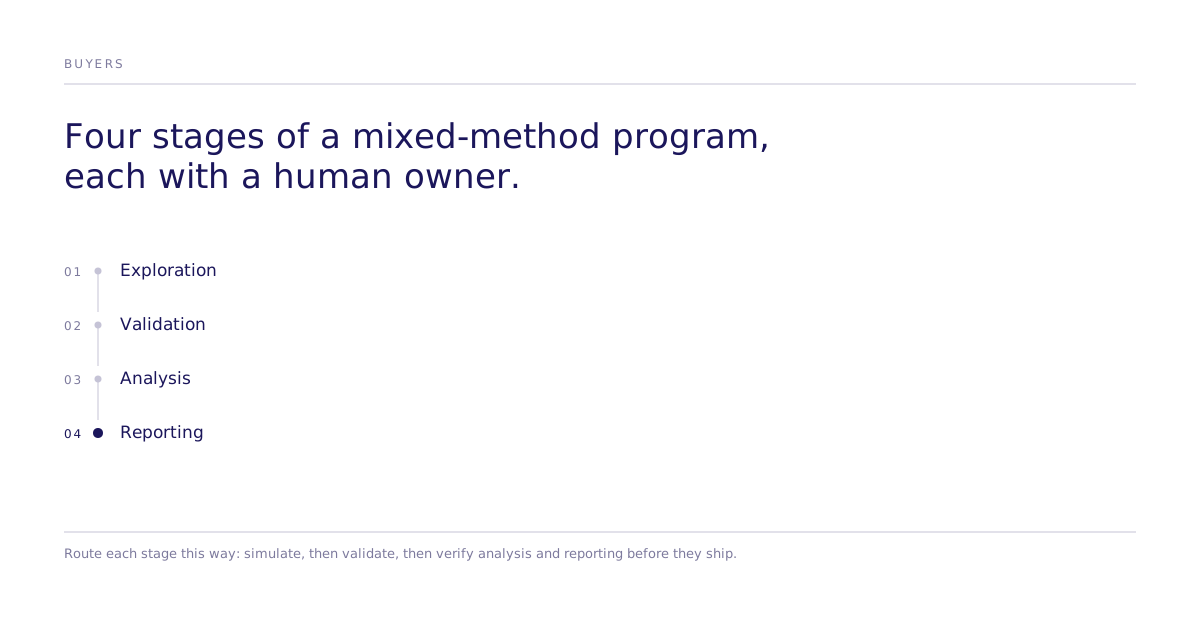
Exploration: use simulation to map the question and generate hypotheses.
Validation: Arrange a matched human study for the claims that matter to the decision. Confirm the participant source, endpoint and scope for the proposed study.
Analysis: use software for an initial thematic structure, then have the researcher verify and interpret it.
Reporting: use software for a draft summary, then write the strategic narrative and recommendation from the evidence.
The research program should record where each method enters and which claims depend on it.
What skills do researchers need to work with AI?
Researchers need to design prompts and study inputs, detect model artifacts, build hybrid methods, and explain the limits to clients. Critical evaluation matters more than fluent output.
Subconscious supports decision-specific causal experiments on product, pricing, messaging, and go-to-market actions. The researcher defines the decision, audience, alternatives, outcome, and validation plan. Software can increase the number of testable questions. Professional judgment determines which answers deserve trust.
To scope a real research decision, book a working session. Bring the decision, the audience, the alternatives you would compare, the outcome that matters and any benchmark you would accept for human validation. The session can then evaluate the experiment and the human-validation plan together. For the evidence behind the method, read the research.