AI Research for Management Consultants: Choosing the Right Stage for Simulation vs. Causal Testing
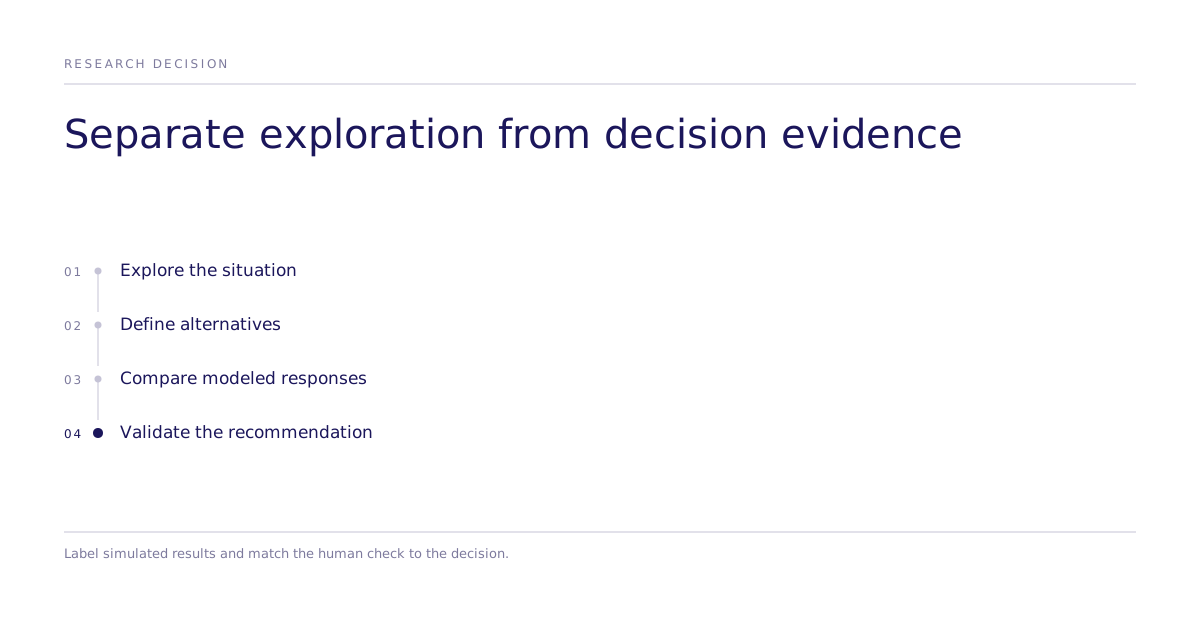
The right stage depends on what the answer needs to survive: use open-ended AI simulation for early hypothesis generation, and reserve controlled causal testing for the number a client or investment committee will scrutinize. A management consulting engagement runs on a compressed clock, and the research plan has to match the decision it feeds. Early hypothesis generation and a client-facing recommendation are not the same job; treating them as interchangeable can get a recommendation dismantled in front of an investment committee or a client's leadership team.
What is the engagement-timeline problem in consulting?
A strategy engagement may front-load stakeholder interviews, then spend the middle weeks scoping and running research before the team has anything to synthesize into slides. A research vendor cycle that eats the middle of the calendar leaves too little runway for iteration, and the client is effectively paying the firm to project-manage that vendor.
Open-ended AI-simulated discussion sessions are one way to fill that early gap. A team can stand up a synthetic panel matching a client's target audience and run a discussion guide through it before committing budget to a formal study.
Where the two methods actually differ
The failure mode is not using simulation. It is presenting an open-ended, uncontrolled panel session as if it were client-ready evidence. An engagement lead who can't tell the difference between "directional impressions from an exploratory session" and "a defensible, causal answer to a pricing or positioning question" is the one whose recommendation collapses under IC or client scrutiny.
| Open-ended AI panel discussion | Controlled causal experiment | |
|---|---|---|
| Best use | Early hypothesis generation, exploratory framing | Recommendation-stage evidence for a specific decision |
| What it produces | Directional impressions, qualitative color | Estimated effects on simulated stated choice, with confidence intervals |
| What it compares | Open conversation, no fixed alternatives | Defined pricing, positioning, or market-entry alternatives across a defined modeled population |
| Where it holds up | Internal working sessions | Input to an investment committee or client leadership review, together with its simulation status, the task fit, its uncertainty and a matched human check where the stakes require one |
Subconscious's controlled experiments sit on the right side of that table. Where an exploratory AI discussion produces useful early impressions, a controlled discrete-choice experiment tests defined alternatives against a defined modeled population and returns estimated effects on simulated stated choice, with confidence intervals. Committee scrutiny does not validate a simulated result. A committee should see what was simulated, what was compared with real people, and what remains uncertain.
Matching the method to the engagement stage
Due diligence support. When a PE firm asks a team to assess a target's market position ahead of an acquisition, the early work (sentiment reads across existing customers, competitor customers, and category non-users) is exploratory. But the number that goes in front of the investment committee (would customers switch, at what price, under what positioning) needs a controlled comparison behind it, not a synthesized transcript. Case studies show how that comparison stage is structured for a specific claim.
Pricing strategy. Directional reads on willingness-to-pay from an open discussion can point a team toward which pricing structures are worth testing. The recommendation itself (which tier structure the modeled population prefers, and by how much) is a causal question that traditional market research has typically answered with a formal conjoint analysis, and it is the kind of question a controlled experiment is built to answer with a confidence interval attached.
Market-entry assessment. Evaluating a new geographic or demographic segment benefits from broad population coverage. A Subconscious simulation can compare defined market-entry alternatives with a modeled population. Geographic coverage and grounding need evidence for the proposed market; a large modeled sample cannot correct missing customer coverage.
What doesn't a causal experiment replace?
A causal experiment is not a substitute for stakeholder interviews, due-diligence fieldwork, expert-network calls, or the consultant's own synthesis and judgment. It answers one kind of question: which of these defined alternatives the modeled population chooses, and by how much. And a simulated experiment's audience scale is not the same thing as a recruited panel of real participants: the two need to stay distinct in how a team describes them internally and to a client.
When a recommendation is large enough to warrant it, the same comparison can be put to recruited participants in a matched human study, with the question held fixed. Scope that study per engagement and confirm the participant source before you promise it to a client.
Putting it into an engagement
Before running a panel exploration on the next research-bound engagement, identify which output actually needs to survive committee or client scrutiny. If it's a directional read for internal hypothesis-building, an open-ended session is the right tool. If it's the number the recommendation rests on, see how a controlled study gets structured before the team commits to a method it can't defend in the room, or book a decision review for a specific pricing or market-entry question. Bring the alternatives, the target population, the committee's evidence standard and any customer data you already hold.