AI Tools for Product Managers: Research at Decision Speed
Product managers work between customer needs, business goals, and technical constraints. The cost of a weak assumption rises once it becomes a specification, sprint, and launch.
Customer evidence often arrives too late. A researcher may have a dozen priorities. A formal study can take several weeks while the team runs two-week sprints. AI can help prepare and screen decisions before the higher-cost research begins.
Use the right claim
AI does not create an on-demand version of a real customer. Simulated audiences can support controlled, early experiments when the team defines the decision, audience, alternatives, and outcome, using the method described on the research page.
Before running a study, define the audience, alternatives, outcome and validation required. Speed does not establish validity.
Choose the tool class by the question
Four classes of work answer different product questions. Pick by the input you hold and the output you need.
| Question | Tool class | Input | Output | How to evaluate it | When to escalate |
|---|---|---|---|---|---|
| What did customers say in interviews or tickets? | Transcript and text analysis | Interview transcripts, support tickets | Provisional themes and quotes | Check each theme against the source text | Escalate when a theme will drive a roadmap bet and rests on few customers |
| Does this spec or story hide an assumption? | General AI review of a written artifact | PRD, user story, acceptance criteria | Questions, edge cases, unstated assumptions | An engineer or researcher confirms each point is real | Escalate to a prototype test or customer observation |
| Which of these alternatives would a defined audience choose? | Simulated choice experiment | Decision, audience definition, alternatives, outcome | Estimated effect on simulated stated choice, with uncertainty | Check the design, the audience grounding and any matched human result | Escalate to recruited participants when the stakes are high or the audience is hard to model |
| What do customers actually do in the product? | Product-usage test or analytics | Instrumented release, A/B test, usage data | Observed behavior | Check the sample, the metric and the test design | This is the outcome evidence the other three classes feed |
Five product-management applications
How do you discover and prioritize product features?
When a backlog contains fifteen possible features and a sprint has room for three, compare the candidates against an explicit customer behavior and business constraint.
Define two to four audience segments. Ask which action changes intended use, which is merely preferred, and which creates a barrier. Treat the result as input to prioritization, not proof of demand.
What should a user-story review check?
Check whether a story reflects the customer's problem, current workflow, and decision. Use the review to find hidden assumptions and edge cases before engineering begins.
Specification and problem framing
Compare the experience implied by a specification with the problem it claims to solve. A language model can inspect the written artifact. It cannot experience the actual product, so prototypes and customer observation remain necessary.
Why does onboarding research matter?
Onboarding can be a high-impact product problem. Compare alternative instructions, sequences, or messages for a new customer. Measure completion or adoption behavior when possible.
Stakeholder preparation
Use simulated CFO, engineering, or design perspectives to rehearse objections. These perspectives do not replace finance, technical, or design review. They help the PM prepare the evidence those reviewers will need.
Competitive-feature analysis follows the same rule. Models cannot reveal a competitor's private roadmap or predict a specific customer's response. They can help structure testable alternatives.
Add experiments to the workflow
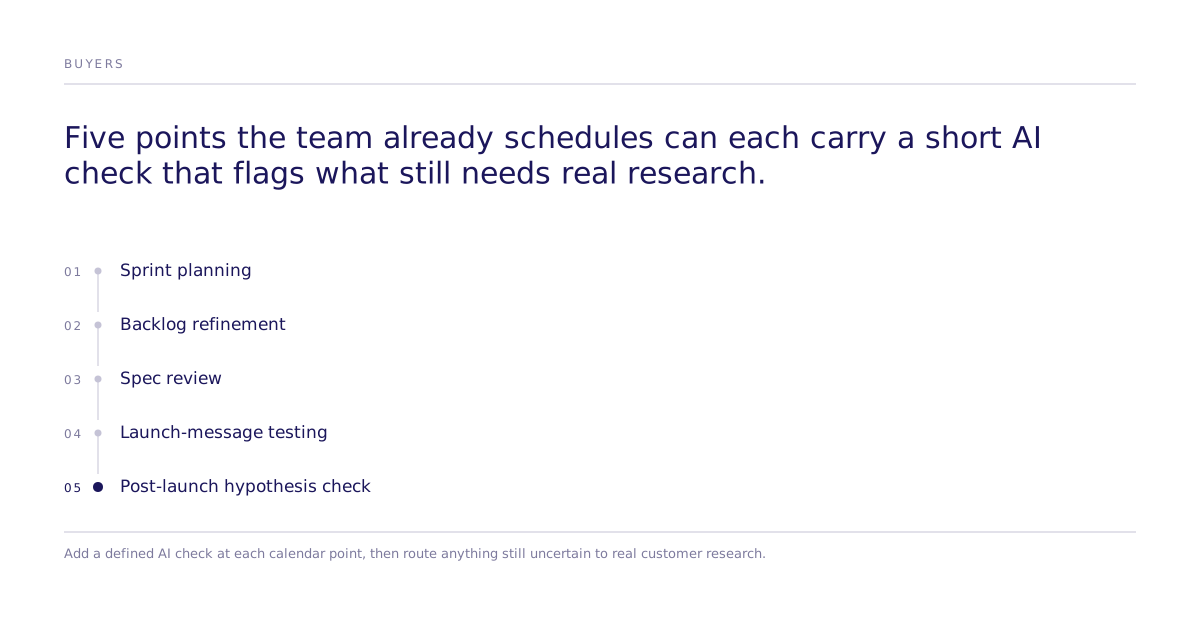
Sprint planning: use a 30-minute planning session on stories where customer intent is unclear. Define what needs evidence.
Backlog refinement: compare the priority order with the stated customer behavior and business constraint.
Specification writing: add an assumption review as the last step before engineering review.
Launch planning: test launch-message and adoption alternatives before production.
After launch: use simulation to generate hypotheses about usage metrics, then check analytics and speak with customers.
The 30-minute duration and last-step placement are planning examples, not universal product limits.
Keep people and behavior in the loop
Real usage data is irreplaceable. People often act differently from what they say. Breakthrough discovery and the rarest early adopter are also difficult to reproduce because simulated audiences represent patterns of the many more readily than the few.
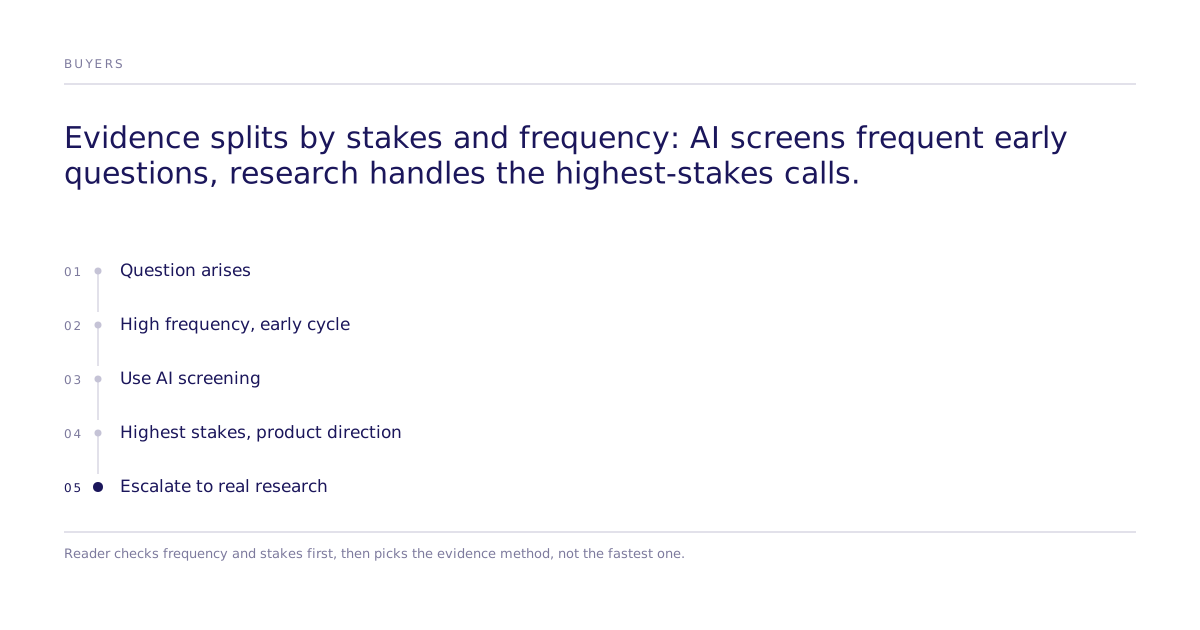
Use AI for high-frequency, early-cycle questions. Use real research for the highest-stakes product direction, following the escalation path described in how we work. Name the outcome each time: simulated stated choice, recruited-participant choice or observed product usage. The public causal fidelity working paper is about the first kind. It reports how well simulated studies reproduce estimated choice parameters from published human studies. It does not report observed usage from product workflows like these. To scope a product decision, book a decision review and bring the alternatives, the audience and the usage metric you would check afterward.