Audience Research for Marketing Managers
Marketing managers make decisions about audiences, messages, campaigns, content, and launches. Formal research budgets do not always follow those decisions: teams use internal opinion to choose an action, then use campaign performance to learn whether the choice was right.
Subconscious gives marketing teams a way to test product, pricing, messaging, and go-to-market actions before committing production or media spend. The work is strongest when it compares clear alternatives for a defined audience and measures how those alternatives change a stated choice.
What marketing teams need from research
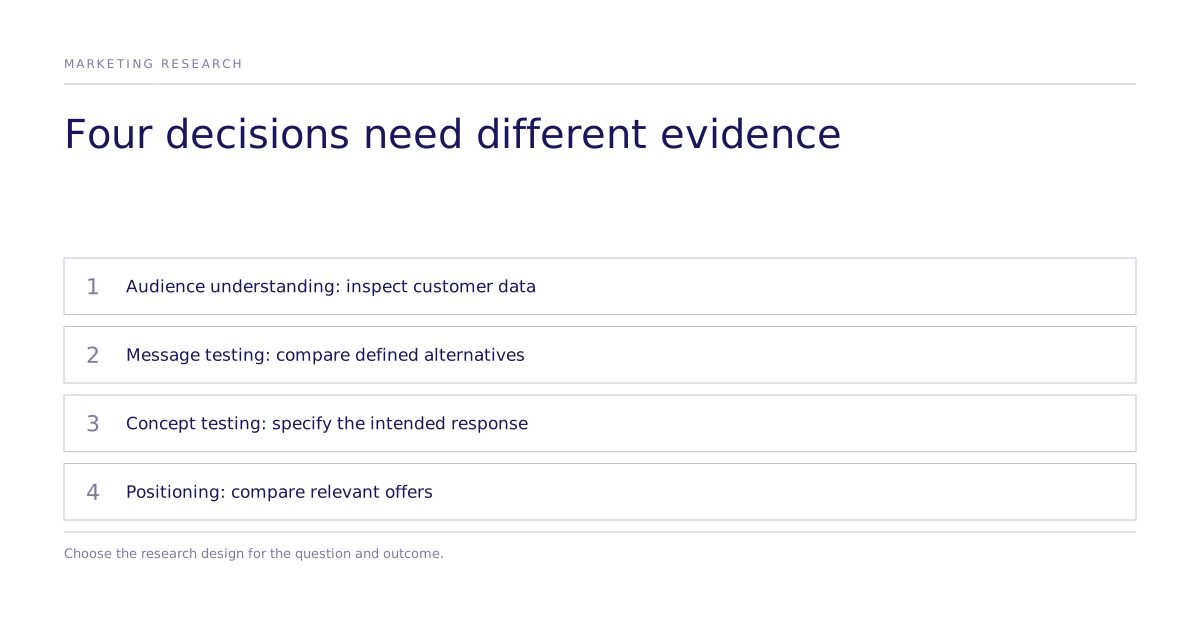
The decision changes from project to project:
- Audience understanding asks which segments matter and how their needs differ.
- Message testing asks which claim changes preference or intent.
- Campaign concept testing asks which direction deserves production.
- Competitive positioning asks why a buyer would choose one offer over another.
- Content planning asks which subjects and formats support a specific audience decision.
- Launch planning asks how defined segments respond to an announcement or offer.
Choose a design appropriate to each question. Interviews or customer data can describe needs; a controlled comparison can estimate the effect of defined alternatives under the study conditions.
Turn an audience question into an experiment
Begin with the choice the marketing manager must make. Name the audience, the alternatives, the expected response, and the evidence needed to act.
For example, “Which message is best?” is too vague. “Which of these messages changes stated choice among procurement leaders evaluating the same offer?” identifies an audience, a controlled contrast, and an outcome.
Define audiences from evidence
Audience definitions can include buyer role, category experience, current solution, needs, and decision constraints. Demographic detail alone does not establish how someone will behave. Use customer data or approved research when available, and do not treat a richly written persona as validation.
A 45-minute planning conversation may help a team surface assumptions about an audience. It should be used to form hypotheses, not presented as a substitute for interviews, ethnography, or observed customer behavior.
Test messages as controlled alternatives
Keep the offer and context stable while changing the message. Present three to five clear directions, then compare the resulting choices across the same audience definition.
Questions about clarity, credibility, and relevance can explain a result. They should follow the choice rather than replace it.
Review campaign concepts before production
Campaign testing is most useful before the team has invested in finished creative. Compare the core idea, message, and intended response while the work can still change.
Visual, video, and experiential campaigns require care. A text description cannot reproduce the emotional impact of finished creative. Use real audience testing when the decision depends on that experience.
Test competitive position in context
An offer rarely appears alone. Put it beside the alternatives buyers already consider. Ask what changes preference, what remains unclear, and which segment responds differently.
Competitive comparison should use accurate descriptions. It should not invent a rival’s weakness or assume that simulated responses represent the market.
Use audience research to guide content
Content strategy becomes more useful when tied to a buyer decision. Instead of asking which topics an audience likes, test which subject, proof point, or format helps a defined buyer understand or choose an offer.
The output can inform editorial priorities. It does not establish channel performance, reach, or conversion without real campaign data.
Research across a buying committee
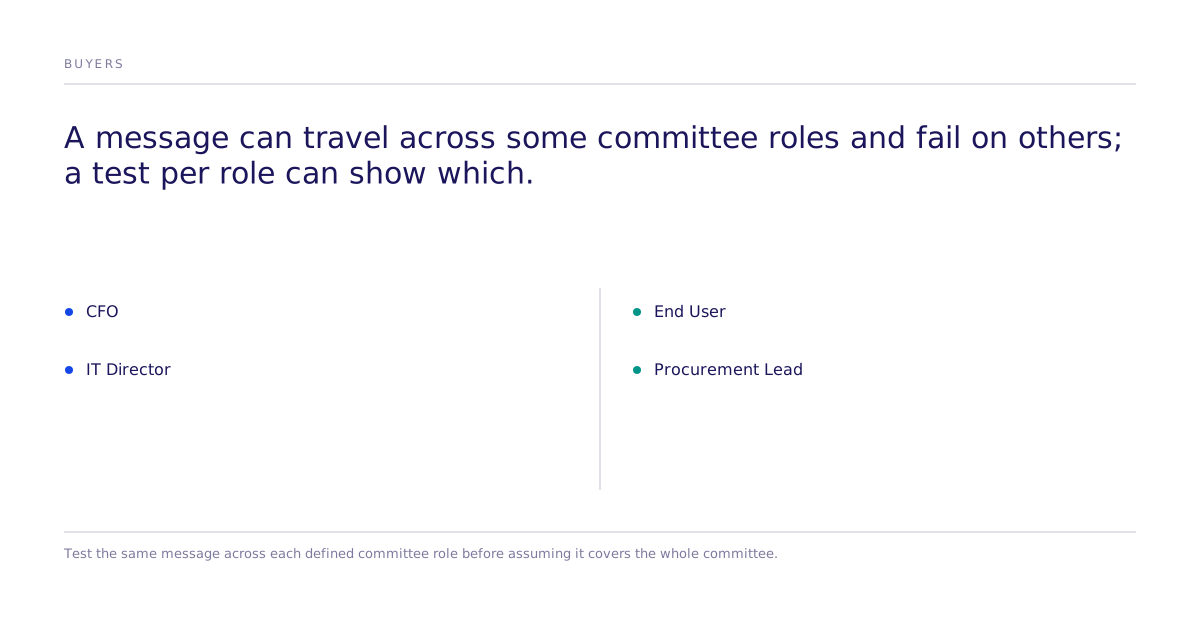
Account-based marketing often needs one offer to make sense to several roles. A CFO, IT director, end user, and procurement lead may evaluate the same purchase through different constraints.
A multi-segment experiment can compare the same message across three to five audience definitions. The result may show where one message travels across the committee and where a role needs different evidence.
Keep the comparison honest. Synthetic research tends to reproduce aggregate patterns better than individual behavior. It may also flatten cultural differences, reduce variance, or reflect prompt wording. Those limits matter more when a segment is small, specialized, or poorly represented in the grounding data.
Put testing into the marketing workflow
Research has more value when it happens before a commitment:
Before the brief
Use a 30-minute session to identify the decision, audience, alternatives, and assumptions. The session creates an experiment brief, not audience truth by itself.
Before production
Test the core message or concept while changing direction is still inexpensive. Preserve the same conditions across alternatives so the result can support a comparison.
Before launch
Check for objections, ambiguity, and segment differences. Use real audience validation when the launch risk or creative format requires it.
After launch
Treat synthetic findings as hypotheses about performance. Use analytics, conversion data, interviews, and other observed evidence to determine what happened.
During content planning
Run a quarterly audience intelligence session to revisit audience priorities and language as market and campaign evidence change. A saved persona should not become a permanent substitute for current research.
Know what the evidence can support
Synthetic audience research is useful for exploration, scenario comparison, and early iteration. It is not a blanket replacement for customer research.
Semantic Similarity Rating (SSR) research is an arXiv preprint, not peer reviewed. It tests whether a language model can reproduce human purchase-intent survey ratings on 57 personal-care product surveys with 9,300 human responses. Its headline is that SSR reaches 90% of human test-retest reliability with realistic response distributions. That result concerns the distribution of stated Likert intent ratings in that corpus. It does not show agreement with actual purchases, and it is not evidence that a causal effect transfers to your category. Use appropriately designed human or market evidence when a recommendation depends on behavior, and inspect the outcome measured in each case study.
Cultural nuance also requires direct evidence. Validate work involving a specialized community with people from that community. Do not assume a model can represent identity or context reliably because its answer sounds specific.
Use an early experiment to improve the decision before production. Match the final validation to the cost of being wrong.
To test a live decision, book a decision review. Bring the alternative messages, the audience you want to reach and any campaign evidence you already hold, so the review can scope the comparison and the validation you need.