How Agencies Can Test Strategy-Deck Recommendations Before a Pitch
Agency strategy leads can test the audience problem, positioning direction, or recommendation they plan to put in a pitch deck before a full research budget exists. The useful move is not to generate plausible audience quotes. It is to compare controlled alternatives with a defined client audience and measure which action changes the response.
Subconscious.ai's research approach makes the recommendation testable while leaving client discovery, direct customer research, and strategic judgment in place.
Test the decision that could lose the pitch
The pitch-stage decision is which audience problem, positioning direction, or recommendation deserves the client's attention. Choosing poorly can commit a future engagement to a weak premise.
A pitch due in two weeks can arrive with zero research budget because the engagement has not started. The team may spend the next ten days collecting secondary evidence, reviewing competitors, and turning assumptions into polished slides. That work can establish context. It cannot show that one proposed action will change the defined audience's response more than another.
The test should therefore start with one decision:
For this audience and outcome, which proposed action performs better than the alternatives?
What job should each part of the deck have?
A strategy pitch usually has three jobs: show that the agency understands the audience, understands the category, and knows what to do next. Each job can be tied to a controlled question.
| Deck job | Testable question | Useful evidence |
|---|---|---|
| Understand the audience | Which problem framing changes preference, trust, or another defined response? | A directional comparison across controlled framings |
| Understand the category | Which positioning alternative changes the audience's choice? | The result for each alternative, with assumptions and uncertainty stated where supported |
| Recommend an action | Which proposed message, offer, or concept moves the target outcome? | A recommendation tied to the tested action and population |
This changes the agency's claim from “the audience wants this” to “this alternative produced the stronger response in the defined test.” The second statement is narrower and more useful.
What does a bounded pitch-stage experiment need?
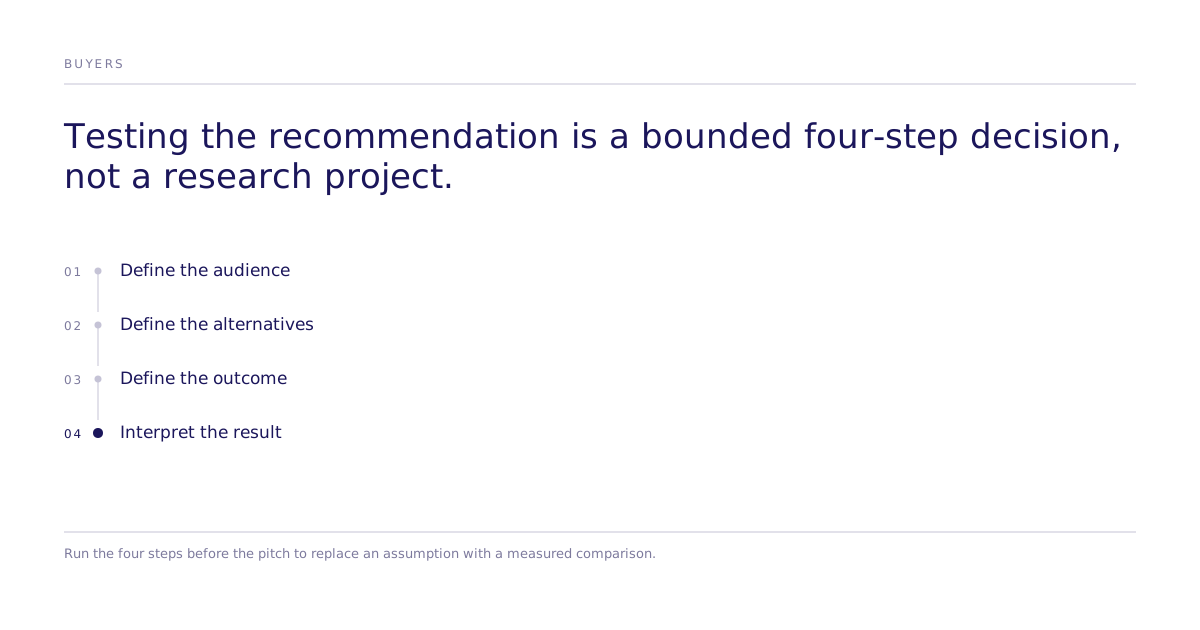
A bounded experiment needs an audience, alternatives, an outcome, and limits. It does not need to imitate a full research engagement.
- Define the audience. Translate the brief into observable criteria such as role, industry, company size, geography, and relevant behavior. One planning setup uses 25 to 50 simulated audience members. That is a study choice, not a universal product limit.
- Define the alternatives. Compare the real options the agency might recommend. For a concept pitch, test three concepts rather than presenting one concept without a comparison.
- Define the outcome. Choose the response that would change the recommendation, such as preference, trust, consideration, or choice.
- Interpret the result. Compare the alternatives and record the assumptions. As with synthesizing ten interviews into themes, the strategist still has to distinguish a repeated pattern from a useful decision.
One pitch-planning example assigns about an hour to design and run each session, with a 3 to 5 day window from brief to an evidence-grounded deck. It compares that window with 2 to 4 weeks for a traditional research-backed deck. A timing estimate without its limits reads as a sales promise, so the limit is stated here directly. Treat those figures as planning assumptions to validate for the engagement. They are not current Subconscious delivery terms or guarantees.
Use four pitch plays without overstating the proof
1. Audience perception
Compare how the target audience responds to the client's current position and a small set of alternatives. A planning example uses 50 simulated audience members. The deck should show the tested alternatives and the measured response, not present generated comments as direct customer testimony: disclosure of synthetic-data use in a study is now a mandatory research-industry standard, not optional (GMO Research, "ESOMAR 20 | GMO Research & AI").
2. Competitive positioning
Start with the audience's choice question, not an agency taxonomy. A market map on two axes can organize the result, but the axes should follow the decision rather than substitute for evidence.
3. Concept choice
When the brief asks for positioning or campaign work, compare three concepts instead of arriving with one. State what changed between concepts and which outcome the test measured.
4. Engagement test plan
Show which recommendation should be tested next if the agency wins the work. Stating this limit keeps the recommendation open to challenge before the client agrees to a scope. Keep the plan conditional. Do not promise a fixed cadence, turnaround time, price, or margin without current evidence and an agreed scope.
For a separate delivery model, see the related agency strategy-deck workflow.
Put the evidence where the client can inspect it
The deck should separate the result, the agency's interpretation, and the proposed action.
| Deck section | Planning example | What it should contain |
|---|---|---|
| Audience problem | One slide | The decision, population, and observed response |
| Category context | Two to three slides | The alternatives and the category comparison |
| Strategic conclusion | One slide | The agency's interpretation of the result |
| Recommendations | Three to five slides | Actions tied to the tested evidence |
| Work plan | One to two slides | What to test during the engagement and what would change the plan |
| Team and proof | Closing slides | Relevant expertise, method limits, and sourced proof |
Every recommendation should point back to a test or be labeled as strategist judgment. That makes the deck easier to challenge and improves the client conversation.
What can't a pitch-stage experiment prove?
A published limit lets a buyer check the method against their own use case. A pre-pitch experiment does not replace client discovery, direct customer research, strategist judgment, or evidence gathered during the engagement. It also does not prove that an action will produce the same result after launch.
Subconscious can test or validate studies with real human participants. This lets a team move from a simulated experiment to real-human validation without changing the causal question. Naming this boundary keeps the claim checkable against a real buyer decision. Real-human validation still does not turn a pitch-stage action test into automatic proof of market performance.
Start with the next consequential pitch
Choose one pitch where the client must select among real alternatives. For a small planning exercise, define 30 simulated audience members and the three questions the client cares about most. Compare the actions. Do not treat the strongest two or three generated responses as proof.
Bring the decision, audience, alternatives, and target outcome to a Subconscious demo. The next step is a bounded test that can change the recommendation, not a larger deck built on the same assumption.