Testing a New Offer on a Limited Runway, Before You Build It
A founder or small-business owner with limited time and capital has one real decision on the table: which product, offer, message, audience, or price deserves the next few weeks of work. Getting it wrong costs runway that does not come back, and can leave the founder confident in the wrong idea for the wrong reason. Three friends said it sounded good.
Subconscious can compare a small set of plausible commercial actions for a defined buyer before the founder builds, buys media, or commits to a price. This test does not replace shipping, selling, or watching what real customers do. It narrows the range of expensive mistakes before the founder makes them.
Why doesn't asking five friends work?
Feedback from a personal network is a convenience sample, not a market signal. Friends are not the target buyer, a Slack group is an echo chamber, and neither will tell a founder that the price is wrong or the headline is confusing. A traditional research engagement can also be out of reach on a limited runway. Confidence built on a handful of friendly responses leads a founder to spend weeks building something the actual market will not pay for.
The cost of skipping validation is not usually a bad product. It is a good product with the wrong price, the wrong headline, or the wrong first audience. A small number of structured comparisons could have caught those mistakes before the work started.
What a resource-limited founder actually needs to test
A founder does not need a research department. The recurring questions, asked at every stage of the business, are:
- Is the offer wanted by the intended buyer?
- Does the message make that buyer care enough to act?
- Will they pay the price being considered?
A traditional research firm can cover this through three separate engagements: a focus group, a survey, and a pricing study. Each needs its own scope and quote, and the combination may be out of reach for a solo founder or small team. The practical need is a cheaper first pass that still produces reasoned answers rather than a raw vote count. The price and delivery time for such a pass are scoped per study.
A worked example: pricing a productized service
The case below is a planning example. The dollar figures, timing, and study sizes describe one hypothetical setup, not a current Subconscious deliverable, price, or guaranteed outcome.
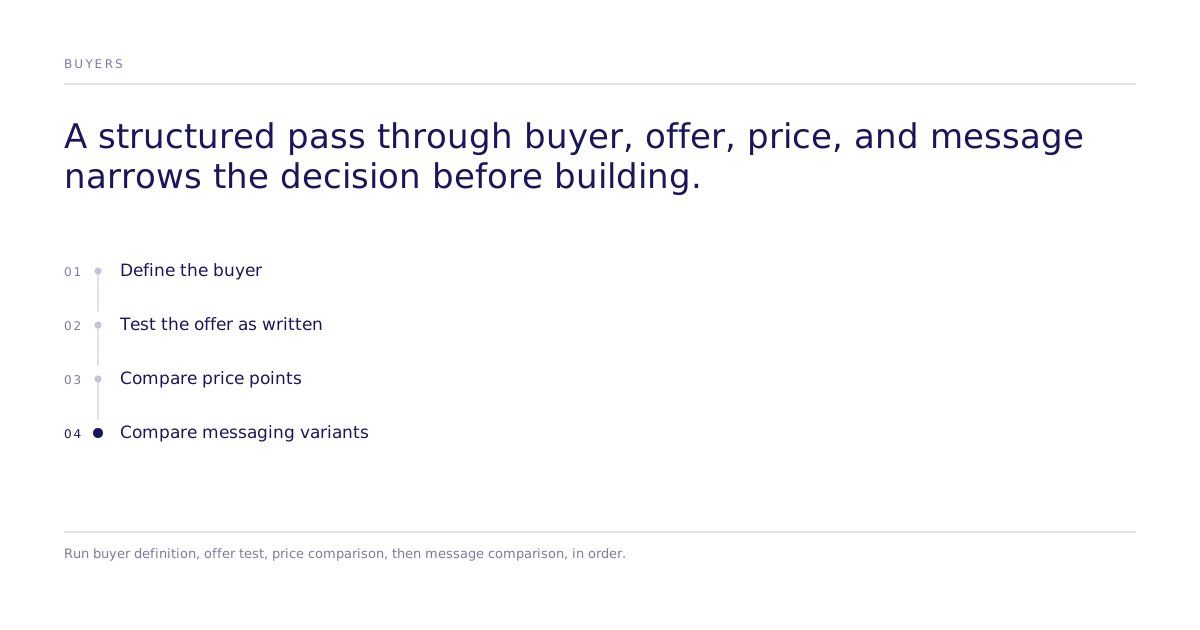
A freelance designer is considering a productized offer: brand identity packages for early-stage SaaS companies at a flat price of $2,500. The designer tests the decision before building the funnel:
- Define the buyer. Describe the audience precisely: founders of bootstrapped SaaS companies with 1 to 10 employees who currently do their own design or use cheap templates. One planning setup defines 30 simulated buyers, within a stated range of 25 to 50.
- Test the offer as written. State the offer in plain language: "brand identity packages, flat fee $2,500, delivered in two weeks." Ask whether the defined buyer would choose it, and why or why not.
- Read the reasoning, not just the count. A response like "interesting, but $2,500 feels high for a SaaS company at $100K ARR" is more useful than a yes/no tally, because it names the specific objection to fix.
- Compare price points. A hypothetical three-point comparison of $1,200, $1,800, and $2,500 might show $1,200 as the clear choice for a lighter starter tier, $1,800 as a stretch, and $2,500 as a premium full package. The founder would see this comparison before committing to one number.
- Compare messaging variants. Testing headline variants against the same buyer compares which version the modeled buyer prefers and says would motivate action, rather than which one the founder personally likes best. A claim about how quickly people understand a headline needs a timed human task.
In this hypothetical example, a six-hour pass over two evenings covers offer, pricing, and headline testing. That estimate belongs to the example only, and nothing here shows a general speed. The output is a narrower, better-reasoned starting point, not proof that the offer will sell.
| Step | What it tests | What changes as a result |
|---|---|---|
| Offer test | Whether the buyer profile says it would choose the stated offer | Selects which offer to take into a human or live check. A weak simulated result is not proof the offer would fail, so keep a check for false negatives |
| Price comparison | Which price reads as fair vs. high to the modeled buyer | Suggests a starting price to test with real buyers |
| Messaging comparison | Which headline the modeled buyer prefers | Picks a candidate headline for a live test, not a final choice |
Cost context
Drive Research's cost guide, dated November 2025, gives vendor ballparks in US dollars. They are not Subconscious pricing, and the guide gives no turnaround times:
| Option | Vendor ballpark (Drive Research) | Scope |
|---|---|---|
| Online survey | $5,000 to $15,000+ | 400 responses, estimated |
| Focus group | $7,000 to $20,000+ per group | Depends on audience difficulty and incentives |
| In-depth interviews | $5,000 to $15,000 | 10 to 15 interviews |
| Informal feedback from a personal network | Free | Biased and unstructured |
These ballparks do not support a cost or speed comparison with a Subconscious study. A founder who wants one should ask each provider for a written scope, price and delivery date for the same question.
Where this method helps most
- Naming. Comparing name candidates against the target buyer surfaces what each name signals, not just which one gets more votes.
- Landing-page copy. Comparing headline and subhead variants against the same defined buyer shows which version the modeled buyer prefers or reads as intended. Test comprehension speed with a timed human task.
- Pricing. Comparing price points against a defined buyer shows whether the buyer is likely to perceive the offer as cheap, fair, or premium.
- Feature priorities. Comparing backlog candidates against the same buyer definition helps separate noise from features the modeled buyer says it would pay for.
- Audience selection. Comparing the same offer against two or three candidate audience definitions can show which population responds most strongly. That is a useful signal for choosing a first beachhead.
What does this replace, and what doesn't it replace?
This approach is a reasonable substitute for guessing based on a personal network, setting price by copying a competitor, or writing copy in a vacuum.
It does not replace actually shipping the product, talking directly to people who have already paid for it, watching how they actually use it, or reading live analytics. A pre-launch test does not prove demand.
A small starting point is deliberate: pick the one decision that has been unresolved the longest, define the target buyer profile, ask the question in plain language, and read the reasoning before deciding. Choose the number of simulated buyers from the study design and the precision and stability the decision needs. The worked example above uses 30, within a hypothetical range of 25 to 50, and that count is not a recommendation for your study.
Limitations
A structured pre-launch test does not replace selling, does not replace observed customer behavior, and does not guarantee any particular price or conversion outcome. Treat every hypothetical dollar figure and timing note above as illustrative, not as a Subconscious price, delivery time, or performance guarantee. Founder judgment about the specific business still carries the decision.
The Subconscious research program describes the evidence behind the method. That evidence concerns how simulated studies reproduce estimated choice parameters from published human studies. It is not validation of your offer. When the decision is high enough stakes to warrant it, the same question can be put to real buyers in a matched human study, scoped per decision. Do the same for apparent winners and for offers the simulation ranked low. The use cases overview shows how that step fits into a broader decision workflow.
If there is one decision on the desk right now, such as an offer, a price, or a headline, bring it to a Subconscious decision review before spending the next few weeks building around a guess. Bring the offer, the buyer profile and the alternatives you would compare.