Causal AI Use Cases: Which Decisions Can Subconscious Test?
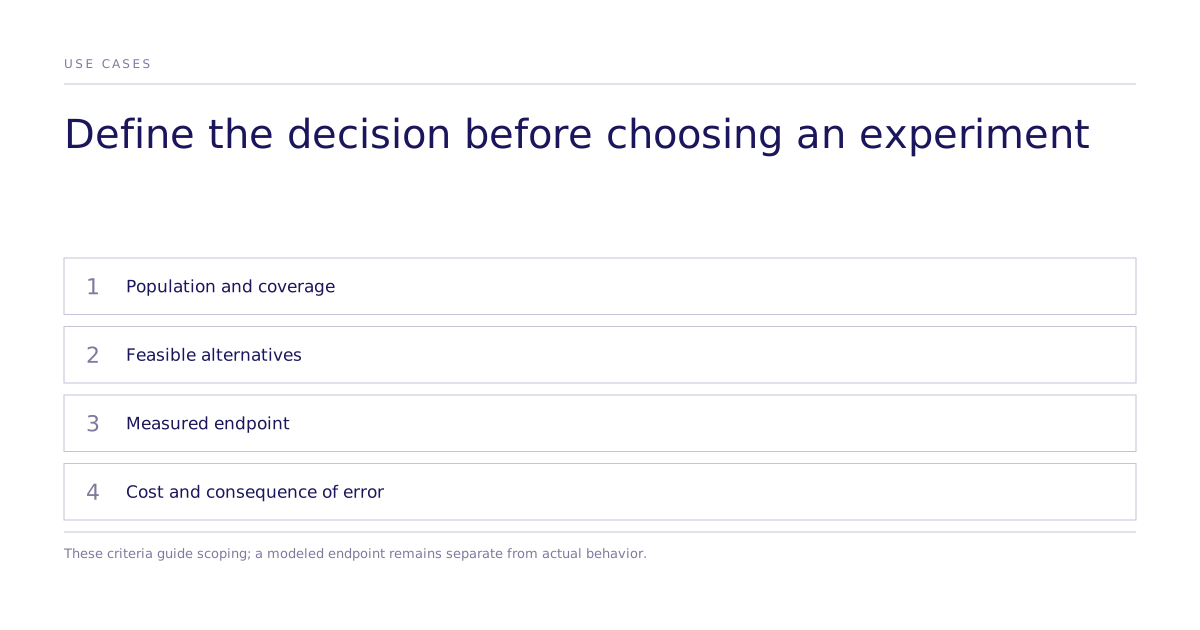
Subconscious helps teams test product, pricing, messaging, launch, and go-to-market actions before committing capital. The strongest use case has a defined population, plausible alternatives, a measurable behavior, and a meaningful cost if the team chooses poorly.
Subconscious structures causal comparisons of defined business actions. The July 2026 causal-fidelity working paper (not peer reviewed) evaluates replicated choice parameters; it does not validate each new customer study. Scope a matched human study for the proposed audience and decision.
Commercial decisions
Product development, innovation, and launch
Compare product concepts, features, claims, packaging, and launch messages before choosing what to build or release. A decision-specific experiment shows which tested alternative produces the stronger directional response and where the response differs across defined audiences.
A comparison score without its limits reads like marketing. This supports innovation and R&D when the team has concrete concepts to compare. It does not replace technical feasibility work or direct customer discovery.
What pricing decisions can Subconscious test?
Compare defined price points, packages, product alternatives, and buyer segments. A number without its limits works as marketing copy. It is not a promise of automatic price optimization, revenue forecasting, or SKU-level elasticity.
The Subconscious case studies show how teams have used repeated experiments to narrow pricing and positioning decisions before rollout.
Brand awareness, positioning, and advertising
Test positioning, campaign ideas, claims, and creative alternatives. Compare segment differences conditionally, and assign messages or offers within segments where the design permits. Audience membership is not itself a randomized action; channel comparisons also need an exposure and assignment plan.
Market segmentation and consumer behavior
Define segments before the experiment, then compare whether the tested action moves each group differently. Aggregate pattern matching is easier than individual simulation. Segment claims need enough evidence and should not be inferred from a plausible persona response.
Customer satisfaction, retention, and customer experience
Compare proposed journeys, service changes, retention offers, and experience concepts against a target behavior. A simulation can help decide which action deserves a live test. Actual churn, loyalty, and satisfaction still require observed customer data.
Research and strategy decisions
Market entry, risk, and go-to-market strategy
Compare offers, messages, audience definitions, sequencing, and market-entry actions. Keep the experiment tied to one decision. Broad market forecasts and automated recommendations require separate evidence.
Can Subconscious forecast market trends?
This fits only when a trend creates a decision with alternatives: a team can test how defined audiences respond to actions under a stated scenario.
It is not a trend oracle. Historical analysis, market data, competitive evidence, and scenario assumptions remain necessary. The causal question is which action changes the outcome under the tested conditions, not whether the model can predict every market shift.
Market research and consumer insights teams
Use causal simulation as an experimental first pass before committing a full research budget. Interviews, surveys, field experiments, and observation remain valuable for discovery and real-world confirmation. The research program explains how Subconscious uses replication and human baselines as the trust layer.
Public opinion, polling, and policy research
Compare public messages, policy choices, or interventions for a defined population and outcome. Consequential public decisions require qualified review, clear limitations, and suitable human validation.
Sustainability and social impact
Compare sustainability claims, corporate-responsibility initiatives, and behavior-change messages. Measure a defined response. Do not treat stated support as proof that behavior will change.
Product and service experience decisions
User experience testing
Subconscious can compare product concepts, journeys, service changes, and proposed experience interventions before implementation. It does not replace watching a real person use an interface.
Use direct usability research for task completion, navigation, comprehension, and accessibility. Use a causal experiment when the decision is which product or commercial action changes choice. The UserTesting, Maze, Lookback, and causal AI comparison explains the boundary.
Can Subconscious be used for healthcare optimization?
Healthcare teams can compare patient, provider, payer, communication, access, or policy interventions when the population, alternatives, and outcome are explicitly defined.
Publishing where simulation stops is what makes it usable for a health decision. Simulation should not be presented as clinical evidence or a substitute for patients, clinicians, trials, safety review, or regulatory analysis. See the pharma decision lab for the current vertical framing.
Education, media, travel, automotive, and digital services
The same method can compare messages, offers, journeys, and adoption actions across education, entertainment, travel, automotive, software, and professional services. Industry context changes the study design. The causal requirement stays the same.
Industries with repeated high-cost decisions
The method is strongest where teams make repeated choices under behavioral uncertainty:
- Consumer goods, retail, and ecommerce: product, price, pack, and claim decisions
- Pharma and healthcare: positioning, access, and support decisions
- Telecom and media: bundle, ARPU, churn, and audience decisions
- Technology and software
- Financial services
- Government and public policy
- Market research and consulting
- Automotive, travel, and hospitality
- Energy, utilities, logistics, and real estate
- Education and learning products
Industry alone does not determine fit. The team must be able to name the decision, actions being compared, people affected, and behavior that matters.
Choose a use case worth testing
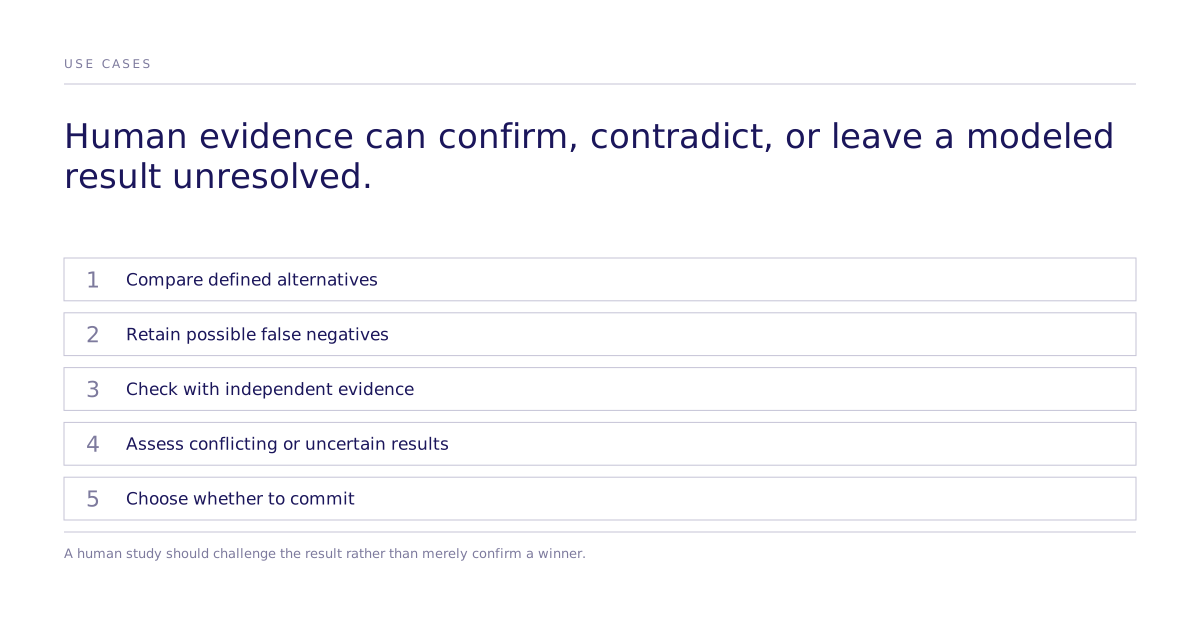
Product launches, price scenarios, message choices, market-entry plans, and policy interventions fit when the decision owner must select among defined alternatives.
Open-ended trend scans, generic opinion generation, automatic financial forecasts, and guaranteed outcomes are poor fits.
Start with one decision. If the team can define the audience, alternatives, and target behavior, bring it to a Subconscious working session.