What Market Researchers Should Stop Doing Manually
A stakeholder wants a clear answer. An AI-generated draft lands on the desk before the researcher has finished going through the raw data. Somewhere in there, a manager floats the idea of letting AI handle the first pass entirely. None of that means research is disappearing: the U.S. Bureau of Labor Statistics projects employment of market research analysts to grow 7 percent from 2024 to 2034. It means the mechanical layer of the job (formatting, cleanup, first-pass synthesis) is shifting to AI assistance, while the decisions built on top of that layer still have to hold up.
The real question for a research leader is narrower than "how much AI should we use." It is: which tasks move to an AI-assisted or synthetic exploratory stage this quarter, and which decisions still require real respondent data or fielded validation before a claim leaves the building.
The mechanical layer is not the valuable layer
The old advantage in research was partly access: knowing how to field a study, clean the responses, and package a finding. AI narrows that advantage. More people can now draft a survey, summarize a transcript, or generate a first-pass read on a concept.
Once anyone can generate a plausible-looking answer, judgment shows up in a different place: deciding which of those answers can be trusted, and defending that call. For a research team, that means framing the question before any AI tool touches it, then attaching the caveats once the tool has produced something: what decision is being made, what evidence would change it, and where an unvalidated read could mislead the business if it reaches a deck unlabeled.
What decides whether a task should be automated?
Every research task can be sorted by one question: what does it cost if this specific output turns out to be wrong? Formatting a summary incorrectly creates rework. Shipping a pricing or launch decision on an unvalidated read can damage the decision and the team's credibility with leadership.
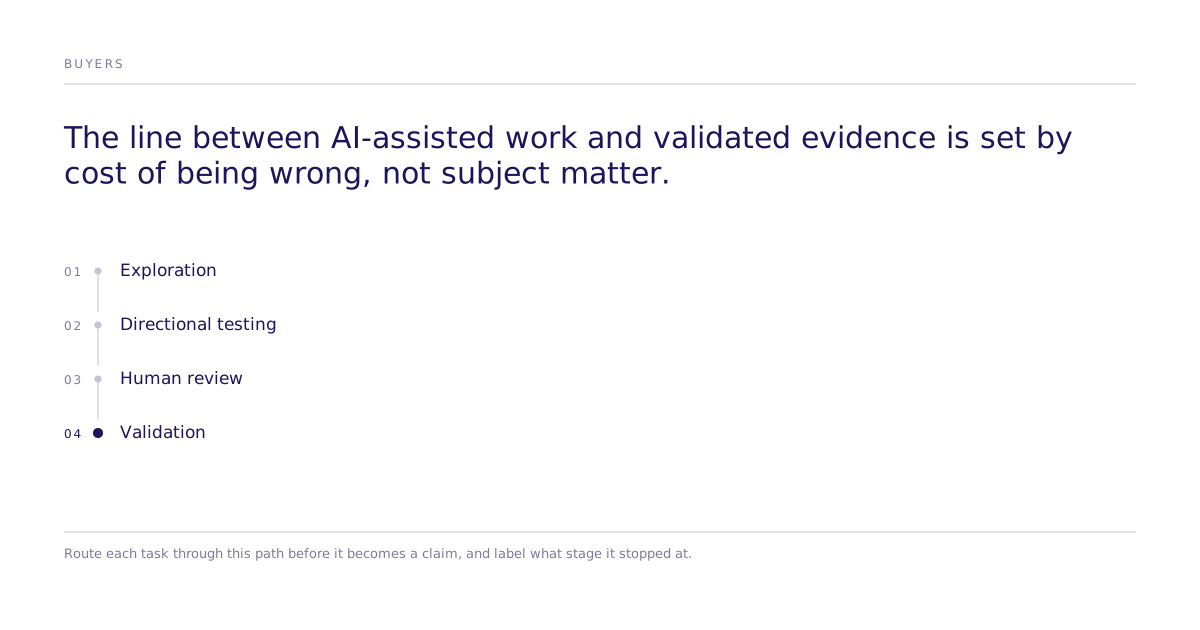
That cost, not the subject matter, is what should decide whether a task stays in exploration or gets escalated to validation. A rough workflow:
- Exploration: draft hypotheses, alternative framings, and objections as material for review, with AI assistance where it's useful.
- Directional testing: compare concepts, messages, or positioning options to determine what a fielded study must validate.
- Human review: check the audience definition, the neutrality of the prompt or stimulus, and whether the read is grounded in something real.
- Validation: bring in real respondent data, behavioral data, or fielded research before a decision that is expensive or goes external.
Skipping straight from exploration to an external claim is the failure mode, not the use of AI itself.
Where does controlled synthetic testing fit in market research?
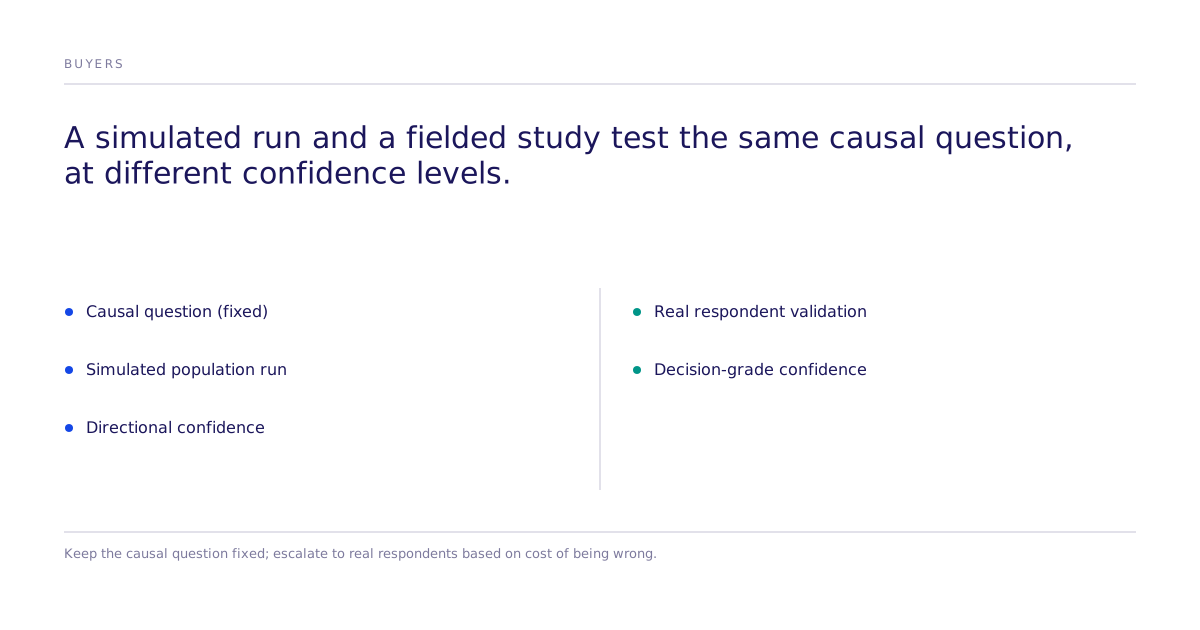
A number without its limits is marketing. This is where a platform like Subconscious is useful, and where it is not. Subconscious runs controlled discrete-choice experiments against a simulated population and returns causal effects with confidence intervals, a way to test how a specific audience segment responds to a concept, message, or pricing change as directional evidence before fielded validation. It is a directional-testing layer inside the workflow above, not a replacement for the validation step: when a decision is expensive or public, Subconscious can test or validate the same causal question with real human participants; the causal question does not change between the simulated run and that validation step.
The causal fidelity paper reports that the best configuration reaches 87% of the measured human ceiling on one study: 0.832 rank correlation against the published human result, where two independent samples of real humans reach 0.959. Across all 43 studies that pass design filters the mean is 0.73. The misses sit on the same leaderboard as the hits. It is a validation result, not a guarantee for every question or audience: a directional read from a simulated population is not the same evidence as a result from real respondents. Subconscious does not automate report writing, first-pass coding, or desk research summaries; those stay human-reviewed work.
What mistake erases the AI advantage in research?
The failure mode is automating the visible deliverable and leaving the messy middle untouched: the team gets a fluent answer, the deck needs a conclusion, and an unlabeled directional finding reaches a stakeholder as if it were validated evidence. AI can produce useful output. It cannot decide on its own whether that output is valid for the decision in front of a team.
The fix is not more caution about using AI. It is stating the limit as part of the deliverable: name what the AI-assisted or synthetic work covered, flag what it left untouched, and spell out the next validation step. Teams that do this consistently don't sound less confident; they sound more precise, because they can explain where their confidence ends.
A one-month planning exercise
Pick one recurring task with a live decision behind it, not a hypothetical one. Write the business decision the task feeds in one sentence, then define the audience and the cost of getting it wrong. Route the task through exploration, directional testing if useful, human review, and validation, in that order, and label the output at each step before it goes further.
For one month, track that workflow against a plain before-and-after log of the decision and outcome. The useful artifact is not a list of tools adopted. It is a working system that shows where AI-assisted exploration and human judgment each did their job, and where a claim still needed real evidence before it left the room. Teams weighing where synthetic testing fits into that system can see current replicated study results or read how the validation step works before scoping a first study.