Test a Case Study Angle Before Committing to the Draft
An agency finishes a client engagement, the client agrees to a testimonial, and someone drafts the case study around whichever framing feels obvious in the room, usually the project lead's favorite telling of the work rather than the one a target buyer finds useful. The case study publishes, picks up a trickle of traffic, and the team calls it done because nothing measurable proves otherwise.
Get that framing wrong and the agency still has a case study, still gets some traffic, and still cannot tell whether the shortfall came from the underlying project, the writing, or the framing itself. A roundup of conversion-rate optimization experiments has turned up results that surprised the teams running the tests: intuition about which variant will win is a weak guide (CXL's surprising CRO case studies), and framing choices are no less prone to that same blind spot.
Can one project support several honest case study angles?
A single finished engagement rarely has only one story inside it: consider this hypothetical growth agency running a paid-search program for a SaaS client. The same underlying facts can be told as a cost story: the campaign cut customer acquisition cost 40 percent inside a 90-day window. Or a speed story: the client saw its first measurable return 21 days after the audit closed. Or a displacement story: the agency's results beat the incumbent vendor's numbers within a single quarter. Or a team story: a three-person unit built the program in six weeks. Or a contrarian story: the agency scrapped 60 percent of the client's existing campaigns on day one and rebuilt from there.
These are invented examples, not results from an actual engagement. Assume an agency has records supporting several such outcomes; each framing highlights a different result: a cost-pressured finance buyer, a time-pressed founder, a prospect comparing agencies, and a prospect who wants to know what the team did might each respond to a different version of the same facts. Most agencies settle the choice in a short internal meeting and move straight to production, exactly where the wrong framing gets locked in before anyone has evidence either way.
What should you test before you write a single paragraph?
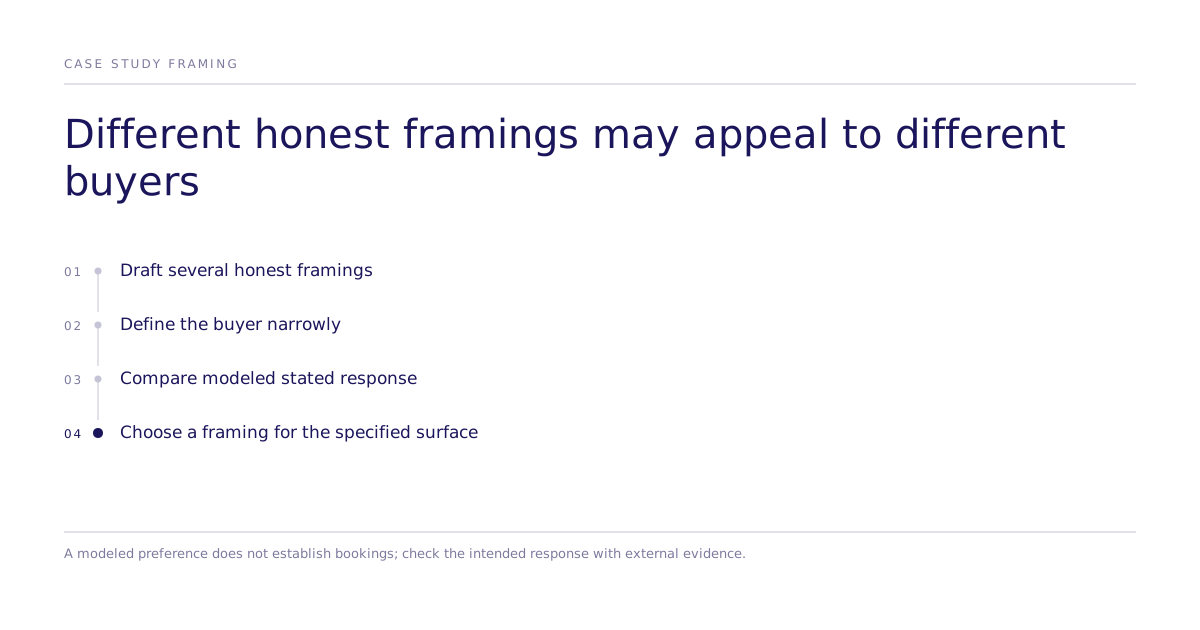
The fix does not require finishing the case study first; it requires treating the framing itself as a testable claim: define who the case study needs to convince, generate more than one honest way to tell the same facts, and compare which version changes that buyer's stated intent to act before committing writer and design time to any single version.
Define the buyer segment, randomize the framing shown, and specify a response such as stated intent to book a call. In a simulation, that estimates differences in modeled responses. An uncertainty interval depends on the actual study and estimation procedure; it does not validate human booking behavior. Verify the preferred framing with human respondents or a live test before claiming conversion lift.
A workflow for testing the framing, not just the headline
The steps that make this practical for a working agency, independent of what tool runs the comparison:
- Force more than one framing onto the page, before drafting any single one fully. The default framing, chosen first and alone, is rarely the strongest one.
- Write a real headline and opening for each framing. A prospect should understand what the case study delivers from the headline and the first few sentences alone. If the framing only makes sense once the reader reaches the body, it will not survive a feed or a subject line.
- Define the buyer narrowly. "Head of growth at a post-Series-A SaaS company facing a board mandate to cut acquisition cost" produces a sharper test than "B2B buyers."
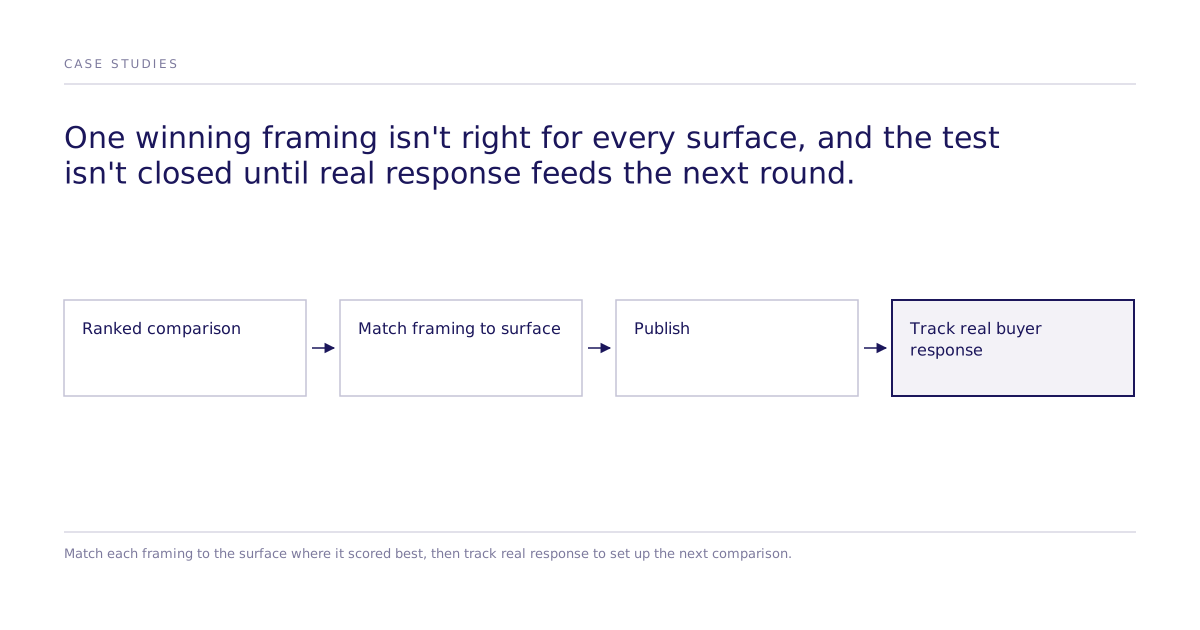
- Compare stated response across framings, against that defined buyer, before full production. The output is a ranked comparison, not a single winner declared by consensus.
- Ship different framings to different surfaces when the comparison supports it. The version that performs best in a social feed and the version that performs best on a website case-study page are not always the same framing, because the reader's context differs.
- Check the comparison against what happens after publication. Track how the shipped framing performs against the buyer's real response, and feed that back into how the next comparison gets set up.
Where the framing test breaks down
Testing only the headline. A headline alone is a fraction of the case study's argument, and the opening paragraphs are where the reader decides whether to keep reading or leave.
Skipping the brainstorm and testing the one obvious framing against itself. Running a single framing through a test and calling it validated confirms a choice that was never compared against a real alternative.
Defining the buyer too broadly. A test built around a generic audience returns a generic result. The narrower the buyer definition, the more the comparison discriminates between framings.
Treating one publication surface as universal. The framing that wins attention in a feed and the framing that earns trust on a case-study page answer different reader questions. A single test run against a single context will not catch that split.
Running the comparison once and considering the question closed. A buyer's context shifts over time. An agency's ideal customer from a year and a half ago is not necessarily its ideal customer today, and a framing that worked once is not guaranteed to keep working.
From a directional read to something you can defend
A framing comparison built on stated opinion or an internal vote produces a plausible-sounding answer that is hard to defend when a stakeholder pushes back on why one version shipped. A controlled experiment against a defined buyer segment, with an estimated difference in stated intent, answers with a comparison behind it rather than a preference.
For a flagship case study, separately scope a human comparison or live experiment. Agree the recruitment owner, buyer criteria, allocation and outcome measurement. Keep the underlying question comparable while checking whether the simulated preference survives that test.
Many agencies publish a case study without testing its framing. Treating the framing as a claim worth testing, before the writer and designer commit real hours, gives the team a comparison to defend instead of a preference. Read the method evidence and its limits, or book a decision review to scope a framing comparison.