When Last-Touch Attribution Breaks: A Funnel-Aware MMM Read
A marketing leader reallocating budget under GDPR-constrained tracking faces a specific question: which channels actually cause leads, when user-level attribution can no longer see the path between them?
Get that wrong and the usual failure mode is quiet. Bottom-funnel, last-touch channels keep looking dominant because they are the last thing tracking can see. Upper-funnel demand generation keeps looking weak because its effect shows up days later, in a different channel, after tracking has already lost the thread. Budget drifts toward the channels that are easiest to measure rather than the channels that cause the outcome.
Why did GDPR break the old measurement?
Multi-touch attribution with last-touch steering worked when user-level tracking could follow a customer across a long journey. GDPR and browser tracking restrictions shortened what that tracking can see, so mid- and upper-funnel touches became partially invisible and channel credit skewed toward the bottom of the funnel. Marketing Mix Modeling exists to fill that gap: it estimates channel contribution from aggregate spend and outcome data instead of individual-level tracking, which is why it has re-emerged as a standard response to privacy-constrained measurement (Analytic Edge).
Standard MMM also treats each channel as independent, missing the case where upper-funnel spend does not convert directly but drives demand that a different, lower-funnel channel later captures.
Modeling the funnel as one causal chain, not separate channels
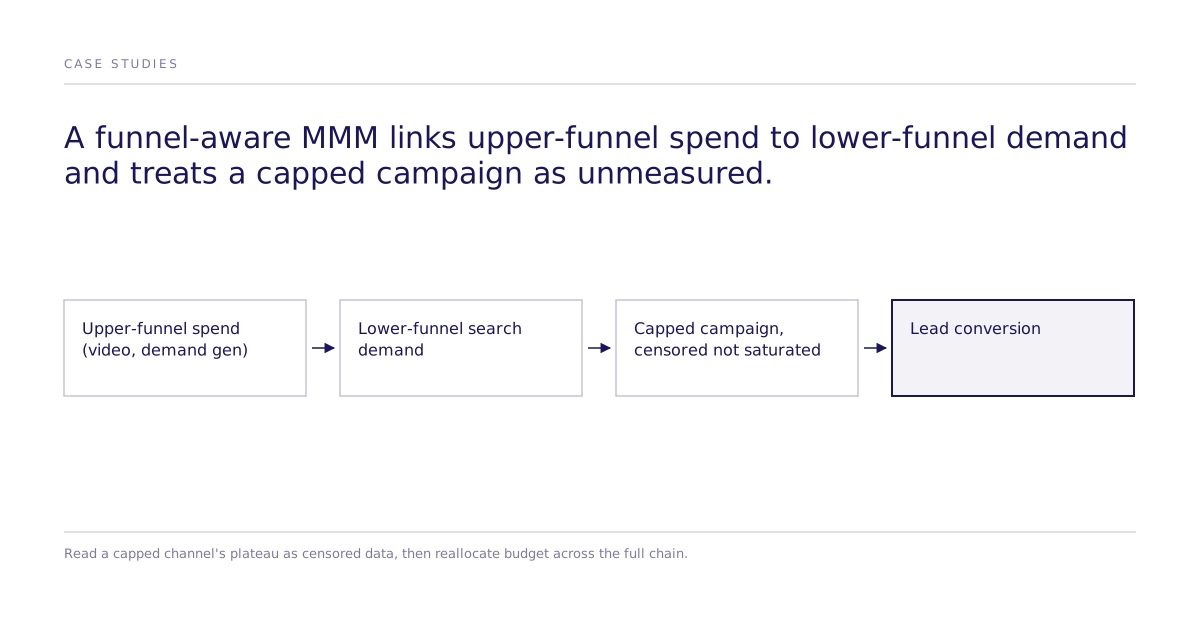
A published Bayesian MMM engagement with a German insurance marketer illustrates the fix. Instead of one model per channel, the team built a funnel-aware model with two linked likelihoods: one for how upper-funnel spend (video, demand generation) drives lower-funnel search demand, and one for how that lower-funnel spend converts to leads.
The model also treated budget caps as a measurement problem, not a ceiling. When a paid-search campaign hit its daily budget cap, a naive read looks at the resulting plateau and mistakes it for saturation. The Bayesian model instead treated the capped periods as censored observations and estimated the latent demand above the cap: the recommendation shifts from "this channel is maxed out" to "raise the cap, because unmet demand is estimated at a specific level." A recent Bayesian framework for privacy-safe attribution anchored in MMM describes the same principle: aggregate, privacy-safe models can still recover granular, channel-level signal when the model's structure matches the funnel it measures (arXiv:2606.16878).
PyMC Labs reports that Nürnberger Versicherung reduced cost per lead by more than 27% during a six-month rollout. That is a historical client-reported outcome, not a Subconscious result or a randomized estimate of the model’s causal contribution. PyMC Labs engagement account, updated September 11, 2026.
What the model made visible
| Before: last-touch attribution | After: funnel-aware MMM |
|---|---|
| Upper-funnel spend looks weak or invisible | Upper-funnel spend has a quantified, standalone contribution |
| A capped channel looks "saturated" | A capped channel has an estimated unmet-demand level |
| Channels are optimized one at a time | Budget is allocated across the full funnel at once |
| Confidence rests on attribution mechanics | Confidence rests on uncertainty intervals and observed trajectory |
The primary account describes stabilization in the first month, a visible CPL decline in the second, and continuing improvement in months three through six. The client described transparency and agreement between predicted and observed results as reasons to continue. The reported trajectory does not isolate the contribution of every budget or market change.
What can't this reallocation tell you before you spend?
A funnel-aware MMM can forecast and simulate budget allocations under its assumptions. Historical fit alone does not identify a creative’s causal effect or prove the counterfactual prediction. Check spend variation, omitted drivers, uncertainty, holdout performance and incrementality evidence before using recommendations for a new budget.
Testing the action before the model has to explain it
A market simulation can help develop hypotheses about a message, offer or buyer choice. It does not directly measure incremental media-spend ROAS or replace live channel experiments. Keep that task separate from the MMM’s allocation forecast and the actual lead outcome. The public validation record and case evidence state the available comparison limits.
This page makes no claim that Subconscious builds marketing mix models or estimates censored demand from ad-spend data. The post-spend measurement of actual media performance that a model like the one above provides is a separate task. A team that wants both, a causal read on which action to fund and a later observational check on what the spend did, runs them as separate steps.
If a human comparison is needed, separately specify the recruitment, assignment, choice task and outcome. A survey choice result does not automatically validate an ad-spend effect on leads.
Next step
Teams weighing a similar reallocation decision can see how Subconscious structures a pre-spend causal test, and where it stops short of post-spend measurement, by walking through how the work is run or booking a session against a specific funnel decision.