Building an AI Governance Layer for Market Research
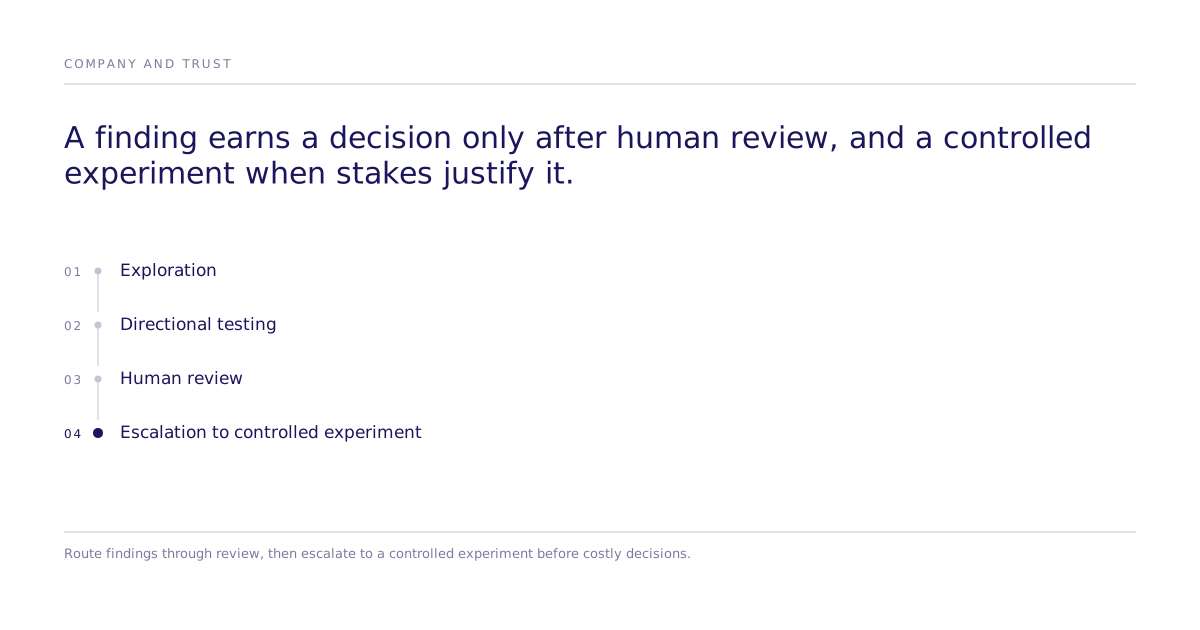
A research leader who lets AI-assisted output move straight into a stakeholder deck is making a governance decision, whether or not anyone wrote it down. The real question a governance layer has to answer is narrower than "can we use AI here": it is whether a given finding is strong enough evidence to act on, or whether it has to be escalated to a controlled experiment first.
Publishing where a directional read stops keeps a number from turning into marketing. A directional AI read gets treated as validated evidence, a decision gets made on it, and the gap surfaces later, after budget or launch spend is already committed. The cost lands on the research function's credibility with the stakeholders who acted on the finding, not on the AI tool that produced it.
Why this needs a rule, not a habit
AI has moved from a novelty layer into daily research work: drafting analysis, formatting reports, preparing data, producing first-pass summaries. That does not mean research demand disappears; it means the mechanical parts of the job get faster and cheaper, which pushes the person doing the job closer to the decision. The exposure is that a research function which only produces output, without a rule for what that output is allowed to support, cannot defend a call after the fact.
A workable governance layer needs four ordinary pieces, staged by how much the decision costs to get wrong. That is the same staged-review principle the NIST AI Risk Management Framework's Generative AI Profile sets out for AI-assisted work generally:
"The NIST AI Risk Management Framework (AI RMF) is intended for voluntary use and to improve the ability to incorporate trustworthiness considerations into the design, development, use, and evaluation of AI products, services, and systems."
NIST, AI Risk Management Framework (source)
| Layer | What happens | Who is accountable |
|---|---|---|
| Exploration | AI generates hypotheses, objections, and alternative framings | Analyst |
| Directional testing | An open-ended AI or synthetic-panel session compares options quickly, with no defined population or controlled alternatives | Analyst |
| Human review | Someone checks audience definition, prompt neutrality, source grounding, and business context | Research lead |
| Escalation | A controlled experiment, and real-human validation for expensive or public decisions, replaces the directional read before anyone acts on it | Research lead + stakeholder |
The value is not the AI output by itself. It is the traceable path from a question, through AI-assisted exploration, to the review and validation step that earned the right to inform a decision.
Where a controlled experiment fits in that path
Naming what a directional session cannot do is what lets a buyer check the claim against the record. An open-ended AI or synthetic-panel session is useful for the exploration and directional-testing layers: it surfaces hypotheses and rules out weak ones quickly, before anyone commits to fielding a study. It does not produce a defined comparison across defined alternatives, so it cannot answer the escalation-layer question on its own.
That is the tier a controlled discrete-choice experiment sits in. Subconscious runs a controlled experiment comparing defined alternatives across a defined population and returns causal effects with confidence intervals. That gives a governance framework a defined comparison with quantified uncertainty, sitting between an open-ended AI read and a fully fielded human study, produced ahead of the slower, costlier fielding stage. Details on how those experiments are structured and validated are on how we work.
A controlled experiment is one input to a governance framework, not the framework itself. It does not write disclosure text, approve which use cases are permitted, or supply an escalation workflow. Keep the scale of a simulated experiment distinct from a recruited human sample: a defined population is not the same thing as a set of participants recruited for a study.
When to add real-human validation
When the decision is expensive or public enough that a causal estimate alone is not enough evidence, the same defined comparison can move to real-human validation without changing the underlying causal question. That step matters most when a governance policy specifically calls for it, not as a default addition to every study.
The misses sit right next to the hits in this record, and this is one of them. Real-human validation does not turn a causal experiment into an observed usability session, a clinical trial, or automatic proof of market performance. It answers the same question the simulated experiment asked, with a recruited sample, so a research function can show a stakeholder how the finding held up outside the simulation.
Writing the rule down
The mistake that makes this dangerous is writing governance after the first incident, once a fluent-but-unvalidated answer has already shaped a decision. The fix is not a policy document nobody reads. It is a workflow default: state what is being decided in a single sentence, name the audience and how much risk is attached, restrict AI or a directional panel to the exploratory stage only, have a person check the output, and label the evidence stage before anyone presents it externally.
That labeling step is not optional. A finding presented as "directional" carries a different weight than one backed by a controlled experiment with confidence intervals, and a stakeholder who cannot tell which one they are looking at cannot make an informed call on it.
Where this fits, and where it does not
A governance layer built this way still leaves room for human judgment in research. What it changes is what a defensible research function looks like: closer to the decision, faster to generate a defined comparison, and explicit about which findings still need validation before anyone repeats them outside the room. Case studies show how that escalation path has worked for specific pricing, messaging, and positioning decisions, and a demo walks through how a specific decision would move through the layers above.
This limit is stated here so a buyer can check the claim before acting on it. The limitation carries through every layer: a causal effect from a controlled experiment answers the question it was designed to test, for the population it was run against. It does not certify that a decision will succeed in market, and a governance framework that treats it as final proof rather than the strongest available evidence has the same defensibility problem it started with.