5 Questions That Decide Between Synthetic Personas, Panel Data, and Causal Testing
A research lead comparing tools starts from the wrong question: "which platform is better?" The better question is what the decision needs: a directional hunch, a measured audience profile, or proof that an action changes an outcome. Picking the wrong tool wastes budget or time.
Three ways to research a market decision
Directional synthetic-persona tools generate AI-driven responses from modeled knowledge about a market or segment. Real-panel audience intelligence platforms, such as YouGov Profiles, collect responses directly from permissioned human panelists and refresh core variables on a regular cadence. A third category, causal behavioral experimentation, runs randomized studies designed to isolate which action changes a decision, not describe an audience or generate a directional response.
| Dimension | Directional persona tools | Panel-based audience platforms | Causal experimentation (Subconscious) |
|---|---|---|---|
| Data origin | Modeled from aggregated external sources | Direct responses from permissioned panelists | Randomized alternatives evaluated in a defined market simulation; human validation requires separate evidence |
| Best use | Early exploration, message and concept screening, objection discovery | Audience profiling, segmentation, trend tracking | Testing which specific action (price, message, feature) changes an outcome before a launch decision |
| Evidence type | Directional, not a substitute for representative statistics | Panel-based, self-reported attitudes and behaviors | Effects on modeled responses, with matched human evidence checked separately |
| Activation path | Feeds research design and creative development | Direct activation into ad platforms (for example DV360, Meta, The Trade Desk) | Feeds a go/no-go launch, pricing, or positioning decision |
Real-panel platforms remain the direct source when a decision needs human evidence, ongoing trend tracking, or activation into ad platforms. YouGov, for example, describes a panel of more than 30 million members, weekly data refreshes, and audience pushes to platforms such as Google DV360, Meta and The Trade Desk (YouGov Profiles, checked October 2, 2026). This comparison does not position Subconscious as a replacement for panel recruitment, weekly-refreshed tracking, or ad-platform activation.
Five questions that route the decision
1. Do you need a hunch or a measurement?
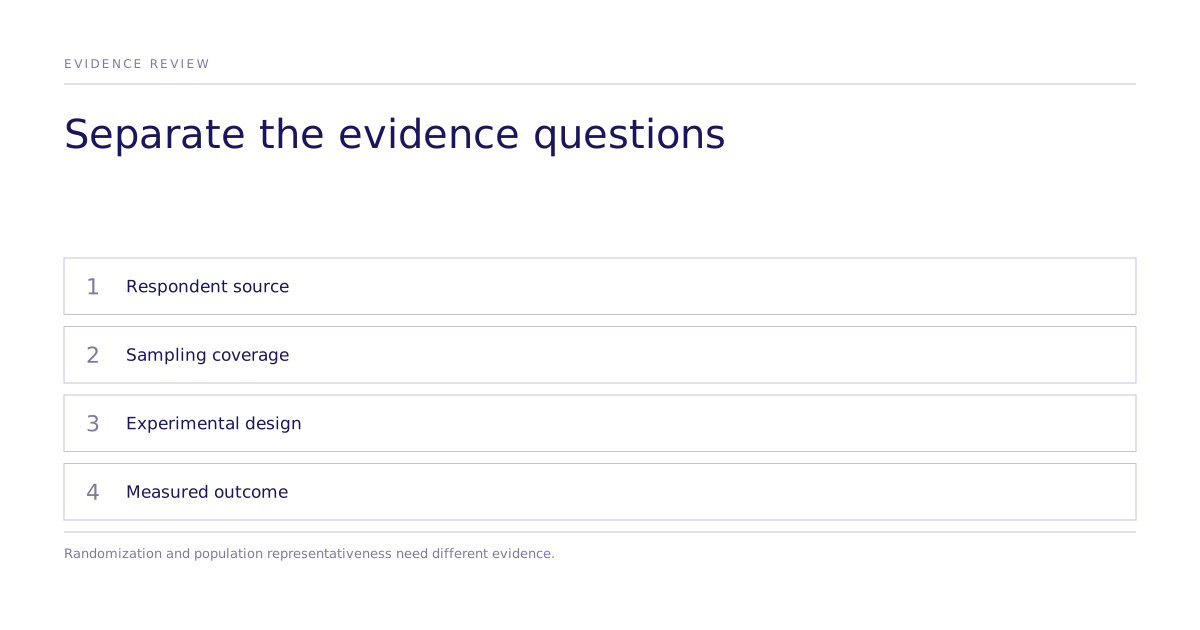
If the goal is to surface objections, screen concepts, or generate hypotheses before committing budget, a directional persona tool fits. If the goal is to measure an existing audience's reported attitudes over time, a panel-based platform fits. The platform category alone does not establish the design. To estimate an action’s effect, inspect the randomized or otherwise identified comparison and the outcome actually measured.
2. Does the answer need to hold up as causal proof, not just a directional read?
A directional persona response can suggest an idea is worth testing. It cannot tell a team a message caused a change in intent; it was never designed to isolate cause. A randomized experiment is designed for that: it assigns defined treatments or attribute levels and measures the response under identifying assumptions. A factorial design may vary several attributes jointly.
3. Is statistical representativeness required for this decision?
Representativeness depends on the sampling frame, coverage, selection, weighting and subgroup evidence. A human panel can have coverage bias, and a simulation can mismatch the intended population. Randomized assignment addresses treatment comparisons under assumptions; it does not repair population coverage. Ask for those two evidence records separately.
4. Do you need to activate the audience in ad platforms, or decide what to do first?
Panel platforms with recontact and API access hand audiences to campaign activation. A causal platform handles the step before that: deciding which price, message, or feature to activate. Treat these as sequential jobs, not competing ones: decide with a causal test, then activate with a platform built for reach.
5. What stage is the decision at: ideation, measurement, or pre-launch validation?
Early ideation tolerates a directional signal; the stakes are low. Ongoing measurement and segmentation need panel-grade evidence collected over time. Pre-launch validation, the point where a wrong call is expensive, needs a causal answer: a randomized study on the specific action, checked with a matched human or live outcome study when the stakes justify it.
Where each method stops
None of these three approaches replaces the others. Directional persona tools do not produce statistically representative audience data. A panel can supply participants for a randomized human experiment. An unrandomized profile or tracking study does not isolate an intervention effect by itself. Causal experimentation still depends on a well-specified study design; a poorly framed question produces a precise answer to the wrong problem.
Matching the tool to the question, not defaulting to whichever is fastest to open, keeps a launch, pricing, or positioning call from resting on the wrong kind of evidence. Teams that need to test a specific action before a launch decision can read the method evidence and its limits, see how an experiment gets scoped, or talk through a specific decision.