AI Buyer Persona Tools in 2026: A Comparison Guide
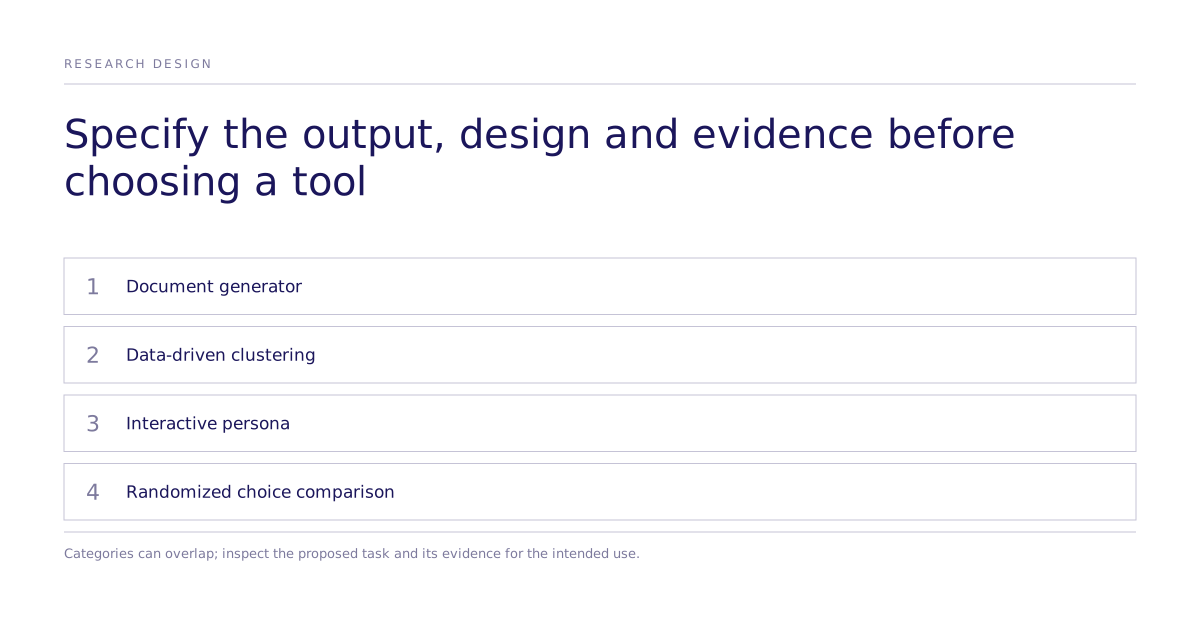
"AI buyer persona tool" covers three unrelated products: a document generator, a customer-data clustering platform, and an interactive persona a team can question. Buying the wrong one is expensive in a quiet way. A team pays for a one-page export nobody reopens, or a clustering platform with too little customer history to find real segments, while the question that actually mattered, which message, price, or feature moves this buyer, never gets tested.
Same label, three different products
A document generator. Tools such as HubSpot's Make My Persona take a short form (industry, role, company size, stated pain points) and return a formatted persona page in minutes (HubSpot, Make My Persona). The result reads well and works fine as a placeholder in a kickoff deck. It is not built to be reopened once the team needs to test a specific headline or price.
A clustering platform built on observed data. Tools may ingest CRM, surveys, analytics or other sources to group customers into segments. Assess coverage, feature quality, missingness and out-of-sample segment stability. A fixed count of customers or signups cannot establish sufficiency; a company entering a new market may need data beyond its existing customers.
An interactive persona profile. A third group builds a standing profile a person can question directly instead of filing a research request. Synthetic Users is one example: it generates interview responses from AI participants for a defined audience and describes itself as a discovery co-pilot, not a replacement for real research.
Where each one stops being useful
The document generator's weakness is durability, not quality. It gets saved once, cited in one meeting, and then nobody returns to it when a new campaign or feature needs a fresh read on the same buyer.
The clustering platform's weakness is data. It describes the customers a company already has, not the ones it is trying to reach. Ask it about a segment with no purchase history behind it, and there is nothing to cluster.
The interactive-persona group's weakness is scope. A profile a team can talk to is useful for exploring reactions and gathering directional color. That is a different job from running a controlled comparison between two prices, two messages, or two feature cuts and reporting which one actually changed the outcome, and by how much.
How the three compare
| Category | What you get | Fits when | Runs out of runway when |
|---|---|---|---|
| Document generator | A formatted persona page from a short form | You need a placeholder for a deck or brief, once | The team needs to revisit or re-test the persona later |
| Data-driven clustering | Named segments pulled from CRM, survey, or analytics data | Relevant features, coverage and stable segments are supported by held-out checks | The segment you need to reach has no data history yet |
| Interactive persona | A profile a person can question in real time | You want directional reactions to a concept or interview-style probing | The decision needs a measured, defensible comparison between specific actions |
What question can none of the three tools answer?
To estimate an effect of a message, price or feature, inspect the actual comparison design and recorded outcome. A persona interface can be part of an experiment; generating a profile alone does not establish an effect on actual buyers.
Subconscious compares defined alternatives inside a market simulation. State the modeled segment, task and recorded response; effects on that response require evidence before being treated as customer behavior. Separately scope the recruitment and analysis for any matched human check. A modeled population does not establish representative coverage or a recruitable interview panel.
What is Subconscious not positioned for here?
This guide does not position Subconscious for exporting a persona document or for CRM-based clustering. It is not a substitute for direct interviews with real customers, or for a leader's own judgment on a call only a human can make. It addresses a narrower question than the three categories above: how defined actions change a modeled buyer's choice, not who the buyer generally is.
Matching the method to the decision
Start from what happens after the output ships, not from which category sounds most advanced. A deck that gets shown once needs a document generator. A mature customer base worth segmenting needs a clustering platform. A concept that benefits from open-ended reaction needs an interactive persona. A decision that still has two or more live options on the table, with real budget riding on which one wins, needs a controlled experiment that names the action and measures it.
Teams that want to see what the public validation covers can read the method evidence and its limits before scoping a first test, or go straight to a decision review.