AI-Coded Survey Platforms vs. Conversational Persona Panels: Which One Answers Your Decision?
Choosing between an AI-coded survey platform and a conversational persona panel is choosing three things at once: who answers (real respondents or simulated personas), how the study is built (open questions, structured questions, or randomized alternatives), and what the output can support. Neither tool on its own tells you what a real customer would do after a real purchase opportunity.
Two shapes of AI-assisted research
What is a structured survey coding platform?
One shape is a platform built around survey methodology for digital delivery. GroupSolver's platform features page lists more than ten question types, AI coding of open-ended answers ("AI Open-End"), live and asynchronous focus groups, real-time result slides, and a pre-launch test of a survey with AI respondents ("AugmentIQ"). A research or insights function usually owns this kind of platform, and results flow into the analytics stack the team already uses (GroupSolver, "How GroupSolver Works"). How long a study takes depends on the audience, the question design and the review process, so compare the timeline for your brief rather than assume one for the category.
What is a conversational persona panel?
The other shape lets a team build synthetic personas, each with a described role, demographics, and behavioral traits, and hold a conversation with them individually or as a panel. Vendors in this group usually design the workflow for self-serve use by marketing, product, sales, or research staff, and a session returns answers while the team is still in it. Persona construction differs by vendor. Ask each one for its documented inputs and for any validation against human answers on a task like yours, and do not accept a multiplier such as "more research per persona" without a dated source and a definition.
Both shapes do real work. A survey platform collects structured answers, and with randomized alternatives it can estimate effects on stated choices among real respondents. A persona panel supports fast qualitative exploration. Neither one, by itself, shows that a real customer's purchase would change under a real alternative.
What each approach actually measures
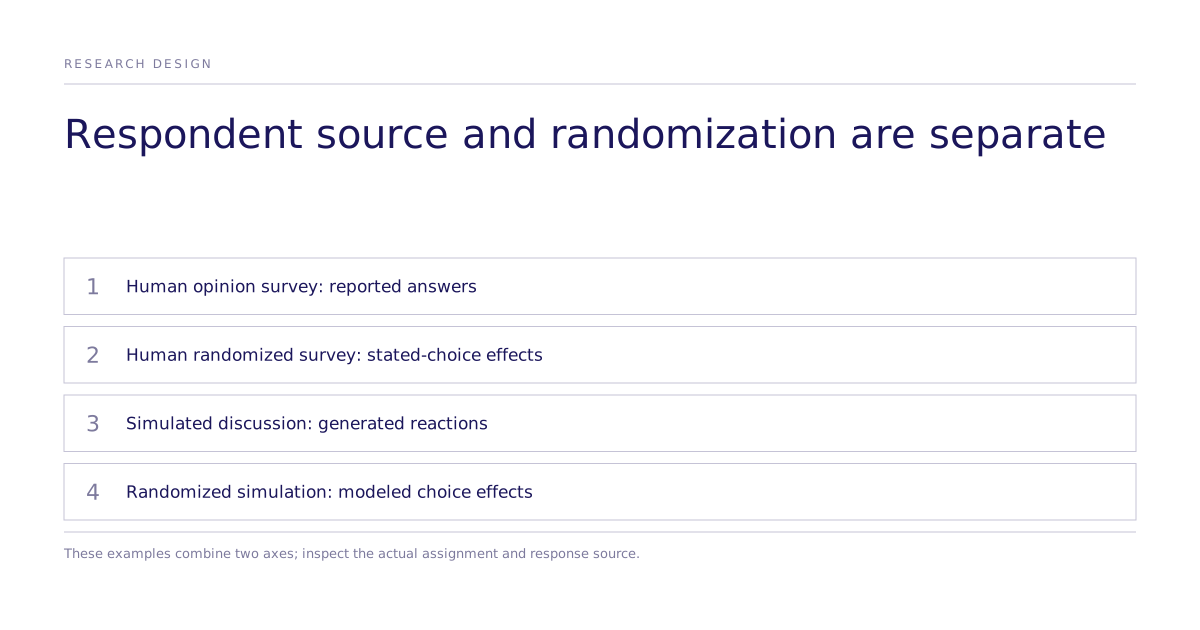
| Approach | What it produces | Respondent source and design | What it does not establish |
|---|---|---|---|
| Unrandomized opinion survey (structured, with AI coding of open answers) | Aggregated answers, themes and counts, with sampling error where the sample supports it | Real respondents; no manipulated alternatives | Which change in an offer would shift choices, or whether a stated preference predicts a purchase |
| Randomized survey experiment (for example a conjoint or monadic test) | Estimated effects of the alternatives on a stated outcome, with confidence intervals | Real respondents randomly shown different alternatives | A realized purchase effect; the result depends on the instrument and the sample |
| Conversational persona panel | A generated conversation or aggregated persona opinion | Simulated personas, usually unrandomized | Whether the persona's answer matches what real people say or do |
| Randomized experiment on a simulated population (Subconscious) | An estimated effect of specified alternatives on simulated stated choice, with uncertainty conditional on the model | Simulated respondents, randomized alternatives | A realized effect in your market until a matched human or live test supports it |
A survey is a collection instrument, not a design. An opinion survey and a persona's answer are both descriptive: they report what was said, not what would happen if the choice were real. A randomized survey with real respondents can estimate effects of alternatives on what people say they would choose. Treating any stated answer as proof that a pricing move, a message, or a launch will work is where the cost of guessing wrong shows up, and treating a descriptive answer as an effect estimate is the more common version of that mistake.
How does a controlled experiment change the answer?
Subconscious runs randomized experiments on a simulated population. For a price point, a feature or a message, the study estimates how each alternative changes simulated stated choice and reports uncertainty that is conditional on the model and the study design. The estimate is a simulated stated-choice effect, not an observed purchase. Where a decision depends on a real-world claim, check the estimate against a matched human study or a bounded live test before committing budget.
The practical difference from an unrandomized survey report or a persona conversation is that the estimate comes from a design that compares alternatives. The replication leaderboard shows the published fidelity evidence, which covers rank agreement on choice parameters across studies and not accuracy for your decision. Who would recruit and field a matched human check, and with what instrument and population, is scoped per engagement in a decision review.
What a controlled experiment does not replace
A randomized simulated experiment is not a substitute for early qualitative discovery. Drafting message variants, stress-testing a rough concept, or exploring an unfamiliar customer segment before a bigger commitment is legitimate work for a fast conversational tool. It is also not a substitute for a structured research program that a dedicated insights team runs for a large, multi-stakeholder study with its own cadence and reporting. Subconscious fits a narrower moment: a specific decision between named alternatives, with capital behind it, that needs an estimated effect and its uncertainty before a human or live test.
Matching the tool to the decision
The right starting question is not which tool is faster or cheaper, but whether the decision is exploratory or a commitment with a measurable cost of being wrong. Early exploration and broad sentiment tracking are reasonable jobs for a survey platform or a persona panel. A pricing change, a launch claim, or a positioning bet that competes for scarce budget calls for randomized alternatives, run on real respondents, a simulated population, or both, followed by a human or live check sized to the risk. For a worked example, book a decision review and bring one pricing or message decision with two or three candidate alternatives.