AI Content Tools vs. AI Persona Panels vs. Causal Experiments: What Each One Actually Proves
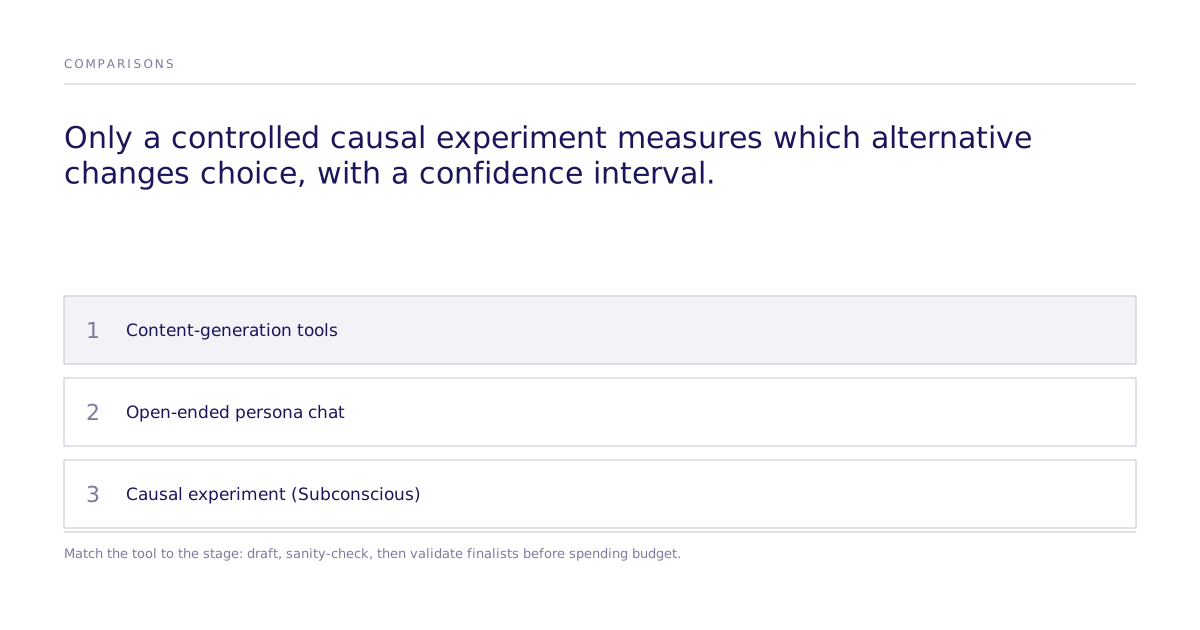
AI content tools prove a draft is on-brand, AI persona panels prove a simulated character can produce a plausible reaction, and only a controlled causal experiment proves a measured effect with a confidence interval on what people actually choose. A marketing or content-ops leader shopping for an AI tool right now is usually looking at one of three different products. One writes copy. One runs an open-ended chat with a simulated persona and returns a plausible-sounding reaction. One runs a controlled experiment against defined alternatives and returns a measured effect with a confidence interval. Only the last one tells you whether a message actually changes what people choose.
Confusing these categories is the expensive part. Shipping content that reads well and got a favorable reaction from a chat persona is not evidence that it will move a target segment's behavior. Without a measured effect, a team can't tell whether the campaign's result was signal or noise, or catch a bad choice before the media budget is spent.
Three tools, three different questions
AI content-generation and copywriting tools answer "how do we produce more on-brand content, faster?" Tools in this category, such as neuroflash, draft blog posts, ads, social copy, and product descriptions in a trained tone of voice, often with integrated SEO and image generation. These tools sit at the production stage of a marketing workflow, and their promise is volume with brand consistency.
Open-ended AI persona chat tools answer "what might this type of customer say about our idea?" A team describes a customer type, chats with a simulated persona, and gets a conversational reaction to a concept, a headline, or a positioning statement. That reaction can be useful for early ideation, but it is one plausible-sounding response, not a measurement. Nothing about the interaction controls for which alternative a defined population would actually choose, and nothing produces a confidence interval.
Controlled causal experiment platforms, which is where Subconscious sits, answer a different question: "which of these specific alternatives changes what our target population actually chooses, and by how much?" Subconscious runs a controlled discrete-choice experiment that compares defined message or positioning alternatives across a precisely specified population and returns a measured causal effect with a confidence interval. Methodology and study results are tracked on the replication leaderboard.
Comparing the three categories
| Content-generation tools | Open-ended persona chat | Causal experiment (Subconscious) | |
|---|---|---|---|
| Primary output | Drafted copy, images, brand-voice text | A conversational reaction from a simulated persona | A measured causal effect with a confidence interval |
| Workflow stage | Production | Early ideation | Pre-launch validation |
| What it tells you | Whether the copy is on-brand and complete | What one simulated viewpoint thinks | Which alternative a defined population would actually choose |
| Evidence type | None, it's the deliverable itself | A plausible-sounding, unmeasured reaction | A controlled comparison with a stated confidence interval |
| What it can't do | Tell you whether the message will land | Measure choice across a defined population | Generate the copy itself |
Why isn't a good reaction the same as a measured effect?
Content that reads well and gets a favorable response in an open-ended chat has cleared a much lower bar than content that has been tested. A chat persona gives one answer, shaped by however that single conversation unfolded; it does not compare alternatives, sample a defined population, or report a confidence interval. A controlled discrete-choice experiment does all three.
That distinction matters most when the decision is expensive to get wrong, such as a positioning change, a new category message, or a pricing frame, because the cost of shipping on the strength of a good-sounding draft or a single favorable chat is a campaign that burns budget on volume without moving the outcome it was meant to move.
Where each tool fits
Choose a content-generation tool if the team's bottleneck is producing on-brand material faster. Choose an open-ended persona chat tool for early, low-stakes ideation where a directional reaction is enough. Choose a controlled causal experiment when the decision is which specific alternative to ship, and the cost of guessing wrong is high enough to warrant a measured answer before launch.
These are not mutually exclusive. A team can draft with a content-generation tool, sanity-check ideas conversationally, and then run the finalists through a controlled experiment before committing budget. Subconscious sits at that last step, not the first two.
What are Subconscious's limitations?
Subconscious does not generate on-brand copy, headlines, or content at scale; that remains a separate category of tool. A causal experiment measures which alternative changes stated choice for a defined population; it does not replace live A/B testing in market, brand voice management, or SEO tooling. When a study calls for it, Subconscious can also validate studies with real human participants, moving from a simulated experiment to real-human validation without changing the causal question being asked.
Teams weighing this decision can see how a controlled study is built at /demo or read more about Subconscious's approach at /about.