AI-Simulated Panels vs. Traditional Surveys: Sequencing a Pre-Launch Research Decision
A pricing tier, a headline, or a launch concept needs a read before it ships. The real choice for a research or growth lead is rarely "AI panel or human survey." It is how much weight to put on a fast simulated result before committing budget, and which questions still need a recruited human study first.
Two Different Sources of Answers
A recruited survey draws answers from real people who were sourced, screened, and paid to respond. An AI-simulated panel draws answers from a language model conditioned on a demographic or behavioral profile, not from a person who actually experienced the product or the price. That substitution explains most of the practical differences between the two methods: what each is fast at, what each gets wrong, and what each can stand behind as evidence.
What Each Method Answers Well
| What you need | AI-simulated panel | Recruited human survey |
|---|---|---|
| Test many concept, headline, or price variants in one sitting | Strong fit; adding a variant is cheap | Each variant needs its own fielded responses |
| Cross-tab by segment, intent, or buying stage | Cuts are cheap to compute, but small segments carry wide uncertainty and many cuts raise the chance of a false finding | Each cut needs its own sample cell large enough for the estimate you want |
| Evidence for a regulatory filing or claims substantiation | Modeled preferences alone do not establish actual human outcomes; check the applicable requirement | Human provenance alone does not establish sufficiency; check design, population and the applicable requirement |
| Sensory, physical, or ergonomic product testing | Not possible; there is no sensory channel | Necessary |
| Tracking the same cohort's attitude change over months | Weak; there is no persistent real behavior to track | A core strength |
| Surfacing a genuinely held but rare opinion | Tends to compress toward the average response | Better at capturing minority views |
| Reacting to very recent events or news | Check dated context, retrieval and supplied audience data, then validate the task | Check field dates, awareness and population coverage |
Generated responses can help explore questions and variants. They do not document an actual person's physical experience or persistent identity; collect direct human evidence when those are the endpoints. For a regulated submission, identify the applicable requirement and model-validation protocol. A recruited survey also needs a suitable instrument, population and design; human provenance alone does not make its conclusions sufficient. Breadth in cuts has a limit on both sides. Before you read a segment result, name the segments in advance, report the uncertainty for each cell, and treat unplanned cuts as hypotheses, whether the sample is simulated or human. A niche cell can be computed quickly and still carry too little information to separate two options.
What Does the Research Support?
The literature on using language models to approximate survey and choice behavior is early and mixed. One study on eliciting purchase intent from language models found that how a question is asked, and whether responses are calibrated against human baselines, materially changes how well the output reproduces real survey patterns (LLMs Reproduce Human Purchase Intent via Semantic Similarity Elicitation of Likert Ratings). Two studies of generated survey answers show where simulated respondents can go wrong. Bisbee and colleagues compared ChatGPT-generated answers with a human survey on political attitudes. The generated answers had far smaller standard deviations, were sensitive to prompt wording, and changed between April and July 2023 under the same prompt (Political Analysis, 2024). Wang, Morgenstern and Dickerson tested four language models against 3,200 human participants across 16 identities and report that the models misportray and flatten identity groups, which matters for any segment cut (arXiv, 2024).
"SSR achieves 90% of human test-retest reliability while maintaining realistic response distributions (KS similarity > 0.85)"
Maier and colleagues, "LLMs Reproduce Human Purchase Intent via Semantic Similarity Elicitation of Likert Ratings" (arXiv:2510.08338, October 2025) (source)
That result comes from 57 personal-care product surveys with 9,300 human participants, so it applies to that task and category. The practical read: naive prompting of a language model for survey-style answers is fragile. Careful elicitation design and calibration against real human data narrow the gap but do not close it uniformly across populations or question types. A third paper, Sfeir and colleagues in the Journal of Choice Modelling (2026), studies something different: whether language models can help an analyst specify and estimate logit choice models (arXiv). It is evidence about modeling assistance, not about simulated respondents.
Where Does Each Method Break Down?
An ungrounded model may miss events after its training cutoff. Retrieval, dated context and supplied audience data can add current information, but their presence does not establish accurate responses. For event-sensitive questions and niche populations, inspect source dates, audience coverage and task-specific validation before relying on the simulated result. A recruited survey underperforms where recruitment quality is hardest to verify: low-incidence populations, fraud and professional-respondent behavior, and self-report biases such as social desirability, satisficing, and primacy effects.
Neither failure mode is a reason to distrust the method generally; both are reasons to match the method to the question.
Is It a Sequence or a Single Choice?
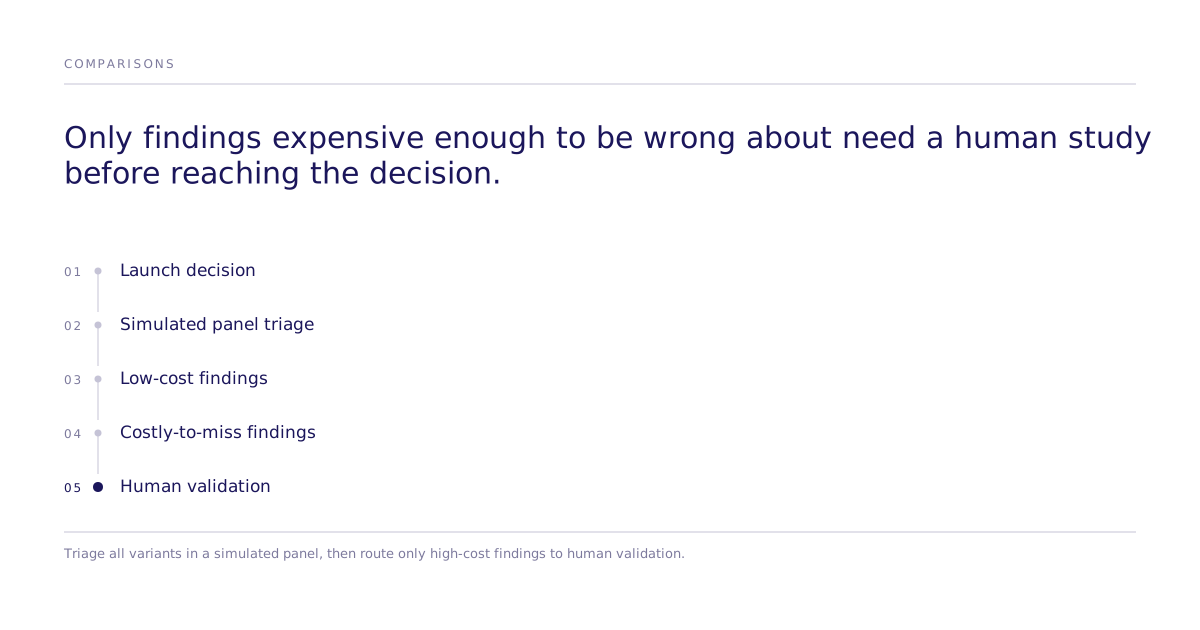
The workable pattern is to triage broadly with a simulated panel, then decide which findings are load-bearing enough to justify a recruited human study before they change a launch, pricing, or messaging decision. Subconscious runs randomized experiments on a simulated population. For a finding that will change a launch, the next step is a matched human check: the same attributes and levels in a human survey, with a respondent sample like the intended audience, planned in advance (research methodology). That matters most for the findings where the cost of being wrong is high enough to need more than a simulated read. A matched human survey tests whether people state the same preference. A purchase claim needs an incentive-compatible purchase, a transaction holdout or a bounded live test.
A simulated panel can also reach audiences a recruited sample would find hard to source. Whether it does so credibly is an empirical question for your segment. Ask any provider for the data behind the audience, the validation for a segment like yours, and the uncertainty. This article does not compare cost, because the two methods have different deliverables and no matched cost basis is published here.
The Buyer's Actual Trade-off
The question that matters is not which method is cheaper or faster in the abstract. It is how many of the small decisions that used to get skipped, because a full recruited study felt too slow or too expensive to justify, actually get tested before they ship. A team that runs more small tests, with sharper hypotheses going into any recruited follow-up study, ends up shipping fewer unaudited guesses than a team that either tests everything with expensive recruited studies or skips testing the small decisions entirely.
Building the Habit of Testing Before Shipping
Teams that treat simulated panels and recruited human studies as a sequence, rather than a single choice made once per project, test more of their real decisions instead of a handful of the biggest ones. Reviewing how a validated study moves from a simulated result to a human-confirmed one is a reasonable next step before committing a launch, pricing, or messaging decision to a single untested read (how it works). To plan that sequence for your own launch, book a decision review.