AI Survey Tools Compared: Real Respondents, Live Sessions, or a Causal Experiment
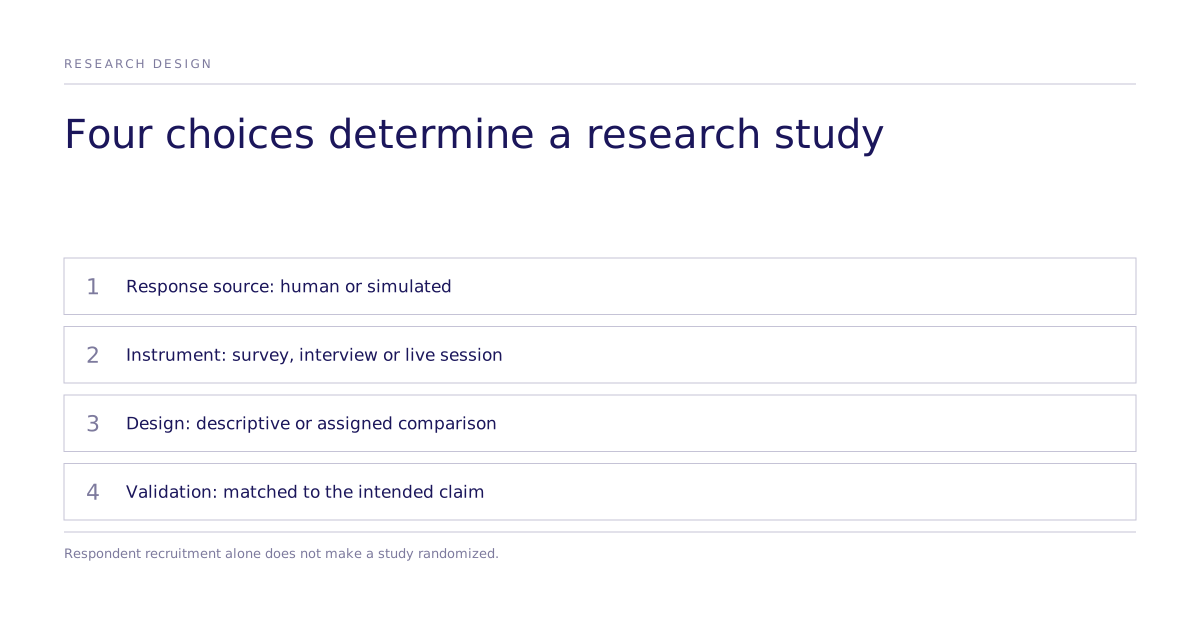
An insights lead choosing a research method is making four separate choices: who answers (real people or a simulated population), what instrument collects the answers (survey, live session, interview), how the study is built (descriptive, or with randomized alternatives), and how the result is validated. The wrong pick wastes budget on an answer to the wrong question. A survey is an instrument, so a survey can be descriptive or randomized. A conjoint survey on real respondents is a controlled comparison of stated choices. A causal experiment on a simulated population is a controlled comparison of simulated stated choices.
The paths, compared on independent axes
| Path | Who answers | Study design | What it settles | What it leaves open |
|---|---|---|---|---|
| Descriptive real-respondent survey | Real people, self-serve or fielded | No manipulated alternatives | What a sampled population reports about preferences today | Which change would shift choices |
| Randomized human survey (conjoint, MaxDiff, monadic test) | Real people | Alternatives randomly shown or traded off | Effects of alternatives on stated choice, with sampling uncertainty | Realized purchases; instrument and sample limits remain |
| AI-moderated live session | Real people, interviewed by an AI moderator | Qualitative, unless alternatives are randomized | Depth and nuance behind a stated preference | Effect size across alternatives |
| Randomized experiment on a simulated population | A simulated population, with randomized alternatives | Randomized comparison | An estimated effect on simulated stated choice, with uncertainty conditional on the model | A real-world effect, until a matched human or live check supports it |
Landscape examples: what each vendor says about itself
These notes come from each vendor's own public pages, read on 2 October 2026. They describe vendor claims, not independent tests, and none is a Subconscious claim. Check each page again before you buy.
- Quantilope: lists 16 automated methods, including MaxDiff, choice-based conjoint, TURF, price sensitivity meter and A/B testing, with access to a panel network and self-serve use. Its conjoint and MaxDiff modules are randomized designs on real respondents.
- Listen Labs: describes an AI moderator that interviews real people from a recruited participant network, or from a customer's own contact list. It is a qualitative, conversation-led method.
- SYMAR (formerly OpinioAI): lists synthetic focus groups and synthetic surveys on persona-based participants. Its pricing page shows a Project plan at €99 or $119 per month and a Program plan starting at €199 or $239 per month, in euros or dollars.
- Aaru: describes scenario testing with segment comparisons and says it validates against real-world outcomes, not only surveys. It cites a median Spearman correlation of 0.90 against the EY Global Wealth Study, a survey of 3,600 affluent investors across 30 or more markets. That is Aaru's stated result for that study. It does not transfer to another task.
- Qualtrics: its choice-based conjoint documentation, checked on 2 October 2026, describes presenting product packages and analyzing respondents' discrete choices. Conjoint is an additional purchase requiring the relevant permissions. Its stated-choice endpoint can support preference and trade-off estimates; check the assignment protocol and held-out validation for the proposed study before making a behavioral claim.
Ask each shortlisted vendor for four comparable items: respondent source, study design, output, and validation on a task like yours. Confirm turnaround and contract terms for that specific study; a category label does not establish either.
What does a randomized simulation answer?
A randomized experiment on a simulated population answers a question that a descriptive survey and a live session leave open: which of two or three specified alternatives the simulated audience favors, and by how much. It does so with simulated respondents, so the result is a simulated stated-choice effect. A randomized human survey answers a similar question with real respondents, and the two can be compared. Subconscious's published fidelity evidence, a July 2026 working paper that is not peer reviewed, reports 0.73 mean Spearman rank correlation on estimated choice parameters across the 43 studies that passed its design filters (causal fidelity paper). That figure measures rank agreement on parameters. It does not validate your study.
To check a result for your decision, run a matched human step: the same attributes and levels in a human survey, a respondent sample like your audience, and a plan for what counts as agreement. For a purchase claim, add a transaction holdout or bounded live test. Who recruits and fields that step is scoped per engagement in a decision review.
What doesn't a simulated experiment replace?
A simulated experiment does not replace a fielded, real-human study when a report must show real-human provenance, or when the question is descriptive. Subconscious does not publish a price list or a ranking of every vendor above.
Where to start: a procurement checklist
Bring one decision to a vendor and ask:
- Who answers: real respondents or a simulated population, and how were they sourced or built?
- How is the study built: are alternatives randomized, and what is the outcome measured?
- What output do you get: a transcript, a topline, or an estimated effect with uncertainty?
- What was it validated against, on which task, and does that match yours?
A sample decision brief: "Should we price the team plan at $29 or $39 per seat, and does the answer differ for companies under 50 employees?" That brief names two alternatives, one outcome and one planned segment cut. Book a decision review to turn a brief like that into a study design, or check the replication leaderboard for how fidelity results are reported.