Another Survey Wave or a Causal Test? Deciding After a Metric Moves
NPS drops eight points. A concept scores low in a tracking wave. Satisfaction dips a quarter after a pricing change. The instinct is to run another survey to explain it. The better question is whether the team already has the measurement it needs, and is missing a test of which specific action caused the shift, and which one would fix it.
What a structured survey program answers
Large-sample survey platforms measure at scale: tracking studies, NPS and CSAT programs, structured comparisons, and statistically significant samples across quarters. Qualtrics's experience-management platform is built around this kind of measurement across customer, employee, brand, and product research, and its survey software is embedded in how enterprise teams collect that data.
That measurement answers "what changed" with precision: how many people rate something a certain way, and whether the movement is statistically significant. It does not, on its own, isolate which action caused the movement. A tracking wave can confirm satisfaction fell after a pricing change and a messaging change happened the same quarter, without saying which one did the damage, or whether a third factor did.
Why doesn't re-surveying the same metric answer why it moved?
Running another wave of the same tracking instrument mostly re-confirms the metric moved. It rarely isolates the cause, because a standard tracking survey isn't designed to hold everything else constant. Teams that re-survey to find "why" usually get a richer description of the same drop: more segments, more verbatims, more confirmation that something changed, not a controlled comparison of the actions themselves.
A team ships a fix based on which explanation sounded most plausible in the verbatims, rather than which action was shown to move the outcome, and finds out at the next tracking wave whether the guess was right.
What does a controlled causal experiment add?
Subconscious is a causal behavioral platform. Instead of re-measuring the same metric, it runs a controlled experiment that holds the rest of the situation constant and tests a specific action, such as a price point, a message, or a packaging change, against alternatives. The output is a causal effect for that action, with a confidence interval where supported, rather than a description of an association.
That reframes the question: not "did satisfaction change," but "does this specific action move the outcome, and by how much, before the team commits budget to shipping it."
Comparing what each approach proves
| Large-sample survey tracking | Controlled causal experiment | |
|---|---|---|
| Question answered | Did the metric move, and by how much, with what statistical confidence? | Does this specific action cause the outcome to move? |
| Evidence type | Structured responses at scale, aggregated over time | A designed comparison isolating one action from the rest of the situation |
| Strength | Statistically rigorous tracking across large samples and long time horizons | Isolates cause from coincidence for a specific decision |
| Where it runs out | Confirms a metric moved without isolating which action caused it | Not built to replace ongoing large-sample tracking or program-level measurement |
| Best use | NPS, CSAT, and brand-health tracking; audit-grade, documented measurement | Deciding whether a specific price, message, or feature change is worth shipping |
Proof and where it stops
The misses sit on the same public record as the hits, next to the study they came from. Our best configuration reaches 87% of the measured human ceiling on one study: 0.832 rank correlation against the published human result, where two independent samples of real humans reach 0.959. Across all 43 studies that pass design filters the mean is 0.73. It is a validation result, not a guarantee for a new market. See the causal fidelity paper. When a decision warrants it, a study built this way can move from a simulated experiment into real-human validation without changing the underlying causal question: the same action is tested against the same design, with recruited participants instead of the simulated panel. Read how a study runs or the published results before deciding what evidence a specific decision needs.
Publishing the boundary of a result is what stops it from being read as more than it proved. That proof point covers replication of causal experiments, not program-level tracking.
Sequencing the two
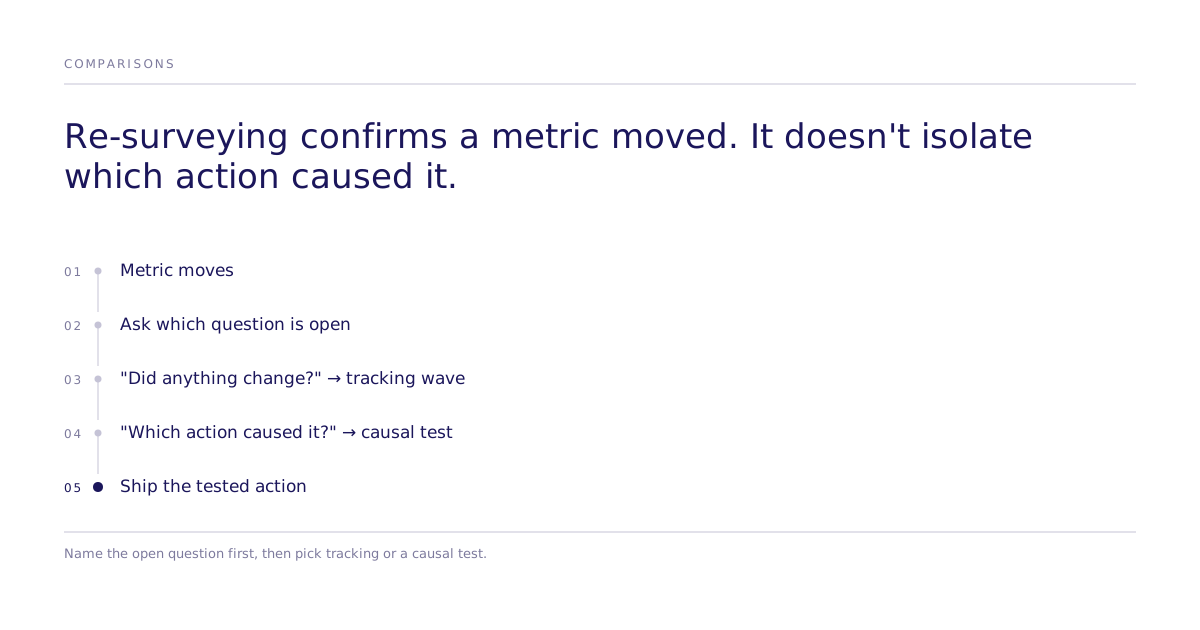
The choice isn't tracking survey versus causal experiment. It's recognizing which question is open. If the open question is "did anything change," the tracking program already answers it. If the open question is "which of these three actions would move the number back," that's the point to stop re-surveying and test the actions themselves.
For a team weighing that next step, book time to walk through what a decision-specific test would look like against the current tracking data.
Limitations
Naming what this platform doesn't do is what lets a buyer check it against their own decision before they rely on it. Subconscious does not manage tracking programs, NPS or CSAT operations, or employee-experience research; those require the audit-grade, longitudinal measurement that large-sample survey platforms provide. Simulated experiments and recruited-participant validation are also distinct steps in the same causal test, not interchangeable descriptions of the same panel.