Audience Profiling or Causal Testing: Choosing Between MRI-Simmons Catalyst and a Causal Behavioral Platform
A consumer insights or brand leader choosing where to spend the next research dollar is solving two problems at once: who is the audience, and which action will change what that audience does. MRI-Simmons Catalyst answers the first question. A causal behavioral platform like Subconscious answers the second. Treating them as competitors instead of a sequence wastes a media budget.
Two questions, not one platform category
"Who should we target?" and "which message, price, or offer moves them?" call for different evidence. Audience-profiling tools describe a population using panel and licensed data. Experimentation platforms compare alternatives under controlled conditions and estimate which one changes a specific outcome.
What is MRI-Simmons Catalyst built to do?
MRI-Simmons positions Catalyst as a consumer audience-profiling and activation platform: it segments and analyzes panel-based consumer data, builds standardized audience definitions, and pushes those audiences directly into advertising and media-activation systems (Catalyst Platform, MRI-Simmons). Its value is the direct path from a defined audience to a running campaign: dashboards, geo mapping, and activation live inside one workflow.
What Catalyst is not built to answer is whether a given message, price, or offer causes a better outcome than the alternative. Profiling tells a team who is in the room. It does not run the experiment that tells them which door they'll walk through.
What is a causal experimentation platform built to do?
Subconscious is a causal behavioral platform: randomized experiments run on a simulated population estimate which action, such as a message, a price point, a bundle, or an audience, is likely to move a defined simulated stated choice, with uncertainty reported where the study design supports it. The starting point is a decision, not a demographic profile: which of these actions should we take? The experiment needs a defined audience as an input, so a profile often comes first.
That distinction matters because a profiled audience can still respond in an unexpected way to a specific claim or price. Profile data describes what a segment looks like; a randomized experiment estimates what changes its stated choices. A real-world effect needs a matched human or live check. See how the method works.
Where the two approaches differ
| MRI-Simmons Catalyst | Subconscious | |
|---|---|---|
| Core question answered | Who is the audience, and how large is it? | Which action changes the audience's behavior? |
| Data foundation | Panel-based consumer data, described by MRI-Simmons as representative of the population it profiles | Randomized experiments on a simulated population, checked against published human studies and, per engagement, a matched human study |
| Primary output | Audience segments, standardized reports, dashboards | Estimated effects of actions on simulated stated choice, with uncertainty where supported |
| Downstream step | Direct activation into advertising and media systems | Informs the message, price, or offer that gets activated elsewhere |
| Evidence and scope to check | Profiling alone does not identify an intervention effect; inspect any proposed testing design | Scope activation deliverables and integrations separately from this modeled choice comparison |
Why isn't this a substitution decision?
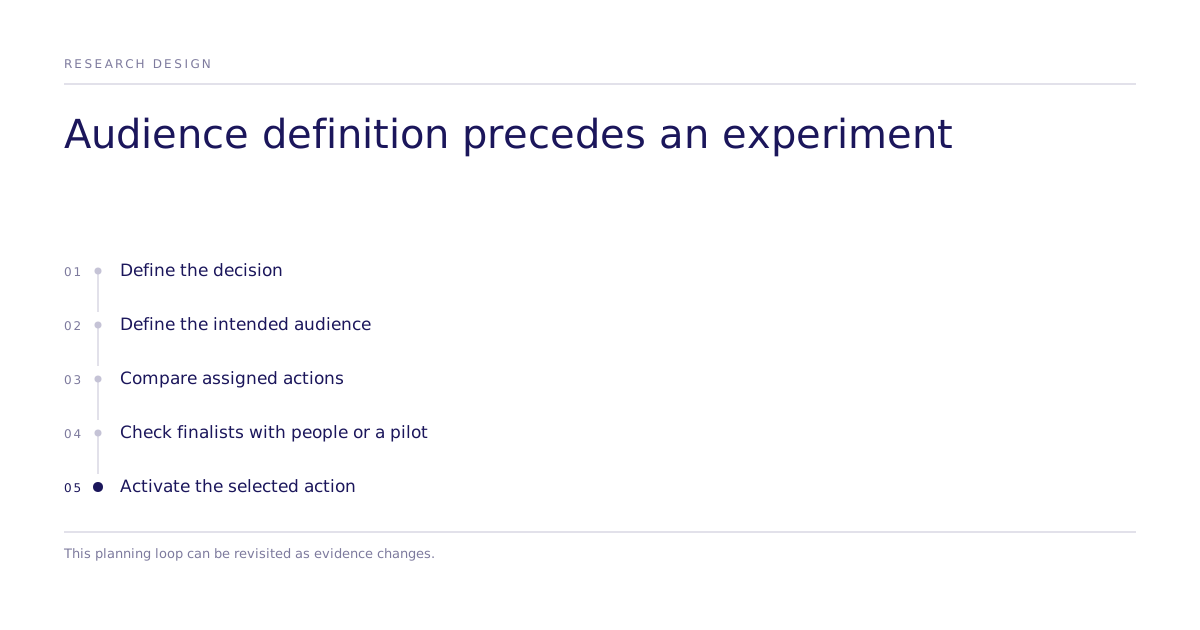
Neither tool replaces the other's job. A team that only profiles skips the test of whether its chosen claim works. A team that only tests actions without profiling has no defined audience for the test and no way to reach the audience it tested. The workflow runs in a loop, not a fixed order. Define the decision. Define or provision the audience the test is meant to represent. Design the test against that audience and compare the candidate actions. Check the finalists with a matched human study or a bounded live test. Then take the chosen action to an audience-profiling and activation platform to reach the people who matter. That sequence reduces the odds a campaign spends against an assumption nobody checked.
The evidence behind the causal claim
Subconscious's published fidelity evidence is a July 2026 working paper, not peer reviewed. It reports a mean Spearman rank correlation of 0.73 on estimated choice parameters across the 43 studies that pass its design filters, and 0.55 across roughly 300 replications. A fidelity score without its limits is marketing, so the limit gets published next to the number. These are rank correlations of parameters against published human studies. They are not an accuracy rate for your campaign, and they are not a guarantee for a new market.
This article makes no claim about security certification or setup time. If your procurement team needs a security attestation, ask for the current report and its scope, such as report type, entity assessed and date. Ask for setup and run times for your own study in a scoping conversation.
Where this comparison has limits
The Subconscious study described here estimates a defined comparison on simulated stated choice. Audience profiling, reporting and media activation need their own input data, deliverables and integration checks. Ask each vendor to document those requirements for the proposed engagement. Subconscious's public site does not currently publish a self-service price list, so cost comparisons require a direct conversation with each vendor. And any regulated or high-stakes decision that depends on formal population statistics still needs a data source built and audited for that purpose; a controlled behavioral experiment is not a substitute for it.
Questions worth asking before you choose
- Do we already know who the audience is, or are we still deciding which claim will work on them?
- Is the immediate need a media-ready audience segment, or evidence for a decision that hasn't shipped yet?
- Would a controlled test of the message or offer change what we plan to activate?
- Does the decision require regulator-grade population statistics, or directional evidence to move faster on an internal call?
See how a study is structured, review published case evidence, or book a decision review and bring the audience definition you already use.