Beyond AI Persona Interviews: Choosing a Method for Consequential Decisions
A research or insights team that adopted an AI persona-interview tool for fast, pre-research hypothesis generation eventually asks a different question: can the same chat transcripts support a budget-level decision, such as pricing, positioning, or a launch call? On their own, the answer is no. Single-persona conversational interviews are built for early qualitative direction, not a measured, segment-level estimate with quantified uncertainty. For a consequential decision, add a design that compares alternatives and an evidence plan for checking the result against people.
What AI persona interview tools do well, and where they stop
Tools in the Synthetic Users category let a researcher define a target user, generate a persona, and question it like a real participant. That focus is the product's strength:
- Quick to launch: pick who the persona represents, build it, and start the questioning.
- The interview format feels natural for product and UX teams already used to qualitative discovery.
- Clear positioning around pre-research and hypothesis generation, before a team recruits real participants.
The same focus creates the limit: a single persona in a single conversation has no built-in comparison group, no sample logic, and no way to quantify confidence. Once the question moves from what a customer might say to which action changes which outcome, for which segment, with what certainty, a conversational interview cannot answer it alone.
Where does population-scale simulation fit, and where does it fall short?
At the other end of the market, Aaru describes population simulation. Its simulation page, read on 2 October 2026, says a study starts from a decision, picks the populations that can affect it, and tests each option with questions. It reports results by audience with cross-tabs, and it says it validates against real-world outcomes and not only surveys. It cites a median Spearman correlation of 0.90 against the EY Global Wealth Study of 3,600 affluent investors in 30 or more markets, which is the vendor's stated result for that study. This article does not state Aaru's price or implementation time, because no dated public offer is available to cite. Ask for a quote and a timeline for your own brief, and compare the actual procurement steps with those of any alternative.
Between interviewing one persona and simulating a whole population, most buyer-level product, pricing, and marketing decisions need a comparison that isolates one action's effect on one outcome for a defined segment. Several categories can provide it, so compare them on separate axes.
The comparison
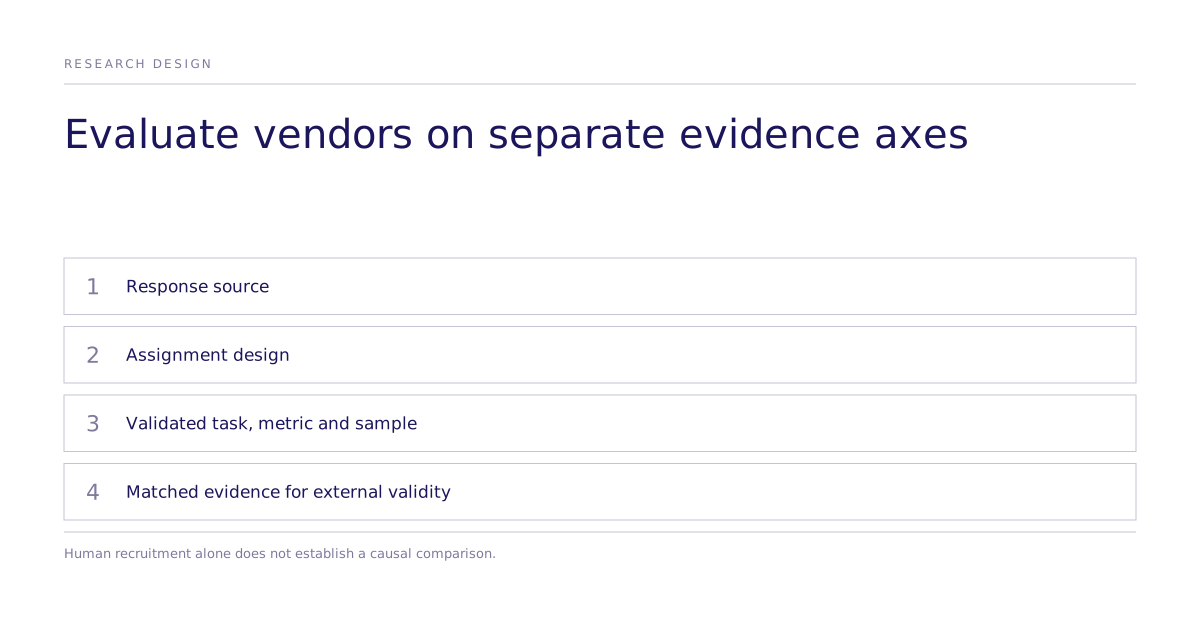
Respondent source and study design are separate choices. Recruiting real people does not by itself make a study randomized, and a simulation can randomize while a recruited study does not. Compare each option on four axes, then ask for validation evidence for your own task.
| Method | Respondent source | Randomized alternatives? | Validated task | External-validity evidence to ask for |
|---|---|---|---|---|
| AI persona interviews (e.g., Synthetic Users) | Simulated persona | No; a conversation | Ask the vendor | Comparison with human answers on a task like yours |
| Population simulation (e.g., Aaru) | Simulated population | Vendor describes scenario tests and audience cross-tabs; confirm the design | Vendor cites validation against survey and outcome data; confirm the task | Matched intervention comparison on your decision |
| Real-participant recruiting (e.g., UserInterviews, Respondent) | Recruited humans | Depends on study design | Depends on study design | Sample quality, fraud controls, and any behavioral follow-up |
| Randomized simulated experiments (Subconscious) | Simulated population | Yes | Rank agreement on choice parameters across published studies (see below) | A matched human or live check on your decision |
Where does a causal test change the answer?
Subconscious runs causal AI experiments: randomized comparisons on a simulation of your market. Once the question is which action changes which outcome, with quantified uncertainty, a randomized experiment is the right design. It compares alternatives and reports an estimated effect on simulated stated choice rather than one persona's opinion. That effect shows which tested action moves simulated choice. It does not by itself explain why real people choose, because randomization does not identify every motive behind a choice. A reason claim needs extra evidence, such as human follow-up interviews or a measured mediator.
The published fidelity evidence is the July 2026 causal fidelity working paper, not peer reviewed. It reports a mean Spearman rank correlation of 0.73 on estimated choice parameters across the 43 studies that pass its design filters, and 0.55 across roughly 300 replications. When a decision needs real-world confirmation, plan a matched human or live check on the finalists, with its own recruitment and instrument. The replication leaderboard shows how results are reported.
Where is a causal test the wrong tool?
An exploratory interview can develop hypotheses and reveal language worth testing. The Subconscious study described here requires defined alternatives and estimates their effects on simulated stated choice. A randomized comparison can evaluate those alternatives once the question is clear, but neither a generated interview nor a simulated experiment establishes real-world transfer on its own.
Choosing the right method
Stick with an AI persona-interview tool for pre-research before recruiting humans, when no segment comparison is needed. Move to a controlled, causal test once the output has to survive a stakeholder asking why real customer behavior might diverge from what one simulated persona said. See how the method works on How it works, or check current results on the leaderboard.
The next step for a consequential pricing, positioning, or launch decision is to book a decision review and scope it against a randomized experiment design, rather than extending a persona interview tool past the job it was built for.