Build a Custom Persona Simulation or Buy a Causal Testing Platform?
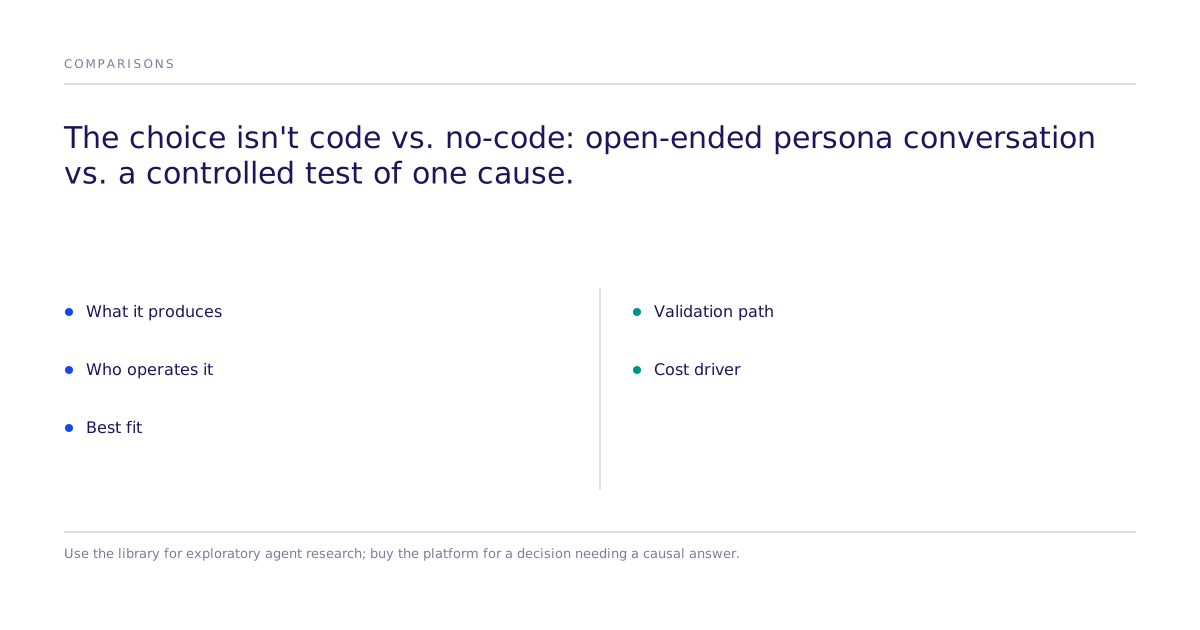
Build a custom persona simulation when the team has engineering capacity for open-ended agent research, and buy a causal testing platform when the goal is a controlled test of which specific action moves a defined behavior. A research, data-science, or product-insights lead facing this choice has a Python library open in one tab and a budget approval form in the other. TinyTroupe is Microsoft Research's open-source, MIT-licensed library for LLM-powered multiagent persona simulation. It gives engineers full programmatic control over agents, environments, and interactions. The question worth asking before either path gets funded is not "code or no-code." It is: does the team need open-ended persona conversation, or does it need a controlled test of which action moves a specific behavior?
What does TinyTroupe answer?
TinyTroupe is infrastructure, not a finished study. A team defines agents, scripts their environment, and interprets whatever the simulation produces. That flexibility fits novel multi-agent dynamics research, population-level scenario modeling, and academic experimentation where the researcher is also the instrument designer. It does not ship a UI, a managed service, or a published validation benchmark, because that is not what a library is for.
What does a managed causal platform answer instead?
A managed platform trades that flexibility for a narrower question: which price, message, or feature change causes the outcome to move. Subconscious runs controlled, randomized experiments rather than open-ended agent conversation, so the output is a comparison a team can act on directly instead of a transcript that still needs interpretation.
The real trade-off
| TinyTroupe (library) | Managed causal platform | |
|---|---|---|
| What it produces | Scripted agent interactions and raw output | A controlled comparison isolating one causal factor |
| Who operates it | Engineers who write and maintain the simulation code | A research, product, or marketing lead directly |
| Best fit | Custom multi-agent research, novel simulation dynamics | A defined buyer decision needing a causal answer |
| Validation path | Researcher-defined; no published benchmark | Simulated result, checkable against real human participants when the decision requires it |
| Cost driver | Engineering time and inference compute | Platform access, not engineering build time |
The comparison is not "product vs. library" in the abstract. TinyTroupe can be pointed at almost any simulation scenario an engineer can code; a causal platform is built to answer one narrower question well: does this change move this behavior, with a result the team can defend.
Where this goes wrong
Naming a failure mode in public is what lets a buyer check for it before it costs them. Two failure modes show up repeatedly. A team builds custom simulation infrastructure on TinyTroupe and, weeks later, still cannot say which action changed buyer behavior, because the library never asked that question. It answers "what happens in this scripted scenario," not "what causes this outcome." The opposite failure is buying a managed tool expecting a randomized experiment and getting directional persona chat instead, which reads like data but does not isolate cause.
What a causal platform does not replace
Publishing what a method cannot do is what lets a buyer check it before relying on it. A randomized causal experiment is not a substitute for engineering-controlled programmatic simulation research, novel multi-agent dynamics work, or academic experimentation. That is TinyTroupe's territory. It is also not a substitute for direct human usability research or engineering judgment about system design. Subconscious does not publish an accuracy benchmark comparable to any figure a competing persona-simulation vendor might quote, and none should be inferred here.
Deciding before committing budget or engineering time
If the team has engineering capacity and the open question is exploratory, "what could happen under these agent dynamics," TinyTroupe is the right tool, and it costs nothing but time. If the question is a specific buyer decision, which price, message, or feature to ship, and the team needs a result it can act on without first building and maintaining simulation infrastructure, that is what a causal experiment platform is for. Reviewing prior test results, reading more on how Subconscious works, or booking a walkthrough are reasonable next steps before either path gets funded.