Conversational Personas, Structured Studies, or Causal Experiments: Choosing an AI-Simulated Research Method
Teams evaluating AI-simulated-participant research tools often compare brand names instead of the underlying method: an ongoing conversational persona, a structured self-serve study, or a controlled causal experiment. Each answers a different question, and picking the wrong one for a high-stakes decision is where the risk sits.
Three methods, three different questions
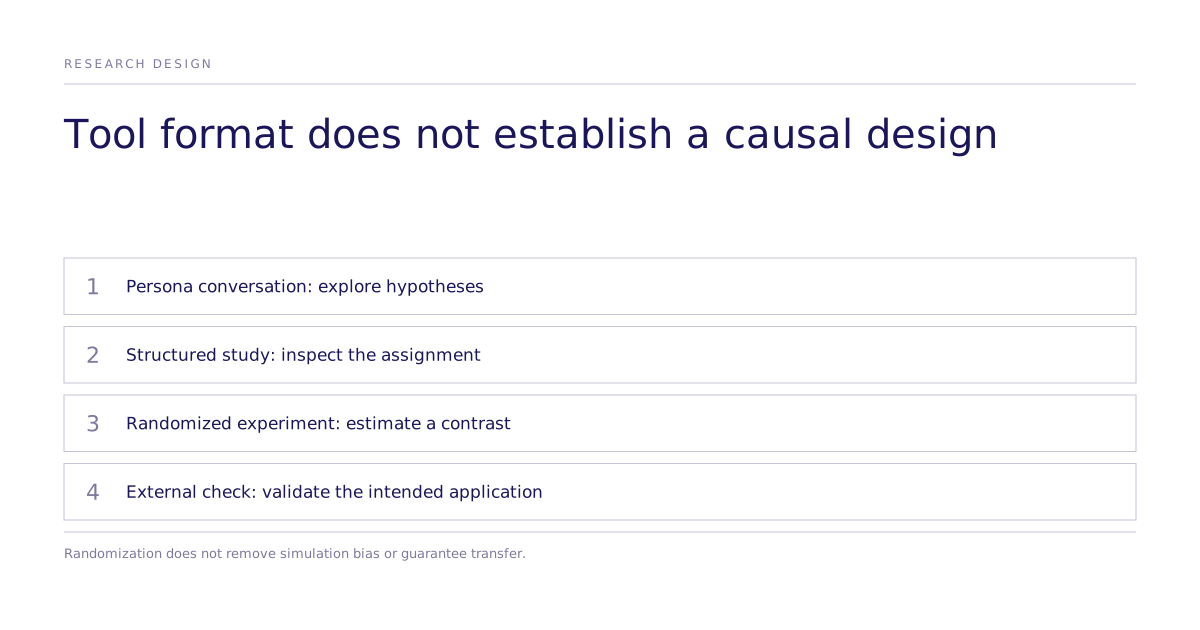
Conversational persona tools let a team build a standing simulated customer and talk to it over time. Marketing, product, and sales can all draw on the same persona. The interaction is open-ended dialogue: follow up on an answer, challenge it, explore a tangent. That makes this approach good at surfacing questions a team didn't know to ask, not at proving what will happen if a specific action is taken.
Structured self-serve study tools work differently: define a research question and participant parameters, run the study, and get back an aggregated output. The workflow mirrors traditional UX or product research, just faster than recruiting real participants. It answers a predefined question well. Delivery format does not decide whether a study is causal. A structured study can randomize alternatives, and one that does not is a descriptive study. Ask which kind of structured study you are buying, who the respondents are, and what outcome is measured.
Randomized experimentation is a third method: a controlled comparison of specific actions, such as a price, a message, a product concept, or a go-to-market move, against simulated buyers, reporting the estimated effect of choosing one option over another on a stated choice. Subconscious.ai is built around this method.
Comparing the three methods
| Dimension | Conversational persona tools | Structured self-serve studies | Randomized experimentation |
|---|---|---|---|
| Interaction model | Ongoing dialogue with a standing simulated persona | Define parameters, run a study, get a report | Randomized comparison of specific actions |
| Best-answered question | Open-ended discovery: what might we be missing? | A predefined research question, answered faster than recruiting | Which specific action performs better in a stated choice, and by how much? |
| Typical output | Qualitative impressions, reusable across teams | Aggregated study findings; effect estimates only if alternatives were randomized | An estimated effect on stated choice, with uncertainty where the design supports it |
| Team reuse | Persona can be revisited by multiple functions | Study is usually specific to one research effort | Experiment design is reusable across similar decisions |
| Validation path | Ask the vendor what it documents | Ask the vendor what it documents | A matched human or live check is planned per decision; ask what a vendor documents |
What's the cost of picking the wrong research method?
The risk isn't using a conversational or study-based tool; it's treating a plausible-sounding synthetic conversation or study output as proof of what real buyers will do. Verian Group, a research provider, published a March 2026 commentary on the limits of AI-generated responses in social research (Verian Group, "Synthetic Sample in Social Research: significant limitations of AI generated responses"). It is a position piece without named authors and without original empirical results, and it summarizes peer-reviewed studies such as Bisbee and colleagues (2024) and Wang and colleagues (2024). Read it as a provider's synthesis of that literature on survey and social-research samples, and check its setting against your own task. A pricing change, a messaging shift, or a campaign built on narrative-level synthetic feedback can ship before the gap between what the simulation implied and what the market actually does shows up.
"From a statistical perspective, if you simply generate a large enough synthetic sample size, every difference becomes statistically significant and thus loses its meaning."
Verian Group, "Synthetic Sample in Social Research: significant limitations of AI generated responses" (source)
That warning applies to a randomized simulation too. Randomization does not remove synthetic bias. The number of simulated respondents is a setting, so a tiny effect can look "significant" if you add enough of them. A useful report therefore leads with the effect size and its uncertainty, states how many simulated respondents the run used and why, and tests whether the finding holds against human data. Conversational and structured-study methods are well suited to open-ended qualitative discovery: figuring out what to ask, or getting fast directional feedback on a concept. The randomized Subconscious study described here starts with a defined decision and alternatives. Exploratory work can help specify those alternatives. Scope study management and persona storage separately, and check the evidence for the intended application before committing budget.
When does a decision need a randomized comparison?
If the decision is high-stakes, such as a pricing move, a positioning change, or a launch decision, a directional impression from a conversation or a single descriptive study isn't the same as evidence that one option outperforms another. That's the gap a randomized experiment closes: it compares defined actions against simulated buyers and reports the estimated effect of the difference.
When the stakes justify it, plan a matched human check of the same comparison. See how a study works. That step replicates the stated-choice comparison with real people. It is not a usability session or a guarantee of market performance, and a purchase claim needs a purchase task, a holdout or a live test.
How do you choose a starting point?
Reach for a conversational or study-based tool when the goal is open-ended discovery or a fast directional read on a defined question. Reach for randomized experimentation when a specific action needs to be compared against an alternative and a wrong call carries real consequences, then confirm the finalists with real participants before they ship. When you evaluate any vendor, ask what validation it documents for its human-check path instead of assuming one exists. Review examples of this method in the replication leaderboard, or book a decision review to talk through a specific decision.