Cultural-Data APIs vs. AI Panels vs. Causal Experiments: Which Research Tool Fits Your Decision
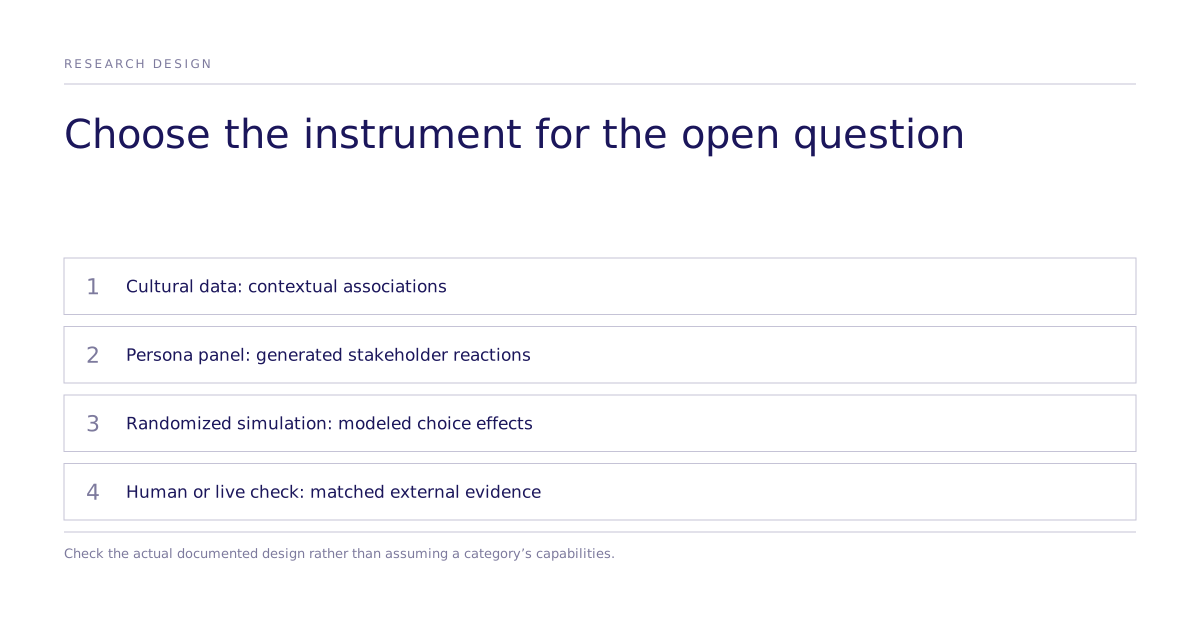
A CMO or VP of insights choosing how to justify a launch, message, or positioning decision usually has three kinds of tools on the table, and they answer three different questions. A taste and preference data API tells you what correlates with what. An AI panel tool lets you interview simulated stakeholders and hear what they might say. A randomized experimentation platform estimates what happens to a stated choice, within a specified simulated population, if you take a specific action. A matched human or live check is what supports a claim about real behavior. Mixing these up is the expensive mistake: treating a correlation or a simulated opinion as proof that a message or launch will move the outcome, then finding out only after the spend is gone.
What a cultural-data API answers
Qloo positions itself as a cultural intelligence layer for AI products. According to its API product page, the platform connects taste and preference signals across categories such as music, film, dining, travel, and brands, and makes that data available through APIs, reports, and data feeds for integration into recommendation engines, personalization systems, and language models. This kind of tool answers "what tends to go with what" for a given audience. It is strongest as an input to a product or model, not as a way to test whether a specific message or launch action will change what someone actually does.
What does an AI panel tool answer?
A separate category of research tool builds interactive AI-generated stakeholder panels: you interview them, run them through surveys, or convene a group discussion to explore reactions to a concept. These tools are useful for early, open-ended exploration, fast directional feedback, and surfacing objections before a message or concept is fully formed. An unrandomized opinion or discussion does not identify the effect of an assigned alternative. A synthetic survey or panel can incorporate random assignment and estimate a contrast inside the model. Whether that contrast transfers to real customers requires matched external evidence; respondent source alone does not establish the design.
Where does a causal experimentation platform fit?
Subconscious.ai sits in a third category. It runs randomized experiments on a simulated population to estimate which action moves a simulated stated choice for a defined decision, such as a message, a price, a product change, or a launch: if we take this action, what changes in the modeled population, and how confident are we.
A fidelity number by itself is marketing until its limits are published alongside it. The published evidence is the July 2026 causal fidelity working paper, which is not peer reviewed. It reports a mean Spearman rank correlation of 0.73 on estimated choice parameters across the 43 studies that pass its design filters, and 0.55 across roughly 300 replications. That is rank agreement on choice parameters. It is not an accuracy rate for your decision and it is not a guarantee for a new market. For a real-behavior claim, plan a matched human or live check: the same attributes and levels in a human study with a sample like your audience, scoped per engagement. How a study works is described on the How it works page, and the published results are on the replication leaderboard.
Comparing the three categories
| Cultural-data API | AI panel tool | Subconscious | |
|---|---|---|---|
| Core question answered | What correlates with what | What might someone say | Which action changes simulated stated choice |
| Primary output | Taste and preference signals for integration | Simulated interviews, surveys, panel discussion | Estimated effect with uncertainty, where supported; a human or live check supports a real-world claim |
| Best fit | Personalization and recommendation systems | Early-stage, open-ended concept exploration | A defined decision with a specific action to test against an alternative |
| Delivery | API, data feed, or report | Interactive research session | Designed experiment on a simulated market |
| Weak fit | Testing whether a specific message or launch will move behavior | Proving a market-level outcome | Broad, undirected cultural or taste mapping |
Limitations to plan around
The Subconscious study described here needs a defined decision, population and actions to compare. It estimates modeled stated-choice effects for that comparison. Cultural data for an API or recommender, and qualitative exploration, require separate data rights, inputs and deliverables. Confirm those requirements with the vendor instead of treating a choice-study estimate as evidence for every workflow. Confidence intervals, segment breakdowns, and other statistical outputs should only be expected where the specific study design supports them.
How do you choose among the three?
If the job is enriching a product or model with cultural context, a preference-data API is the right layer. If the job is fast, open-ended exploration of a concept before it is fully formed, an AI panel tool has a place. If the job is choosing which message, price, or launch action to carry forward before committing budget, that is a randomized comparison, followed by a human or live check before you claim a real-behavior effect. Teams that need to make that call can book a decision review to see how a study is scoped, see the study workflow or the replication leaderboard, or meet the team.