Customer Chatbots, AI Audience Interviews, and Causal Experiments Compared
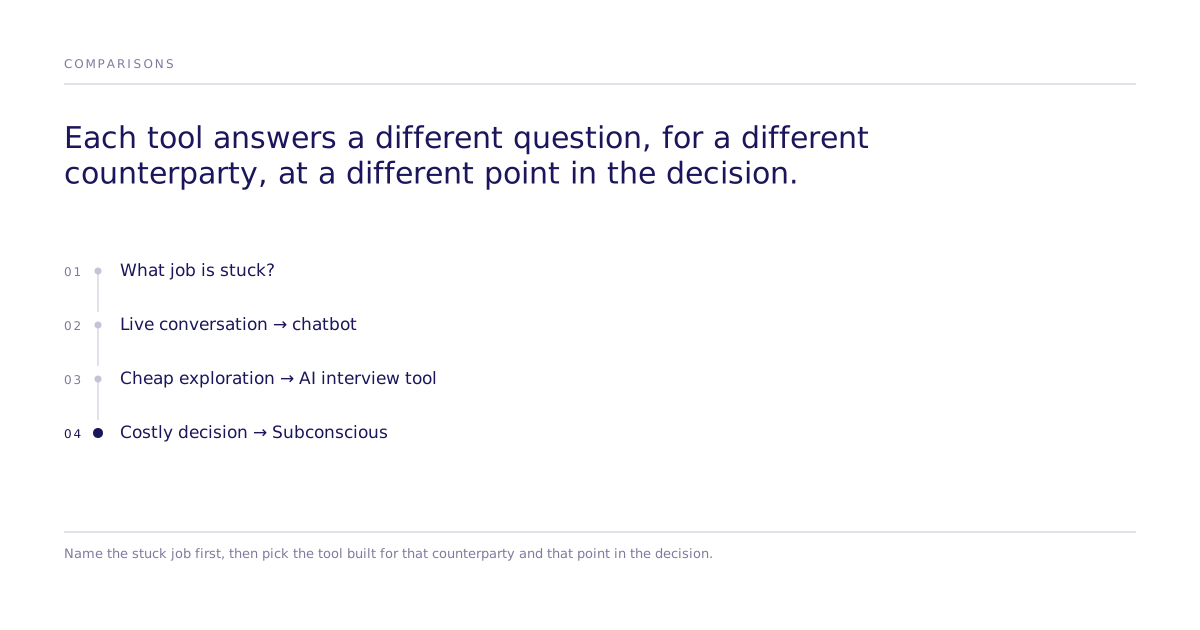
A customer-facing chatbot, a self-serve AI audience-interview tool, and a causal behavioral platform get compared as if they compete for the same budget line. They don't. Each answers a different question, for a different counterparty, at a different point in the decision. The buyer's job is to name which question is actually stuck, not to pick the tool with the bigger category name.
What a customer-facing chatbot does
A chatbot persona builder serves live conversations with your own customers. You configure a brand voice and a knowledge base from product documentation and FAQs, then a deployed bot handles support and sales conversations on a website or messaging channel, in the pattern of a platform such as Makebot. The buyer here already has an operational workflow, usually a support queue, and needs a tool that plugs into it well. The chatbot's value is deflection rate, resolution time, and customer satisfaction on tickets that already exist. Publishing this limit is what lets a buyer check the fit before committing budget. It does not tell a team what to build, price, or say before launch.
What does a self-serve AI audience-interview tool do?
A self-serve AI audience-interview tool lets a team define a target customer profile, brief a structured conversation in plain English, and get directional answers back from a calibrated model in minutes. The counterparty is internal: your team is talking to the tool, not the customer. This is fast, cheap to iterate, and useful for early-stage hypothesis generation. It is not the same as a randomized experiment, and it is not a substitute for talking to real customers when a decision is expensive to get wrong.
What does Subconscious do instead?
Subconscious runs randomized experiments on a simulation of the market to estimate which action, price, message, or launch decision drives a target outcome, before a team commits budget or build time. Subconscious can test or validate studies with real human participants, so a team can move from a simulated experiment to real-human validation without changing the causal question being asked.
The decision that actually separates these tools
Is the job to deflect or answer a live customer conversation, or to decide what to build, price, or say before spending the budget to find out? Buying a support-facing chatbot when the real need is validating a decision before launch leaves the decision unvalidated. Buying a pre-launch research tool when the real need is ticket deflection leaves the support queue backed up.
| Dimension | Customer-facing chatbot | Self-serve AI audience-interview tool | Subconscious |
|---|---|---|---|
| Who is the counterparty | Your customers | Your internal team | Your internal team |
| What it's built from | Product docs, FAQs, brand voice | A described target customer profile | A simulated market, validated against real human behavior |
| What it answers | Customer support questions | Directional, unstructured exploration | Which action causes which outcome, with uncertainty |
| Success metric | Deflection rate, resolution time, CSAT | Speed and cost of exploration | Whether the decision holds up before and after real-human validation |
| Rigor position | Ground-truth on live conversations, scoped to known queries | Directional; useful for generating better questions | Causal experiment, extendable to real-human confirmation |
| Best fit | High-volume support with a stable FAQ | Early hypothesis generation before a decision is expensive | Product, pricing, messaging, or launch decisions before commitment |
When is a chatbot the right call?
A customer-facing chatbot fits when the team has a high-volume support queue, a stable FAQ, clear deflection ROI, and someone with the standing to set how an AI surface talks to customers on the brand's behalf.
When a causal experiment is the right call
A causal experiment fits when the cost of guessing wrong on a product, pricing, messaging, or launch decision is high enough that a team needs an estimate of which action drives the outcome, not just a directional read. Run the experiment, then extend the same causal question to real-human validation when the decision warrants it.
Where a directional AI interview tool still helps
Naming where a tool stops is what keeps the recommendation checkable. A self-serve AI audience-interview tool remains useful upstream of both of the above: for generating hypotheses and rough concepts cheaply before deciding which question deserves a full causal test or real-respondent fieldwork.
The bottom line
Match the tool to the job, not the category label. A support queue needs a chatbot. Early-stage hypothesis generation can use a directional interview tool. A decision that is expensive to get wrong needs a causal experiment, with a clear path to real-human validation when the stakes justify it. See how Subconscious runs that experiment, or talk to the team about a specific decision. Learn more about Subconscious.