Customer Research Platforms vs. Sales Roleplay Tools: Picking the Right Category
Customer research platforms run causal experiments to predict buyer response before launch, while sales roleplay tools simulate prospects so reps can practice calls, and the deciding factor is whether the open question is buyer behavior or rep performance. "AI that simulates people" covers two different jobs. One category simulates prospects so sales reps can practice a call. The other simulates customers so a marketing, insights, or product team can test a message, price, or feature before it ships. Confuse the two and you buy the wrong tool.
The question that actually decides which category you need
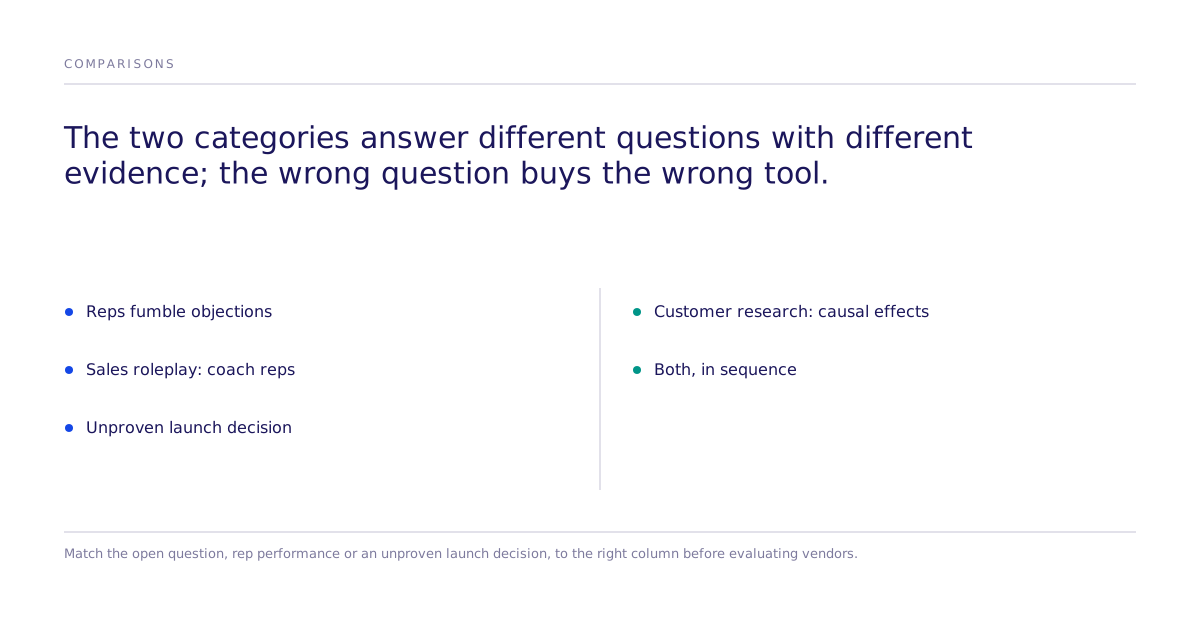
Is the problem "our reps fumble objections and take too long to ramp," or is it "we are about to spend budget on a launch and do not know how buyers will respond"? The first is a sales-enablement question. The second is a market-research question. They require different tools, different buyers on the team, and different evidence.
What does a sales-roleplay tool do?
Tools built for rep coaching, such as Pitchbase, put a synthetic prospect on a call with a rep. The rep picks a scenario (cold call, discovery, demo, objection handling, close) and practices in real time while the system scores structured coaching feedback per call. It does not answer whether a market will respond to a given message or price.
What does a customer-research platform do?
A causal behavioral platform runs controlled experiments on synthetic populations to estimate how buyers would respond to a specific messaging, pricing, or positioning choice, before a team spends budget on it. Subconscious.ai runs this class of experiment (discrete choice experiments, mixed logit, and ICLV) and returns causal effects with confidence intervals rather than a simulated conversation. See the replication leaderboard for the methodology and the replication-accuracy evidence.
Where the cost of picking wrong shows up
A team that evaluates a rep-coaching tool to answer a go-to-market question gets conversational practice reps, not a causal read on how real buyers would respond, so the launch decision still gets made on guesswork. Naming the wrong-fit case up front is what lets a buyer check it before purchase. A sales team that tries to use a customer-research platform to drill call handling gets aggregate insight reports, not real-time per-rep coaching feedback.
Matching the need to the category
| Need | Category |
|---|---|
| Train reps on objection handling and call structure | Sales roleplay / coaching |
| Reduce ramp time for new sales hires | Sales roleplay / coaching |
| Test campaign messaging before launch | Customer research (causal) |
| Run synthetic panels for product or brand research | Customer research (causal) |
| Stress-test a pricing change | Customer research (causal) |
| Pre-test a discovery call script across many buyer profiles, then drill the resulting objections with reps | Both, in sequence |
Where does Subconscious fit, and where does it not?
Subconscious answers the customer-research side of this split: whether a message, price, or feature lands with a defined buyer population, with a causal effect and a confidence interval. It does not offer sales-rep coaching, voice-based call simulation, or per-rep performance scoring. A team running both jobs needs a tool from each category, not one stretched across both.
Keep audience reach and validated human research distinct
Reach and validation are different claims, and each gets stated on its own terms here rather than folded together. A synthetic panel's breadth (how many segments or profiles it can cover) is not the same claim as recruited real-human validation. When a launch decision is high-stakes enough to warrant it, a team can move from a simulated discrete choice experiment to real-human testing without changing the underlying causal question. See /how-we-work for how that step fits the same experimental design. Simulated output on its own does not replace validated human research; it narrows what is worth validating.
Next step
If the open question is "are our reps handling objections well," that is a sales-coaching evaluation, outside what a causal research platform is built for. If the open question is "will this message, price, or feature land before we spend budget on it," book a demo to see how a controlled discrete choice experiment answers that with a causal effect and a confidence interval.