Hire a Bayesian Expert or Buy On-Demand Access? A Buyer's Decision Framework
A head of analytics who needs Bayesian or causal-modeling depth for marketing mix modeling, customer lifetime value, or causal inference is choosing between two paths: put a specialist on payroll full-time, or line up expert input for the moments it's actually needed. Before hiring, compare recruitment and onboarding lead time, employment cost and the candidate's expertise with the workload the role must own. Defer expert input entirely and the team risks shipping unvalidated models, missing a governance deadline, or facing stakeholders who reject results it can't defend.
What does a Bayesian expert actually do?
This role builds models that express uncertainty as a range of plausible outcomes rather than a single number. Day to day, the work spans:
- Designing prior distributions grounded in domain knowledge, not arbitrary guesses
- Building hierarchical models that pool information across regions, products, or segments without letting any one dominate the fit
- Running Markov Chain Monte Carlo (MCMC) sampling and diagnosing failures like divergent transitions and poorly mixing chains
- Checking prior implications before fitting, then evaluating fitted models with posterior predictive checks and held-out data
- Turning probabilistic results into budget allocations, policy thresholds, and go/no-go decisions
Assess the statistical, software engineering and domain skills required by the proposed workload. Ask a candidate to explain a relevant model, its diagnostics and how it was maintained.
Common applied problems teams bring to this expertise:
- Marketing mix modeling (MMM). Isolating how much revenue each marketing channel drives, factoring in carryover effects, saturation curves, and diminishing returns.
- Customer lifetime value (CLV). Combining purchase frequency, average order value, and churn probability into a forecast of a cohort's long-term revenue.
- Causal inference. Measuring what an intervention actually caused, a price change, a launch, a policy, with no randomized experiment to lean on, through quasi-experimental designs like difference-in-differences, regression discontinuity, and matched synthetic controls.
- Demand forecasting. Building time series models that carry uncertainty through, so planners work from a range of outcomes instead of a single guess.
- A/B test analysis. Swapping p-value-based testing for Bayesian updating, which supports sequential analysis and states a treatment effect's probability directly.
What should a specialist hire cover?
Relevant modeling and deployment experience. Ask for examples using PyMC, Stan, NumPyro or another suitable framework. Inspect how the candidate handled diagnostics, validation and production ownership for a problem comparable to yours.
Recruitment and onboarding lead time. Estimate that lead time from your own hiring pipeline, then compare it with the work that needs specialist review this quarter.
The breadth the workload requires. Compare each candidate's statistical, domain and engineering experience with the model's requirements. Identify specialist support still needed for causal identification, time series, software operations or another specific gap.
What does on-demand expert access look like?
On-demand Bayesian consulting gives a team access to experienced practitioners for recurring questions. PyMC Labs Expert Access is one vendor example. Check the contracted scope, response arrangements, practitioner availability and ownership of model code before comparing its cost with a full-time role.
Expert input matters most at five recurring moments:
- Before a critical deadline. Compare the planning, governance or launch deadline with the availability and onboarding of each staffing option.
- When model diagnostics fail. Ask the practitioner to investigate divergent transitions, poorly mixing chains or unexpected posterior behavior using the actual model and run diagnostics.
- When extending an existing model. Adding a channel, a time-varying component, or lift-test results raises structural questions about architecture, priors, and validation. A wrong early call compounds into technical debt that's costly to undo later.
- When stakeholders push back on the methodology. Executives and reviewers frequently question probabilistic outputs, especially when they conflict with simpler attribution methods.
- When one model needs to grow into a full measurement program. Going from a single build to a multi-channel, production-grade framework is a fundamentally different problem than the initial build.
Hire vs. on-demand access, side by side
| Full-time hire | On-demand expert access | |
|---|---|---|
| Time to first value | Estimate search and onboarding from the hiring pipeline | Confirm practitioner availability and onboarding under the contract |
| Cost structure | Salary, benefits, and overhead | Contracted subscription, retainer or project fees; check included scope and overages |
| Depth of expertise | One specialist's background | Confirm which practitioner backgrounds the contract covers |
| Continuity | Assign model ownership, documentation and handover duties | Confirm practitioner continuity, availability and handover in the contract |
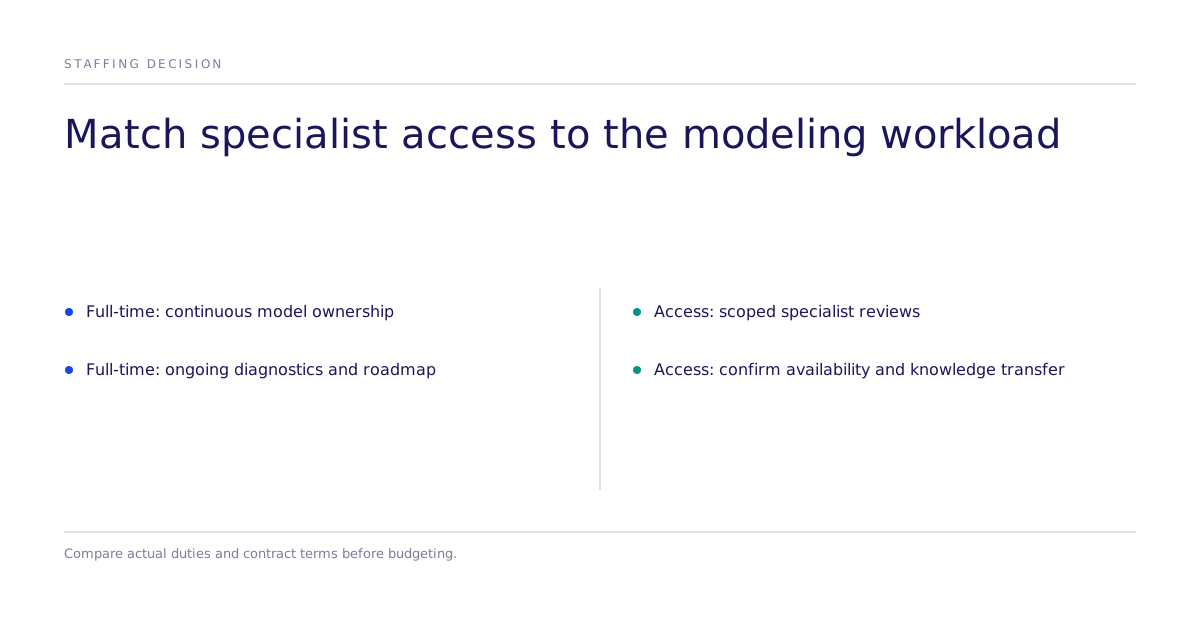
| Best fit | Constant, core-function modeling need | Episodic moments: deadlines, diagnostics, scaling |
| Main risk | Skills or availability do not match the ongoing workload | Contracted access or change terms do not cover the required work |
There's no universal winner. A team that treats Bayesian modeling as a core product function, shipping weekly against a dedicated modeling roadmap, will likely need a full-time hire eventually. A team that leans on Bayesian methods for quarterly planning, is building its first MMM, or just needs expert review ahead of a governance deadline is usually better served by on-demand access.
Where a causal experiment fits into this decision
List the models your team must maintain and the decisions each model supports before committing to a hire or an access contract. An existing MMM with weekly diagnostics needs a different owner from a one-off comparison of two proposed prices. For the latter, a scoped experiment may answer the outstanding question; it does not remove the need to maintain forecasts, data pipelines or production models.
Subconscious's study methodology describes randomized comparisons on a market simulation. If that fits one of your decisions, specify the alternatives, simulated choice endpoint and human confirmation needed. Keep that study separate from the staffing assessment.
Limitations of this framework
This comparison stays a decision framework, not a benchmarked cost-benefit analysis. This article supplies no independent comparison of time-to-value or outcomes between hiring a specialist and buying on-demand access. Estimate recruitment and onboarding time from your own hiring pipeline. Check which of the five review needs above are covered by the proposed expert-access contract.
Next step
Map the modeling workload, delivery dates and long-term ownership first. Ask an expert-access supplier what its contract covers, then compare that scope with the duties of a full-time specialist. For a discrete product, price or message decision within that workload, book a decision review with the alternatives and evidence already available.
Bayesian and causal-modeling methods referenced here, including PyMC-based marketing mix modeling, follow the open-source PyMC-Marketing documentation.