Persona Library vs. Persona Builder vs. Causal Experiment: Choosing Before You Spend
A research or CMO lead comparing AI persona tools answers one question: does a synthetic-character chat tell you enough to ship a launch, a price change, or a message, or does the decision need an experiment? Two vendor categories dominate this market, and neither answers that question on its own.
What are the two persona-platform categories?
The first category sells breadth: a large pre-built library of synthetic characters tuned to standard demographic and psychographic segments, queried like a lookup table. Ask a question, get responses across many segments at once.
The second category sells specificity: a builder where you define a character's job, industry, attitudes, and context by hand, then hold a conversation with it. The pitch is a narrow, unusual buyer persona that a fixed library was never going to contain.
Both categories share a limit that neither markets loudly: the output is generated text from a language model, shaped by whatever the operator configured or the library curated. It reads as confident regardless of whether it reflects how real people behave.
Where that limit becomes expensive
Evaluation work on using large language models for choice modeling found that prompting strategy and model choice materially change the answers, and that current models show systematic gaps against real preference data (arXiv, 2026). Separate research comparing predictive and generative fidelity in cognitive models found that generating plausible-sounding behavior is not the same as predicting what a specific population will do (Nature, 2026).
Neither a wide persona library nor a hand-built conversational persona resolves this. A team that treats a confident transcript as decision-grade evidence, without checking it against a human baseline, is trusting the artifact, not the market, and the gap surfaces after the budget is spent.
What is the causal experiment option?
A different approach starts from the decision rather than the character. Instead of asking a synthetic persona what it thinks, Subconscious runs a randomized experiment on a simulated population: it varies one thing at a time, such as a price, a message, or a feature, and measures the causal effect on what the buyer cares about, with a confidence interval attached.
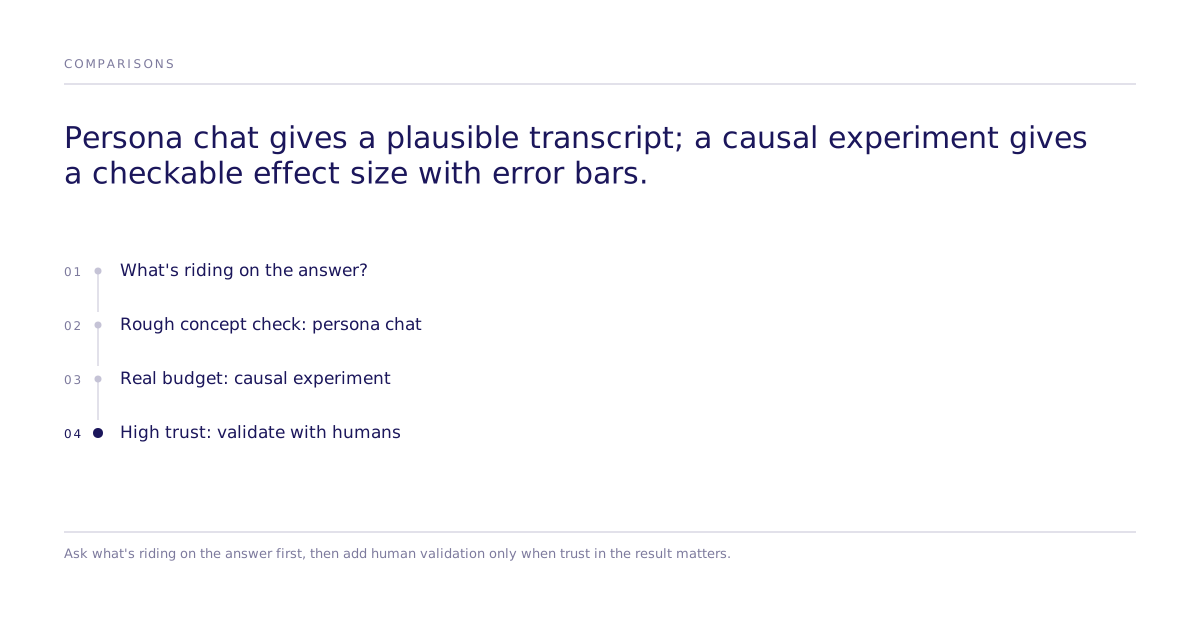
The practical advantage over a persona chat: the question is structural, not conversational. "Which of these two messages moves purchase intent, and by how much" is a different kind of claim than "here is what this persona said when asked." One produces a number with error bars; the other produces a plausible transcript.
When the decision depends on trust, the same experiment design can move from a simulated population to real human participants without changing the causal question. Subconscious can test or validate studies with real human participants, so the check lands on the answer, not on a redesign of the study.
What each approach is actually for
| Pre-built persona library | Custom persona builder | Causal experiment | |
|---|---|---|---|
| Best for | Fast directional read across known segments | A specific, unusual buyer type not in any library | A decision with real budget behind it |
| Setup effort | Lowest, query an existing library | Moderate, configure the persona by hand | Highest, define the causal question and design |
| Output shape | Aggregated responses across segments | Open-ended conversation transcript | Effect size with a confidence interval |
| Failure mode if unchecked | Generic averages mistaken for your specific buyer | Confident-sounding chat mistaken for market signal | Requires more setup than either persona tool |
| Validation path | Not typically offered | Not typically offered | [Same question, real human participants](/#why-it-works) |
Limitations to hold onto
A causal experiment is not the right tool for every question. Fast, low-stakes exploratory conversation, sanity-checking a rough concept before it is worth formalizing, is what persona chat tools are built for; a full experiment design at that stage is overkill.
Real-human validation is a service run on a specific study, not a standing panel of recruitable people. Keep that distinct from the audience reach Subconscious can draw on for study design: a person-level audience graph covering 800 million real people is not the same claim as an on-demand panel of participants.
Real-human validation also does not turn a causal experiment into a usability session or a clinical trial. It checks that the causal answer holds against real behavior, nothing more.
The next question to ask before choosing
Before comparing persona platforms on price or library size, ask what's riding on the answer. If it's a rough concept check, a persona chat is proportionate. If real money follows the decision, ask whether the tool in front of you was ever checked against real people, and what it would take to run that check before, not after, the spend is committed.