Prolific or a Controlled Choice Experiment: What Each Choice Proves
Prolific and Subconscious solve different parts of a research decision. Prolific supplies recruited human participants. Subconscious runs controlled choice experiments on generated responses, and a matched human study of the same question can be scoped separately. Choose based on what the study must establish.
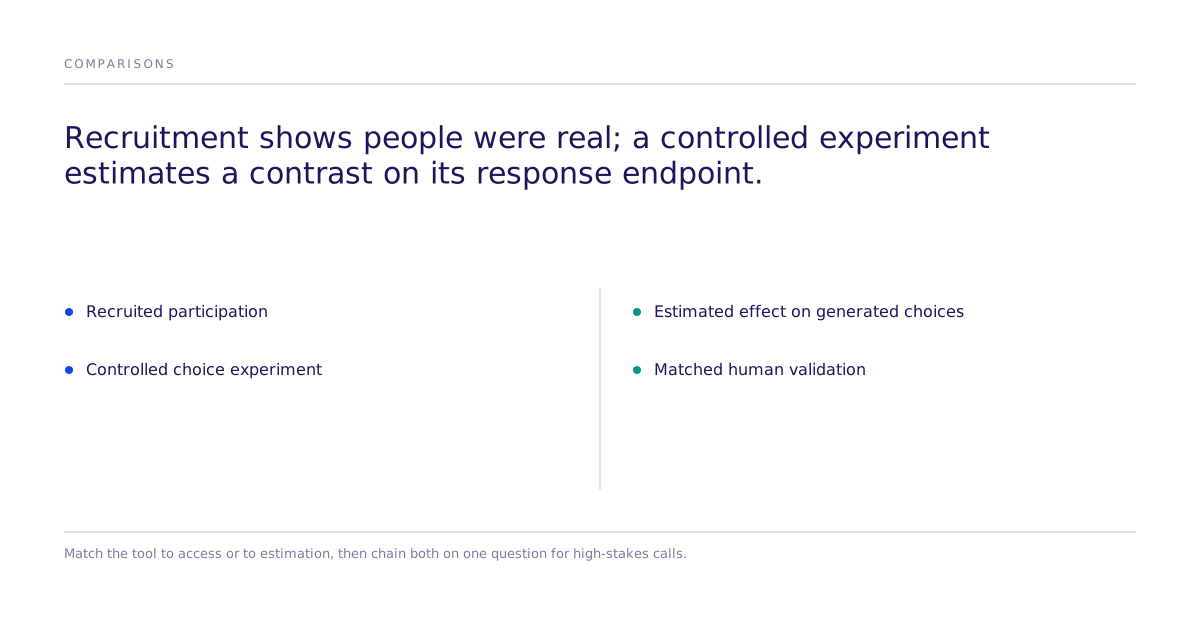
First decide whether the constraint is access or inference
Use a recruitment platform when the immediate need is access to real people for a survey, task, or experiment. Prolific describes its service as recruiting research participants for human data collection (Prolific: participant recruitment).
Use a controlled choice experiment when the harder question is causal: which change in price, message, feature, or concept changes the measured choice response, and by how much? Subconscious runs randomized discrete choice experiments on generated responses. An estimator such as Mixed Logit is a separate analysis step, and its intervals depend on the model and design. A randomized design separates the tested action from background variation instead of treating a plausible reaction as decision evidence.
These choices can be combined. A team can define the causal question once, test it in simulation, and validate it with real people before committing a consequential decision.
Is the evidence from both methods equivalent?
A recruited sample establishes that real people supplied the observations. Recruitment alone does not determine whether the study isolates a causal effect. That depends on the experimental design, assignment, comparison conditions, and analysis.
A simulated experiment can compare many controlled alternatives against a specified audience. Simulation alone does not establish that the effect will replicate in real people. Confidence intervals describe uncertainty inside the experiment. A real-human validation step tests whether the result survives outside it.
The practical buyer question is two-part:
- Does the study require direct human participation from the start?
- Does the decision require a causal estimate that will be checked against real-human evidence?
Compare the research roles
| Decision point | Recruited human participation | Controlled choice experiment with real-human validation |
|---|---|---|
| What is being procured? | Access to people who complete a survey, task, or experiment | A causal study design, simulated experiment, and validation path |
| What does it establish? | The observations came from real people | The tested action changed generated choice under controlled conditions, with model-conditional uncertainty reported |
| Strong fit | Human-subject data collection and tasks that require direct participation | Pricing, messaging, feature, and concept decisions where the effect of a specific change matters |
| Main boundary | Recruitment does not by itself make a study causal | Relevant human validation can check human elicited choices; validated stated choices still do not establish market performance |
| How the methods connect | Recruited participants can supply the validation evidence | The causal question remains consistent from simulation through validation |
Stakes determine the sequence
For a low-consequence exploratory question, direct recruitment may be enough if the team needs reactions from real people and does not need to estimate the effect of a controlled action.
For a price change, campaign, or product concept that is expensive to reverse, the safer sequence is to define the action and outcome, randomize the alternatives, estimate the effect with intervals that depend on the model, and validate the same causal question with real people. This addresses the core failure condition in simulated research: a convincing result that has no holdout or replication evidence before budget is committed.
Subconscious can run a controlled choice study with generated responses, then plan a recruited human study of the same alternatives and causal question. Disclose modeled population provenance separately from human recruitment. A synthetic population does not establish access to a recruitable participant pool.
What cases need a different research method?
This workflow is not a substitute for an observed usability session, task-performance study, clinical trial, or any process whose validity depends on direct human behavior under its own protocol.
It also does not prove market performance automatically. A replicated preference effect is evidence about the tested choice under the study conditions. Launch conditions, distribution, competition, and execution can still change the commercial result.
The procurement rule: buy participant access when direct human participation is the requirement. Use a controlled choice experiment when the business decision depends on identifying the effect of a specific action. Pair the two roles when the consequence of a wrong answer justifies validation before the decision ships.
Review the research basis, see how a controlled study is run, examine case evidence, or discuss a specific decision.