A Quick Persona Draft vs a Tested Decision: Choosing the Right Tool
A persona sketch from an in-browser writing assistant is fast, but speed is not evidence. Before greenlighting a positioning, messaging, or pricing change, the real question is whether that sketch is grounded in anything tested, or whether it just reflects whatever pattern the underlying model defaults to.
What the two tools are actually built for
Voilà is an in-browser AI writing assistant that surfaces inside email, docs, social, and CRM tools to draft messaging, summarize text, and sketch quick persona profiles on the fly. It is a general productivity assistant, not a research or experiment platform.
Subconscious is built for a different job: testing a specific product, pricing, or messaging action against a defined buyer population before a team commits budget to it, using a randomized experiment run on a simulation of that market and checked against real human behavior.
Neither tool is a worse version of the other. They answer different questions.
Why is one generated persona sketch not decision-grade?
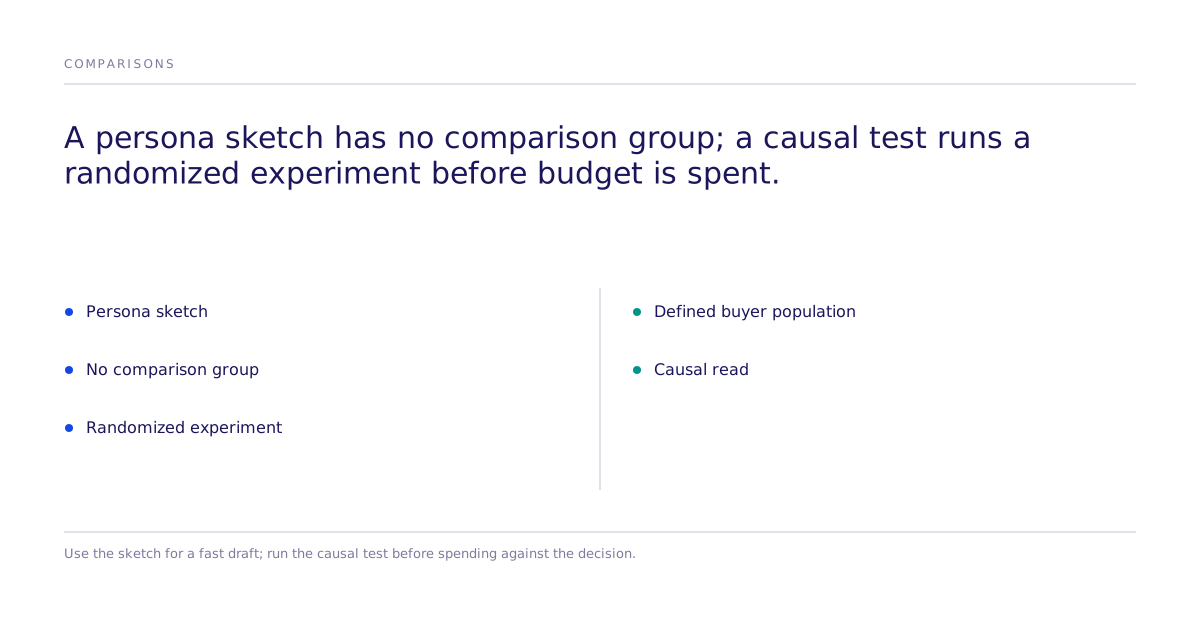
A single persona produced by a general-purpose assistant reflects one pass through a language model, with no comparison group and no check against how real people actually respond. Published 2026 reliability research on persona-conditioned language models documents demographic flattening and reduced response variance when models are asked to stand in for a population: the generated respondents cluster around a narrower, more "average" answer than the people they are meant to represent (Assessing the Reliability of Persona-Conditioned LLMs as Synthetic Survey Respondents, ACM Web Conference 2026 Companion Proceedings). A companion study on when digital personas can reliably approximate human survey findings reaches a similar caution about treating one generated profile as a stand-in for tested demand (When Can Digital Personas Reliably Approximate Human Survey Findings?, arXiv).
That is the gap that matters for a positioning or pricing call. A persona sketch can help a team draft copy faster. It cannot tell them whether the message actually moves the buyer, because there is no test built into producing it.
How does a causal test close that gap?
Subconscious runs a randomized experiment against the actual action under consideration, such as a specific price point, message, or launch decision, across a defined buyer population, rather than generating one profile and treating it as representative. The output is a causal read on which action moves the outcome, with the comparison built in from the start instead of added afterward.
A simulated result stated without its validation step is a marketing number. When the decision calls for it, a team can move from that simulated experiment to a real-human validation check without changing the question being tested. Whether that extra step is worth taking depends on the stakes: a wrong call has to be expensive enough to earn it. For a routine positioning draft, the simulated read is usually the point where the team already has enough to decide.
Where each tool fits
| Voilà | Subconscious | |
|---|---|---|
| Core job | Draft persona sketches and messaging copy in-browser | Test a specific decision against a defined buyer population |
| Output | A written profile or content draft | A causal read on which action moves the outcome |
| Built-in comparison | None; one generation, one answer | Yes; the experiment compares actions by design |
| Best fit | Fast first drafts inside an existing workflow | A decision worth the cost of being wrong |
| Not built for | Testing whether a message or price actually changes buyer behavior | Quick in-context copywriting |
What Subconscious does not do here
Naming what a tool does not do is what lets a buyer check the fit before they commit budget. Subconscious is not a browser extension or an in-workflow writing copilot. A causal test still needs a defined decision, a defined audience, and a comparison set before it can run; it does not replace real-human validation when a decision calls for it, and it does not produce a persona sketch as a standalone deliverable the way an in-browser assistant does. Teams that want both, a fast draft for internal alignment and a tested read before spending against it, typically use each tool for what it is built for.
Which tool should you reach for?
Reach for an in-browser assistant like Voilà when the job is a fast first draft, a messaging idea, or a persona sketch to align a team internally, and nobody is about to spend budget on it yet.
Reach for a tested decision when the next step is shipping a positioning change, a price, or a launch message, and being wrong is expensive enough that a draft is not sufficient evidence. Recent example studies show what that test looks like in practice; a walkthrough of a specific decision is the fastest way to see whether it fits the one in front of you.