Simulated Markets vs Real Participants: How Much Evidence Does the Decision Need?
A simulated-market experiment can carry an exploratory decision when its calibration is relevant and the cost of a wrong call is limited. It should not carry every decision alone. Pricing commitments, major launches, regulated-market choices, and emotionally sensitive questions can justify testing the same causal question with real participants before the organization commits.
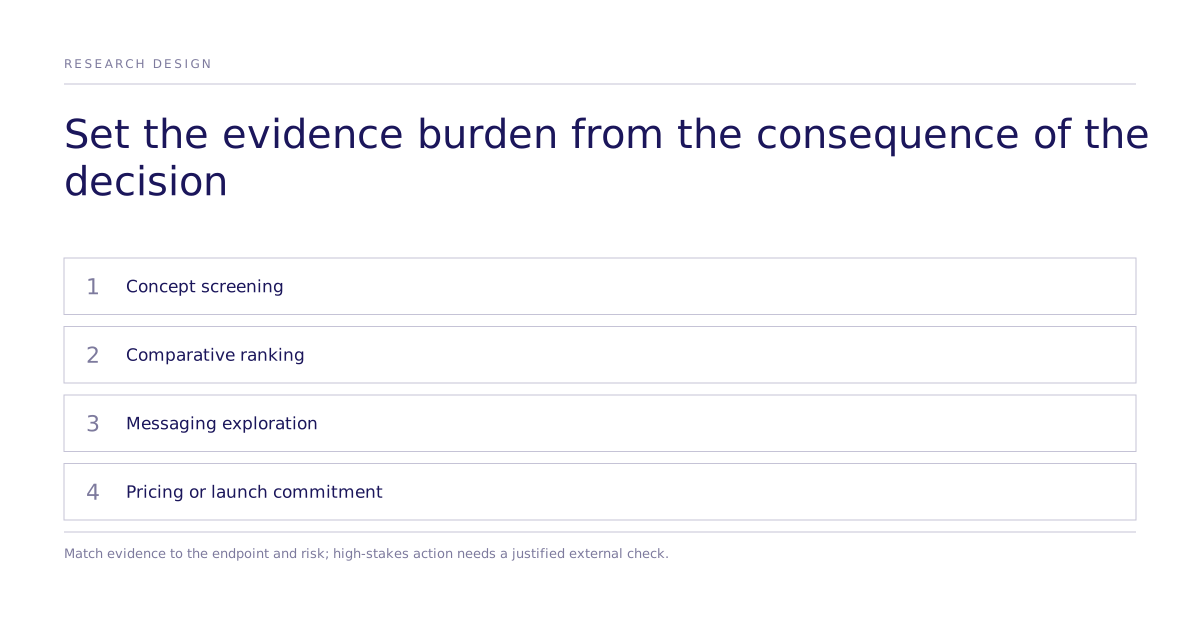
Trust should rise with consequence
A low-cost concept screen can use a simulated experiment to reject weak options or identify a direction worth studying. A choice that commits budget, changes price, or affects a regulated population needs a stronger basis.
| Decision situation | What a simulated-market experiment can support | When real-participant evidence becomes important |
|---|---|---|
| Early concept screening | Prioritize hypotheses; check the risk of discarding useful options | When the direction triggers a material commitment or rejected options may matter |
| Comparative ranking across several concepts | Screen alternatives under a consistent design | When small differences between finalists would change the decision |
| Messaging or positioning exploration | Test causal contrasts and expose likely objections | When emotional nuance or cultural context is central to the choice |
| Final pricing or launch commitment | Generate a hypothesis and a directional result | Before committing material budget, roadmap capacity, or market exposure |
| Regulated, legal, or emotionally sensitive choice | Help define the question and competing scenarios | Before treating the result as decision evidence |
| New market with thin calibration data | Reveal assumptions that require examination | Before generalizing to the target population |
The table is a decision framework. Reversibility, calibration relevance, and the required endpoint determine the evidence needed for a particular study.
Why does calibration matter for a simulated result?
Calibration determines how much weight a simulated result deserves. A result checked against known human outcomes carries different evidence from an untested population description. Relevance matters too: evidence from one corpus does not automatically transfer to a new market, question type, or decision.
The July 2026 causal-fidelity working paper evaluates rank agreement between estimated choice parameters in synthetic and human replications. Its design-filtered results and broader corpus results answer different questions. Inspect the included designs and exclusions before using either aggregate to justify a new study.
Parameter-rank agreement does not establish calibrated effect magnitudes, individual-level accuracy, or commercial outcomes in a new market.
What does the wider research record add?
Sfeir and colleagues study LLM assistance with multinomial-logit model specification and, where feasible, estimation. They evaluate prompting and information supplied to the model. This is evidence about analyst assistance, rather than synthetic respondents reproducing population heterogeneity.
A separate Nature study introduces Centaur, a model evaluated on human cognitive tasks. Its task-prediction evidence concerns a different endpoint from choice-model specification or a commercial pricing study. Neither source establishes the performance of a proposed customer experiment.
Where simulation should yield to human validation
Real-participant confirmation matters when:
- the market has thin or irrelevant calibration data;
- legal, regulatory, clinical, or emotional context could change behavior;
- segment heterogeneity is central to the decision;
- the study design does not support the confidence intervals, segment comparisons, or rankings the buyer wants to use;
- the downside could threaten the product, brand, or business.
Set the human-validation requirement from the downside and available calibration evidence, rather than a universal spending threshold.
Plan human validation around the same target population, alternatives, endpoint, and analysis as the synthetic study. Document instrument differences so the team can assess whether disagreement reflects the generator, the sample, or a changed task.
This does not turn a causal action test into an observed usability session, clinical trial, or automatic proof of market performance, and it does not make confidence intervals, segment breakdowns, or scenario rankings universal outputs; those depend on the specific study design.
How should you design the study around the commitment?
Start by naming the action the evidence will authorize and the consequence if the direction is wrong. Then choose a causal experiment that preserves that question across simulation and real-human validation. Review case studies for examples of decision-focused research, or discuss the decision before fixing the study design.