Social Listening vs. Causal Simulation: When Talkwalker Data Isn't Enough
A brand strategy or consumer insights leader running Talkwalker already has a steady read on what customers are saying: sentiment trends, share of voice, mention volume across social, news, and broadcast. The harder question shows up the moment that data has to justify a decision that hasn't happened yet: a price change, a new claim, a repositioning. Listening data describes the conversation that already exists. It has nothing to say about a conversation that hasn't started.
What social listening answers, and what it can't
Talkwalker and platforms like it aggregate what people have already said, then structure it into dashboards: sentiment over time, spikes tied to events, share of voice against competitors (Gartner Peer Insights). It tells a team what happened and how people reacted to it.
It cannot tell a team what will happen when something new ships. A price increase nobody has announced generates no conversation to listen to. A repositioned claim that hasn't gone to market has no share of voice.
What's the gap when deciding on something that hasn't shipped?
A team greenlights a price change, a new claim, or a repositioning because sentiment has been trending favorably and volume looks healthy, then finds after launch that real customer behavior in response to the new, real option doesn't match what the pre-launch conversation seemed to predict. Past sentiment wasn't measuring the thing that mattered: how people respond to a specific action once it's real and in front of them.
Closing that gap requires a different kind of evidence: a controlled test of the specific change, run before it ships.
How does Subconscious answer a different question?
Subconscious runs randomized experiments on a simulation of the market to estimate what happens if a specific action is taken, a price, a claim, a feature, and reports the causal effect with confidence intervals. Where listening data is descriptive (what has been said), this is prescriptive (which action moves the outcome).
The simulated results are validated against real human behavior. A fidelity number without its limits is marketing. Our best configuration reaches 87% of the measured human ceiling on one study: 0.832 rank correlation against the published human result, where two independent samples of real humans reach 0.959. Across all 43 studies that pass design filters the mean is 0.73. It is a validation result, not a guarantee for a new market. See the causal fidelity paper. When a decision calls for it, a team can move from a simulated study to real-human validation of the same causal question without changing what's being tested.
Where each tool fits
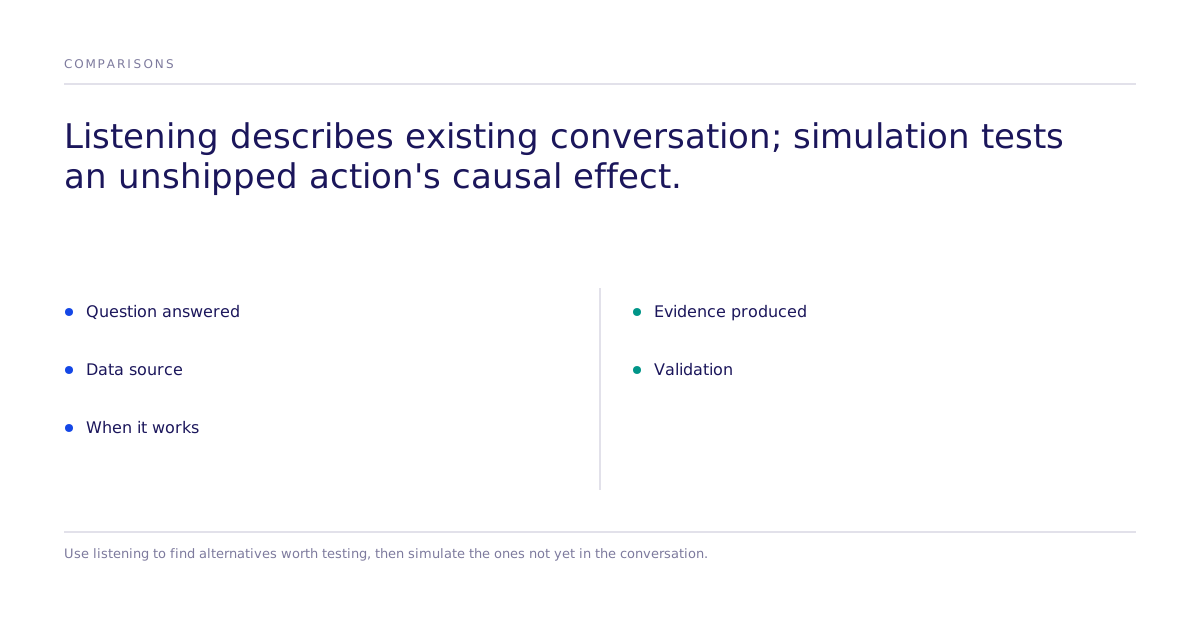
| Social listening (e.g. Talkwalker) | Subconscious | |
|---|---|---|
| Question it answers | What has already been said, by whom, how sentiment is trending | What happens if we make this specific change |
| Data source | Existing social, news, and broadcast conversation | Randomized experiments on a market simulation |
| Works when | The option already exists in the conversation | The option hasn't shipped yet |
| Evidence produced | Sentiment, volume, share of voice | Causal effect with confidence intervals |
| Validation | Methodology-dependent, on the aggregated data collected | Benchmarked against real human study outcomes |
The two are complementary rather than substitutes. Listening data can surface which alternatives are worth testing, a spike in complaints about a price point, a competitor claim gaining share of voice. Simulation tests the alternatives that don't exist in the conversation yet, before a team commits budget to them.
What doesn't Subconscious do?
Naming what the tool skips is what lets a buyer check the fit before they commit budget. Subconscious does not monitor live social conversation, track sentiment trends, measure share of voice, or scan brand mentions across social platforms, news, and broadcast archives. Causal simulation is useful when there is a specific action to test, a price, a claim, a feature, not for an open-ended read on what people are currently saying. A team that needs both should expect to run both: listening for ongoing signal, simulation for the decision that hasn't shipped.
Where this applies
If the question is "what have people been saying," listening data answers it. If the question is "what will people do when this specific, unreleased thing is real," that requires a controlled experiment on the action itself, not a read on the conversation that preceded it.