Subconscious vs. Brandwatch: Which Job Does Your Team Actually Need?
A VP of Consumer Insights weighing a pricing change, a repositioning, or a launch message this quarter needs to answer one question before any budget moves: will this specific action change behavior? Brandwatch and Subconscious both get filed under "consumer intelligence," but they answer different questions, and confusing them means shipping a decision built on the wrong kind of evidence.
What is Brandwatch built to answer?
Brandwatch is a consumer intelligence platform that aggregates social and web conversation, then surfaces it through dashboards and reports for research and insights teams. It answers "what are people already saying about my brand or category?" That is a monitoring job: mentions, sentiment, and volume for conversation that already exists.
Brandwatch fits organizations with a dedicated insights function, an established research cadence, and a need for that conversation data flowing into an existing analytics stack.
What is Subconscious built to answer?
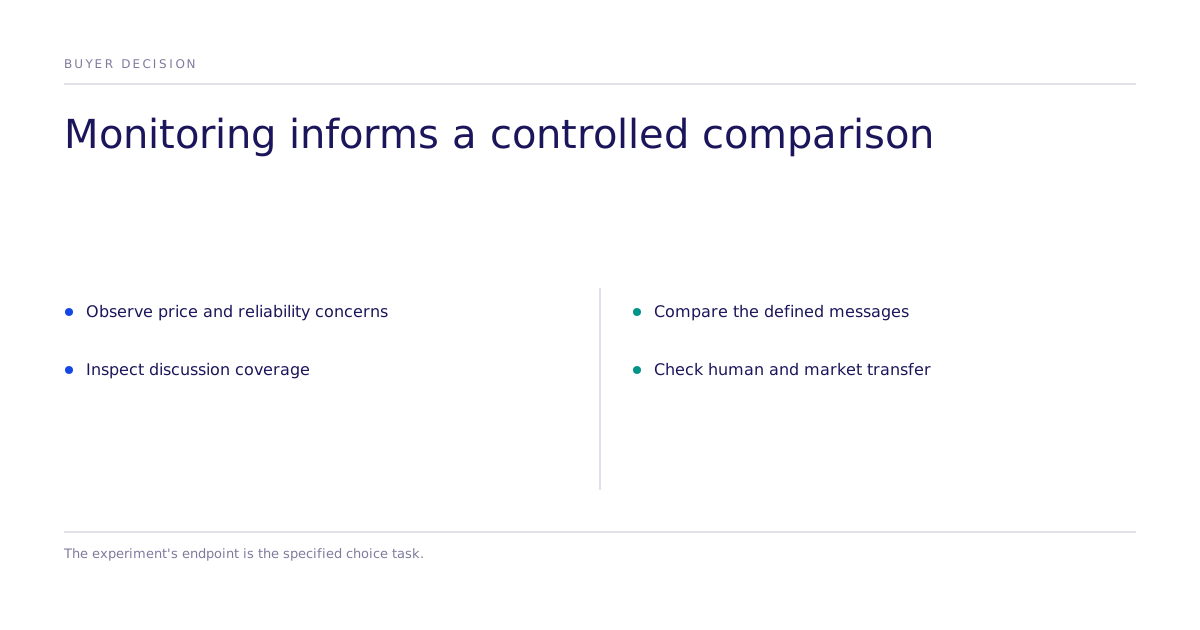
Subconscious's synthetic method estimates how defined alternatives change generated choices in a controlled task. For example, compare a lower-price message with a reliability message under the same offer and response options. Specify the contrast, sample assumptions, and interval calculation. A human follow-up checks transfer; deployed behavior requires additional market evidence.
That is a testing job: it pressure-tests a decision before it ships, not after.
Where the two jobs diverge
| Brandwatch | Subconscious | |
|---|---|---|
| Question answered | What appears in collected discussion? | How do defined alternatives change generated choices in this task? |
| Data source | Existing social and web conversation | Controlled experiments on a simulated population |
| Output | Sentiment, volume, and mention trends | A task-specific contrast with design-appropriate uncertainty |
| Best suited to | Ongoing brand and category monitoring | A decision that has to be made before it ships |
A monitoring dashboard can identify concerns that inform a proposed price or message. The observed trend alone does not identify that action's effect. A controlled comparison needs a relevant task and transfer check; it does not supply an ongoing monitoring feed.
The cost of using the wrong one for this decision
Using conversation volume or sentiment as evidence that a proposed action will work skips the intervention comparison. Existing discussion can inform alternatives, such as price concerns or reliability objections, without establishing the response to the new offer.
What does Subconscious not do?
Treat continuous listening and a bounded choice study as separate requirements. Confirm current monitoring and delivery scope before procurement. An experiment alone does not provide continuing mention or sentiment tracking.
Deciding where the budget goes this quarter
Use monitoring for observed discussion and a defined comparison for selecting among actions. Inspect the study process, decision examples, and the validation record. For a specific upcoming decision, discuss the required endpoint and evidence.