Survey-Replication Tools vs. Persona Platforms vs. Causal Experiments
A consumer insights, product, or pricing leader evaluating synthetic-research tools usually asks the wrong question: which tool is fastest or cheapest. The question that matters is narrower: does this decision need to know what people say they would do, or which action changes what they do?
Those are different research problems, and most tools on the market solve only the first one.
Three categories, three different questions
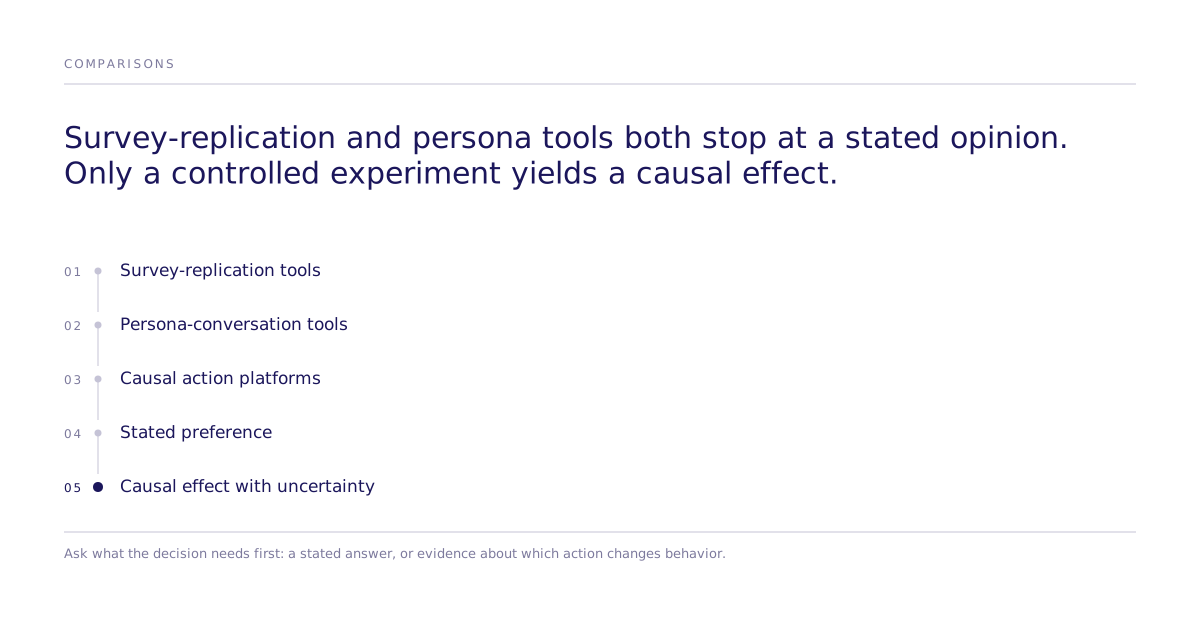
Synthetic-research platforms split into three methods that answer three different questions. Confusing them is the expensive mistake: shipping a decision based on a stated answer when it required evidence about what changes behavior under a controlled alternative.
| Method | Question it answers | Interaction model | Evidence produced |
|---|---|---|---|
| Survey-replication tools | What would a respondent say on a structured questionnaire? | Fixed instrument, sample-level statistics | Stated-preference results formatted like a traditional survey report |
| Persona-conversation tools | What does this specific persona think or say when asked? | Open-ended, one persona (or panel of personas) at a time | A plausible synthetic opinion or conversation transcript |
| Causal action platforms | Which action is most likely to change the outcome? | Controlled experiment comparing alternatives | Directional causal comparisons, with uncertainty where the study design supports it |
The first two methods are both forms of stated preference: they tell you what a simulated respondent claims about an idea. Neither, by construction, tells you which of two actions moves adoption, conversion, churn, trust, or preference. That gap is why a research question that looks survey-shaped or persona-shaped can still produce the wrong answer for a decision about cause and effect.
When is a survey-replication tool the right choice?
Survey-replication tools fit teams that already run a formal market-research function and want to keep an existing survey or structured-interview methodology, running it faster. If your research question maps cleanly onto a questionnaire item, and stakeholders expect traditional survey or focus-group deliverables, it's a reasonable fit. The tradeoff is the same one traditional surveys carry: a fixed set of questions can't chase down an unexpected response, dig into why a respondent feels that way, or pivot as the conversation unfolds, and it stays scoped to the research team, not product, marketing, or sales.
When a persona-conversation tool is the right choice
Persona-conversation platforms trade statistical breadth for open-ended depth. Talking to a single synthetic persona, or a small panel of personas, is useful for early-stage ideation: pressure-testing a positioning angle, surfacing objections before a launch, or generating hypotheses worth testing with real customers later. That step is useful, and Subconscious doesn't replace it. But a persona conversation produces a plausible opinion, not evidence that a specific action changed behavior, and shouldn't be treated as a substitute for validation.
Where do both methods stop?
Neither tool is designed to answer the question that drives most product, pricing, and launch decisions: which action is more likely to cause the outcome you want. A stated preference, however it is collected, is not a causal effect. Reading a persona's answer as market performance, or a synthetic survey result as revealed behavior, is the substitution that ships a decision the method was never built to support.
Subconscious.ai is the causal AI company: randomized experiments on a simulation of the market, validated against real human behavior, that show why people choose and which action drives the outcome. It sets up a controlled comparison between the actions and estimates which one is more likely to move a decision-specific outcome, for a defined population, with uncertainty reported where the study design supports it.
Our best configuration reaches 87% of the measured human ceiling on one study: 0.832 rank correlation against the published human result, where two independent samples of real humans reach 0.959. Across all 43 studies that pass design filters the mean is 0.73. Publishing the shortfall alongside the number is what lets a buyer check the claim against the record. It is a validation result, not a guarantee for a new market, drawn from a broader corpus of about 300 replicated studies across 9 domains (the causal fidelity paper). It can also run controlled studies against a person-level audience graph covering 800 million real people, distinct from a recruitable participant panel. Where a decision hinges on it, a team can move from a simulated experiment to real-human validation on the same causal question without redesigning the study.
Fair comparison: where population-scale and interview-style tools fit
Two other approaches sit at different ends of the synthetic-research spectrum.
Aaru works at the population-simulation end: multi-agent modeling built for enterprise research functions that need statistical rigor at scale, typically with a longer implementation timeline than a self-serve tool. It fits a research team that needs population-level behavior simulation and the internal process to support an enterprise deployment.
Synthetic Users sits closer to the persona-conversation category: it interviews a single synthetic respondent at a time, a narrow fit for generating hypotheses before recruiting real participants.
Both answer a different question than a causal action platform: useful for representing a market or surfacing a hypothesis, but neither compares two actions on the same simulated population to estimate which one changes the outcome, the evidence a pricing, launch, or messaging decision usually needs.
How to pick
Three questions narrow the choice:
- Is the research question about what people say, or which action changes what they do? A questionnaire item or an opinion belongs to a survey-replication or persona-conversation tool. "Which price, message, or feature moves the outcome" belongs to a causal experiment.
- Does the decision need to move from simulation to real-human confirmation without changing the question? If yes, the platform needs to support that transition on the same causal design, not a separate re-run.
- What is the cost of being wrong? A low-stakes internal brainstorm can tolerate a plausible synthetic opinion. A pricing, launch, or GTM decision that is expensive to unwind needs evidence about the action, not a stated preference.
Limitations
These limits sit next to the results in the open record, and naming them is what lets a buyer check the claim before deciding whether to trust it. Subconscious is not a conversational persona-interview tool and does not replace open-ended persona conversations. It is not a self-serve, minutes-to-insight tool for casual cross-team use outside a configured study. Current public pricing and packaging are not published for self-service comparison. Confidence intervals, segment heterogeneity, and decision-memo outputs are study-specific, not guaranteed on every study.
A next step for a team weighing this decision is to look at how Subconscious runs a study, review case studies from comparable decisions, or talk to the team about the specific action under consideration.