Two Synthetic-Audience Models: Check the Grounding and Experimental Design
A consumer insights or growth marketing lead evaluating synthetic-audience tools usually runs into two families of product, built on different foundations, before ever reaching the harder question: what happens after the screen comes back positive.
How do vendors build a synthetic audience?
As checked in October 2026, GWI's synthetic audiences are grounded in its recurring survey data. GWI describes weekly data refresh and conversational personas or multi-segment focus groups. The response remains generated, even when the underlying source is a human survey.
A different possible configuration grounds generated respondents in supplied documents, transcripts, or other permitted evidence. Synthetic Users describes proprietary-data grounding for its studies. Check which sources, versions, retrieval methods, and refresh rules the actual configuration uses.
| Survey-grounded segments | Source-modelled personas | |
|---|---|---|
| Data grounding | Recurring survey evidence, as documented by the vendor | Supplied evidence under the configured retrieval and generation procedure |
| Evidence to inspect | Survey scope, recency, model construction, and validation | Source permissions, completeness, retrieval, and validation |
| Refresh and reuse | GWI describes weekly data updates and reusable conversational access | Confirm the configuration's source versioning and refresh behavior |
| What provenance does not settle | Whether the actual study identifies an intervention or transfers to the target audience | Whether the actual study identifies an intervention or transfers to the target audience |
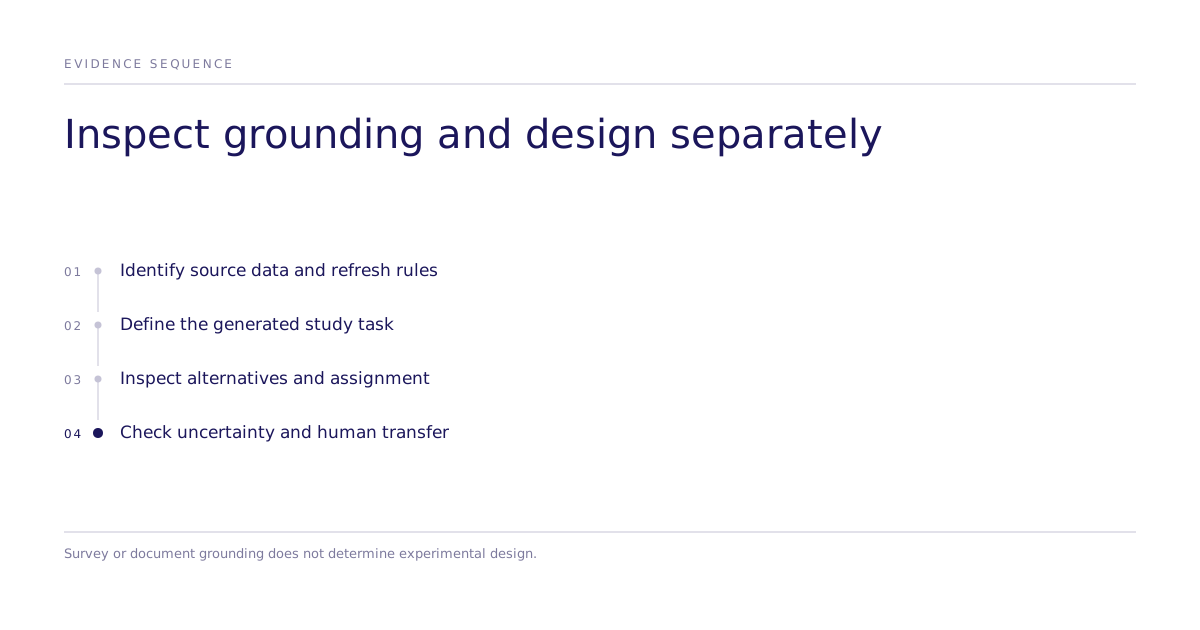
Data grounding affects relevance, but it does not determine whether a workflow includes random assignment, explicit alternatives, or an appropriate estimator. Inspect those properties before interpreting a screen as an action-effect result.
What can't a directional screen carry on its own?
A directional synthetic read can help narrow alternatives. Define what the screen measures and what validation follows; the narrowed list does not by itself justify media spend, a price change, or a public positioning claim.
For an intervention claim, check whether the selected workflow includes controlled alternatives, a specified outcome, and design-appropriate uncertainty. The experiment may occur inside the same platform or in a separate study. Data provenance alone does not establish or exclude it.
Where does a causal experiment pick up?
Subconscious's published choice method concerns generated responses under controlled tasks and comparison with human choice-parameter rankings. The buyer's study needs a defined population, alternatives, endpoint, estimator, and human-transfer check. Confirm current outputs and delivery rather than assuming every comparison includes a calibrated effect magnitude.
Three things worth keeping separate
Buyers evaluating this space tend to blur three distinct capabilities into one claim:
- Audience reach: how broad a population a tool can represent or simulate.
- Simulated experiments: a controlled discrete-choice test run on that population, which is what produces a measured effect.
- Recruited real-human validation: testing the same causal question with real respondents once the stakes justify it.
Align population, alternatives, endpoint, and analysis for a human follow-up, and document task differences. A wider modeled audience does not establish validation, and a human choice study does not automatically prove market adoption, usability, or clinical safety.
The practical next step
If a synthetic-audience screen has already narrowed a decision to one or two live options, the next move isn't running another directional read. It's defining the specific alternatives being compared and the population that matters, then measuring the effect with a controlled experiment before committing budget or making the claim public.