UserTesting, Maze, Lookback, or Causal AI: Which Method Fits the Decision?
Use usability research to observe people interacting with a product or prototype. Use a controlled comparison when selecting among designs, prices, messages, or concepts requires an intervention estimate. These capabilities can overlap within UserTesting, Maze, or other platforms; inspect the configured task and endpoint.
These methods are complements. Each becomes expensive when asked to answer a question it cannot measure.
What does each method measure?
| Method | What it measures | Best question | Main limitation |
|---|---|---|---|
| UserTesting and UserZoom workflows | Participant behavior and commentary; supported studies can compare randomized task variants | Where does the experience fail, or how do variants affect a measured task? | Prototype or elicited results do not automatically establish market performance |
| Maze | Task completion, prototype interaction, survey, and usability outcomes | Can people complete a defined task? | Task success is not the same as market choice |
| Lookback | Live or recorded interface behavior plus participant explanation | Why did the participant act that way in the interface? | Small qualitative sessions do not estimate a causal market effect |
| Subconscious | Choice responses to controlled commercial alternatives in simulated audiences, recruited human participants, or both | Which defined action produces the stronger behavioral response? | Does not replace session-level observation of interface use |
When should you use UserTesting?
UserTesting records real people interacting with a product, letting researchers watch sessions, hear participants explain their actions, and see where an interface creates confusion.
UserTesting's UserZoom task documentation includes assigning participants to website or prototype versions. Randomization availability depends on study type. Define whether the endpoint is preference, task completion, or actual deployed behavior before interpreting the contrast.
Request current quotes for participant eligibility, recruitment, study volume, seats, supported design, analysis, and services. Obtain a delivery estimate for the actual audience and instrument; the unavailable historical annual-contract examples do not establish current price or timing.
When should you use Maze or Lookback?
Maze's current variant-comparison documentation describes exclusive random assignment and randomized presentation order. It distinguishes research comparison from live production A/B testing. Check plan availability and specify the metric before the study.
Lookback supports live and recorded usability sessions. It fits a researcher who needs follow-up questions, screen interaction, participant commentary, and direct observation.
Both retain an advantage causal simulation should not pretend to replace: a researcher can watch a real participant use the interface.
When Subconscious is the right choice
The study starts with an intervention and an outcome. The team defines the audience, holds the decision context stable, and compares plausible actions.
A synthetic choice comparison estimates a contrast in generated responses. For a human check, align population, alternatives, outcome, and analysis where feasible, and record task differences. Actual interface completion needs participants using the interface.
This is the right method when a product or marketing leader must choose:
- One price or package over another
- One product concept or claim over another
- One position or message over another
- One launch or market-entry action over another
The defined choice comparison can inform action selection within the study conditions. It does not by itself establish usability completion, purchase behavior, or launch performance.
The supported causal experiment use cases show where this method fits. The research program explains why human baselines and validation remain part of the workflow.
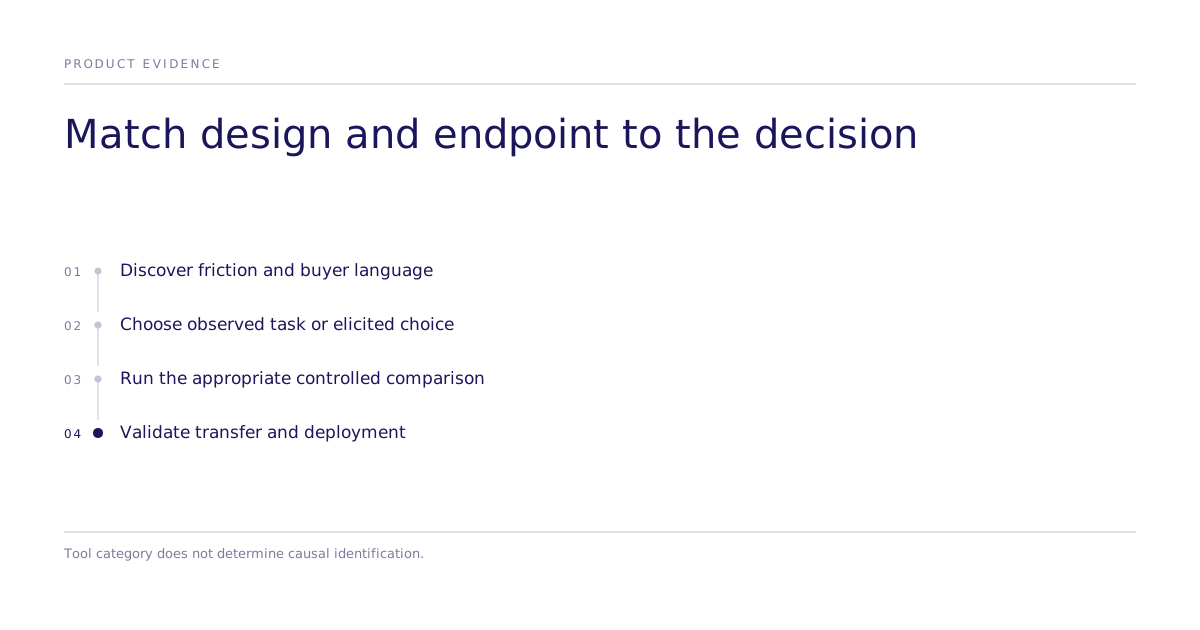
Use the methods in sequence
- Use exploratory interviews to find the problem and learn the language customers use.
- Use an observed interface study to diagnose friction or compare task variants under an appropriate design.
- Compare commercial alternatives on a defined choice endpoint, with relevant human validation for a synthetic study.
- Observe the rollout to learn whether the measured effect holds in market.
It prevents a stated preference, a usability failure, and a causal effect from being treated as the same result.
Limitations
Remote usability tools depend on recruitment quality, task design, and the realism of the tested interface. A Subconscious experiment, whether simulated or human, depends on the study design, audience definition, alternatives, and outcome chosen for that decision.
No method removes the need for human judgment. Consequential product, health, financial, or policy decisions require real-world validation and qualified review.
If the team has a concrete action to compare rather than an interface task to observe, bring the decision to a Subconscious working session.