Video-Avatar Production vs. Causal Message Testing: Where Should Pre-Launch Budget Go?
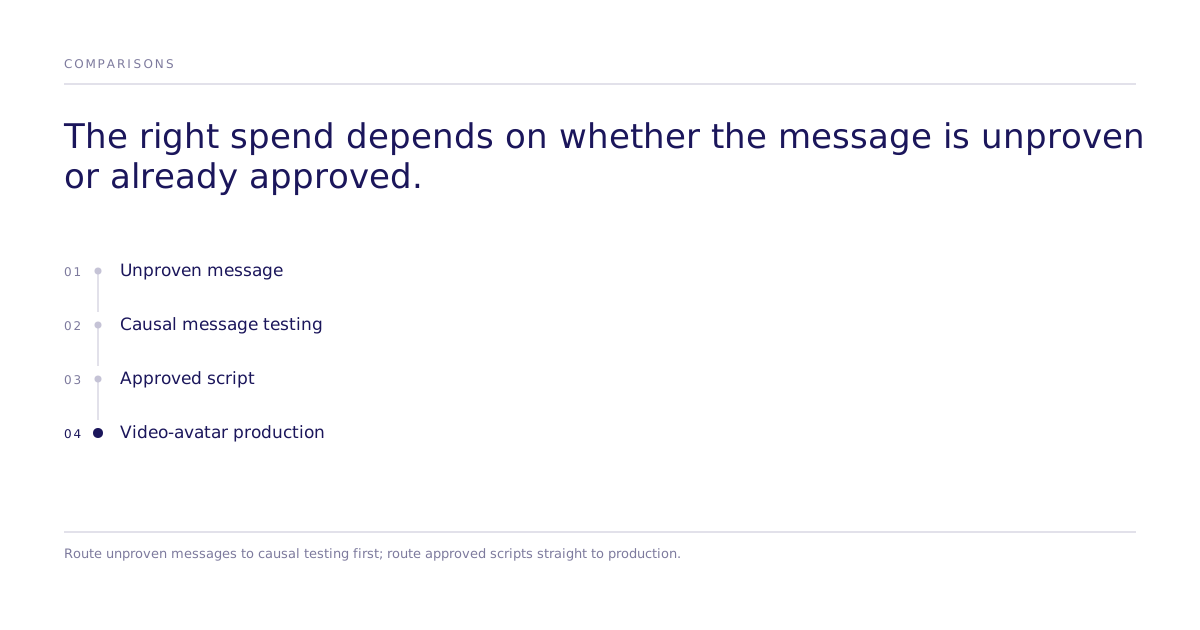
A pre-launch team should fund causal message testing when the claim, positioning, or audience is still uncertain, and video-avatar production when the script is settled and the remaining job is to produce the asset.
Start With the Open Question
Video-avatar production answers, "How should we render this approved script?" Causal message testing answers, "Which message, claim, or action changes behavior, and for whom?" If the second question is unresolved, producing the asset first commits budget before the decision has evidence behind it.
When Is Video-Avatar Production the Right Spend?
Video-avatar tools are appropriate when a team needs a scripted video asset for training, localized product demos, spokesperson content, or marketing. The input is a written script. The output is a voiced video. Current vendor materials describe script-to-video creation and related production capabilities (product overview).
Recent product updates add more production options, but those options do not provide evidence that the script's central claim will change audience behavior (May 2026 product update). A team producing dozens of localized versions may still need this category after its message is validated.
When the Message Is Still Unproven
Subconscious.ai is the causal behavioral platform. It runs randomized experiments on a simulation of the target market, validated against real human behavior, to show why people choose and which action moves the outcome. For a campaign, the action under test can be a message, claim, or positioning alternative. The output is evidence for the decision, not a finished creative asset.
This matters when the team has several plausible scripts but no causal basis for choosing one. The experiment compares controlled alternatives before the creative format is fixed; the production team then executes against the selected message.
One Budget, Two Different Outputs
| Buyer decision | Video-avatar production | Causal message testing |
|---|---|---|
| What remains uncertain? | How to produce an approved script | Which message, claim, or action to approve |
| What is the input? | A finished script | A decision, target audience, and alternatives |
| What is the output? | A rendered, voiced video | A directional comparison of actions |
| What does it not provide? | Evidence that the message changes behavior | Video, voice, avatars, or other creative assets |
| Where does it belong? | After the message is settled | Before production when the message is unsettled |
What Is the Expensive Sequencing Error?
Producing a polished asset around an untested claim spends the execution budget while leaving the central market question unanswered. If the claim fails after launch, a new render cannot repair it; the team must revisit the decision and produce the asset again.
A historical planning example used a 12-variant message test. The useful lesson is structural: those plausible messages create a choice problem before they create a production problem. The example is not a current platform benchmark, vendor claim, or delivery promise.
The opposite error is also possible: if the message is already supported and the only open question is how to produce the video, the production tool is the appropriate purchase.
How Do You Keep the Causal Question Intact?
A team can move from a simulated experiment to real-human validation without changing the causal question. This does not turn the study into an observed usability session or guarantee market performance; it adds a human validation step before the message becomes a finished asset.
Fund the Unresolved Decision
If the script is approved and the team needs video, buy production tooling. If the team still needs to know which claim will change buyer behavior, test that action first. Teams with both needs may use both categories in sequence, but Subconscious does not generate video, voice, avatars, or lip-synced clips.
Review the research and validation approach, then see how a causal study moves from question to action.