Build a Consumer Insight Workflow Your Boss Notices
A stakeholder wants the answer tomorrow. A report draft appears before the analyst has finished reading the data. Someone in management floats the idea of letting AI handle that first pass instead. None of that is abstract. It is pressure on a specific decision: how a consumer insights team structures its workflow before asking leadership to fund or approve the change.
Make the decision contribution visible: what the team planned to do, what evidence changed or preserved that plan, who acted, and which later outcome will be measured.
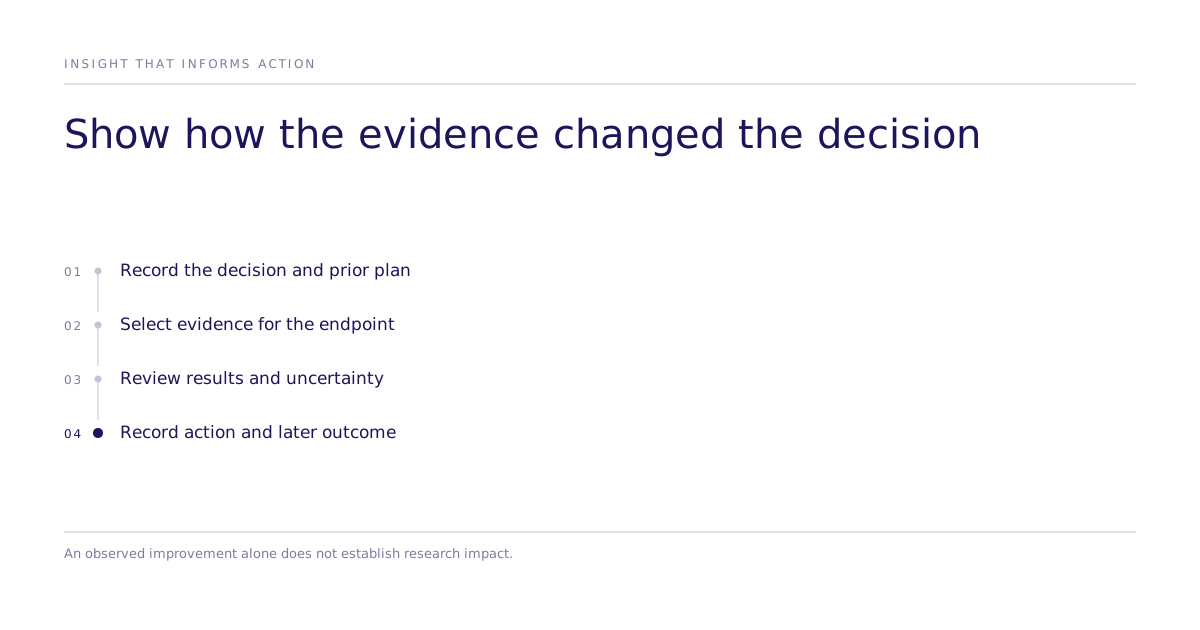
The decision: formalize a staged workflow or keep shipping ad hoc output
A head of insights needs a workflow that identifies the decision, selects suitable evidence, reviews results, and records the action taken. Add a generated screen when it supplies useful missing evidence; direct human research or a live test may be the better starting point.
Two ways to get this wrong sit on opposite ends. Ship an ungated synthetic read as if it were fact, and a wrong directional call reaches a real business decision; the research function's credibility with leadership takes the damage. Over-validate everything, and the speed advantage that justified the workflow change in the first place disappears, taking the case for the workflow with it.
Why did the access advantage stop protecting the role?
Tools can draft surveys and summarize transcripts, but the team still needs to check their relevance and accuracy. WRITER's April 2026 survey reports AI use and implementation challenges among surveyed executives and nontechnical employees using AI. It does not establish a labor-market forecast for research analysts.
The analyst owns the question, checks the evidence, and states what remains unresolved. A fluent summary is useful only when its claims survive review against the underlying sources and the business context.
A four-stage workflow
A workflow built around this shift has four stages.
| Stage | What happens | Who owns it |
|---|---|---|
| Exploration | Generate hypotheses, objections, and alternative framings | Analyst, tool-assisted |
| Study | Compare specified alternatives with the required response source and endpoint | Analyst or study owner |
| Human review | Check the audience definition, framing neutrality, source grounding, and business context | Analyst |
| Decision and follow-up | Compare results with the decision threshold, record the action, and measure a relevant later outcome | Decision owner plus analyst |
Subconscious uses controlled choice studies on generated responses. Such a screen may help prioritize concepts or prices, while human or live comparisons assess their relevant endpoints. Align versions and outcomes for validation, record differences, and allow contradictory evidence to change the recommendation.
Document the configured audience's provenance, coverage, and relevance separately from any recruited human sample. A modeled profile does not establish who can be recruited or that the response represents the target market.
How do you build the audience brief before running anything?
The audience brief helps determine what a directional test can support. Before running a comparison, define the segment, the context, the current behavior, the available alternatives, and what the person is trying to accomplish. A vague audience produces a vague read, which is what makes an ungated workflow dangerous in the first place.
Use open-ended reactions and objections to explore uncertain concepts. For a choice comparison, define alternatives and assignment. For example, randomly vary a lower-price offer and an onboarding-service offer while holding the specified remaining attributes fixed, then measure the selected offer. Record whether the choices are generated or human.
What mistake undermines the whole system?
The failure mode looks like this: the automation runs quietly, out of view, and then nobody can point to the impact once leadership asks what happened. It usually comes from pressure: speed is what the team wants, a deck needs a conclusion, and whatever the tool outputs sounds fluent enough to fill that gap. But sounding fluent is not the same thing as being evidence, and a workflow that skips the distinction eventually produces a claim nobody can defend.
Label each output by its source, endpoint, uncertainty, and validation status. Preserve the underlying evidence and identify the reviewer. Do not treat an AI-adoption survey as an employment projection or as proof that the workflow improves decisions.
What to change this week
Do not rewrite the whole workflow at once. Start with one visible project.
- Pick a real project tied to a live decision.
- Write the business decision the project depends on in one sentence.
- Define the audience and how much confidence the decision requires.
- Select a study that measures the needed endpoint; use a generated screen only when its evidence limits fit the role.
- Review the estimates, sources, audience assumptions, and uncertainty against the design.
- Record the prior plan, recommendation, decision owner, action taken, study cost and cycle time, and the next observable outcome.
For the onboarding example, record whether the team changed the offer, who approved it, and the actual completion or purchase outcome to be measured. State whether the outcome comes from a randomized live comparison or an observational follow-up. A later improvement alone does not prove that research caused it.
Where this workflow stops
This workflow requires named owners and review; it does not imply that a governance product automatically performs every step. Inspect aggregate replication evidence, how the process works, or discuss a decision with the prior plan and required outcome.