Build vs. Buy: A Custom MCP Research Agent or a Causal Research Platform
The deciding factor between wiring a custom MCP agent chain and using a causal research platform is whether the decision can tolerate an unvalidated verdict with no confidence measure or audit trail. A growth or marketing-ops team can wire a coding agent to a product-analytics tool, a synthetic-response tool, and a messaging tool, and have it post a weekly "ship or don't" verdict on a shipped feature. The harder question is not whether that pipeline can be built. It can. The question is what happens the first time the verdict is wrong and nobody in the channel can tell.
What does tool-chaining through MCP actually do?
The Model Context Protocol standardizes how an AI agent discovers and calls external tools, so one agent session can pull data from an analytics service, hand it to a second tool, and pass the result to a third, without custom glue code for each pair (Anthropic, "Introducing the Model Context Protocol"). An analytics vendor that ships an MCP server typically exposes its existing API surface as callable tools: querying events, cohorts, and dashboards through the same operations already available in its product (PostHog, "Model Context Protocol (MCP)"). Chaining several such servers behind one agent prompt is a real, working integration pattern. It is not an experiment design.
Where the verdict breaks
A common version of this pipeline: pull the cohort that used a feature in the last 30 days, describe that cohort to a synthetic-response tool, ask the resulting persona whether it would recommend the feature, and post the answer to a team channel. Each step works on its own. None of the steps checks the others.
The persona's stated opinion is free-text output from a language model conditioned on a cohort description. It is not a controlled comparison between the feature and its absence, and nothing in the chain checks the stated opinion against how a real customer would actually behave. A team that treats that weekly post as a causal read on customer behavior can ship or kill a feature on an unvalidated verdict, with no held-out human check, no confidence measure, and no audit trail showing which step introduced the error.
What does a structured causal question add?
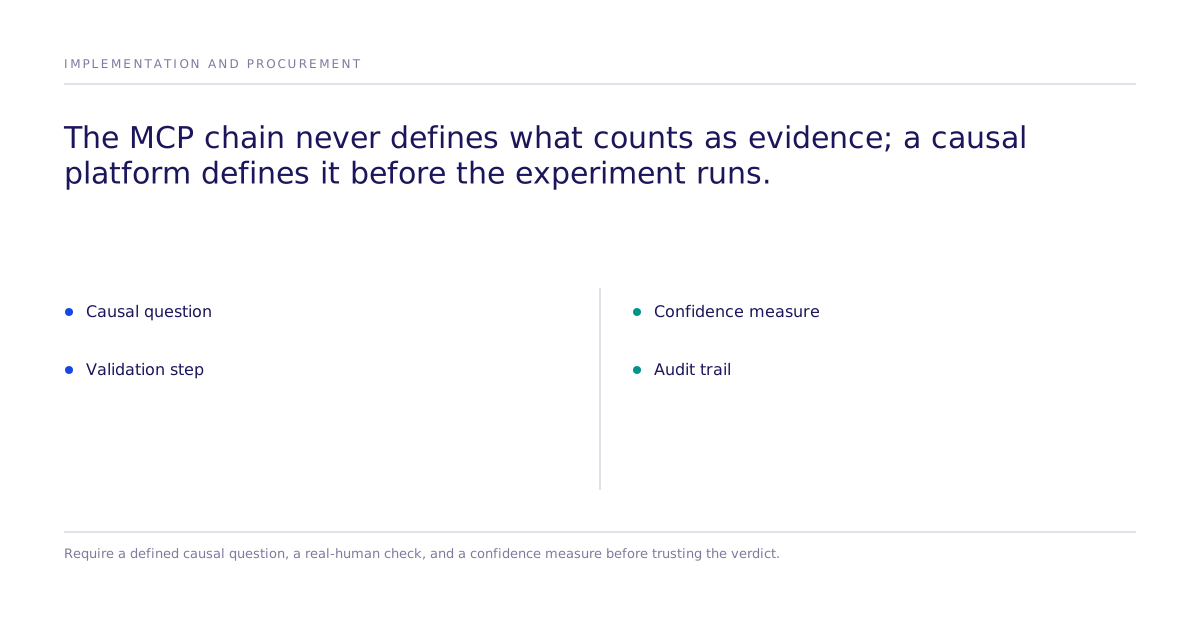
The fix is not more tools in the chain. It is defining, before any data is pulled, what would count as evidence and what would count as noise.
Subconscious is the causal AI company. It runs randomized experiments on a simulation of a market and can validate the result against real human behavior, so the report answers which action drove the outcome rather than what a chat-style persona said it might do. A team can move from a simulated experiment to real-human validation without changing the underlying causal question, a step a hand-wired agent chain has no place for.
Two related terms are easy to blur: "audience" and "panel." Subconscious can run controlled studies against a person-level audience graph covering 800 million real people. That audience graph is a pool the platform can draw a study against, not a recruited panel of 800 million people standing by to answer questions.
Comparing the two approaches
| Hand-wired MCP agent | Structured causal platform | |
|---|---|---|
| Causal question | Defined implicitly by whatever the prompt asks | Defined before the experiment runs |
| Validation step | None built in; depends on someone auditing the chain | Real-human validation available without redefining the question |
| Confidence measure | Not produced | Reported alongside the result |
| Audit trail | Whatever the agent's tool-call log happens to capture | Part of the experiment record |
| Best fit | Fast to assemble for a narrow, low-stakes workflow | Suited to decisions where being wrong is expensive |
When the two are worth combining
The build-your-own path is not wrong to attempt. Grounding a research question in real usage data is a legitimate pattern, and a team that already has product-analytics tooling in place can use it to decide which features are worth a proper test. Analytics data can narrow which cohort or feature deserves scrutiny; a structured, validated experiment should be what decides the action.
What doesn't this analysis prove?
This is a build-versus-buy framing, not a claim that a packaged, automated MCP workflow ships today. The comparison is about what each approach can and cannot validate, not turnaround time or per-call cost.
Next step
Before adding another tool to an agent chain, decide what would have to be true for the weekly verdict to be trustworthy: a defined causal question, a real-human check, and a confidence measure that travels with the result. Learn how Subconscious runs that kind of study, or see the research behind the method.