Customer Segmentation: Stated Answers or a Behavioral Test?
Building a segmentation means picking one of two ground truths: what simulated or interviewed personas say they care about, or what a controlled test shows actually changes their choice. The two produce different segment boundaries, and only one survives contact with a real launch.
The say-do gap is the risk, not a detail
Simulated persona interviews are fast to run: describe a hypothesized segment, ask it a structured set of questions, and read across the answers for patterns. That surfaces stated preference: what a respondent claims matters when asked directly. It does not test revealed preference: what actually moves their choice when price, framing, or a competing option changes.
Stated intent systematically diverges from the choices people make once real trade-offs are on the table (Journal of Economic Behavior & Organization), and correction methods exist precisely because that bias is large enough to distort downstream decisions (Health Economics). A segmentation built entirely on stated answers inherits that gap: marketing builds campaigns, product reprioritizes roadmap, and sales retrains pitches around segment boundaries that were never checked against an actual behavioral response.
Should you build a segmentation hypothesis before testing it?
A segmentation hypothesis is worth writing down early. The discipline holds regardless of what tool runs the interviews:
- Name segments specifically enough to act on. "Owners of independent restaurants with one to three locations who handle their own marketing" is testable; "small business owners" is not.
- Write a one-paragraph persona per hypothesized segment: who they are, what they currently use, what frustrates them.
- Interview each hypothesized segment with the same structured question set (jobs to be done, pain points, decision criteria, channel and source, willingness to pay) so answers are comparable across segments.
- Read across the answers for three signals: convergence within a segment (it's real and tight), divergence between segments (they're worth treating separately), and surprises (segments that should merge or split).
Naming a method's limit here lets a buyer check it before a budget gets committed against it. That gets a team to a defensible hypothesis about segment boundaries. It does not tell them which message, price, or feature actually changes a given segment's behavior; that needs a different kind of test.
Where a causal test replaces a guess
| Stated-answer interview | Controlled behavioral test | |
|---|---|---|
| What it measures | What a respondent says they'd do or value | What choice actually changes when an action changes |
| Best use | Shaping and narrowing a segment hypothesis | Deciding which message, price, or feature to ship per segment |
| Failure mode if treated as final | Segments reflect the say-do gap, not real demand | Output is a measured causal effect with a confidence interval, scoped to the study design |
Subconscious runs controlled behavioral experiments where the segment or buyer definition is a direct input, and the output is a causal comparison between actions: for example, which price point or feature framing changes stated intent to purchase for one segment versus another.
Subconscious can also validate a study with real human participants, without changing the underlying causal question, when a decision is high-stakes enough to justify it. Audience definition for a study can draw on a person-level audience graph covering 800 million real people (a sourcing capability, not a recruited panel), so keep the two distinct when scoping a study.
What doesn't a controlled behavioral test replace?
This section spells out the boundary of a controlled test so a buyer can scope a study correctly before committing to it. A controlled test is not a packaged segmentation, clustering, or persona-interview product; it answers one action-comparison question per study, not "here are your five customer segments." Confidence intervals, segment-level heterogeneity breakdowns, and willingness-to-pay outputs are specific to how a given study is designed, not a standard deliverable of every engagement; confirm what a specific study will produce before commissioning it.
Next step
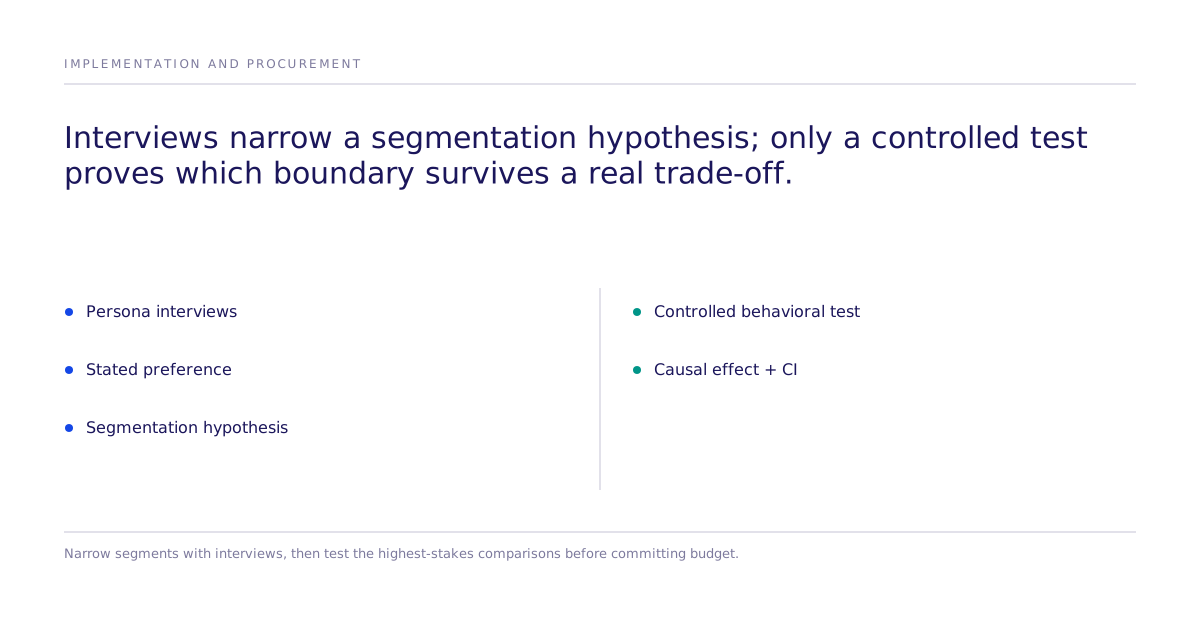
Use the interview-based hypothesis step to narrow candidate segments and the messages or features worth testing per segment. Before betting a roadmap or a campaign budget on the result, run the highest-stakes comparisons as a controlled experiment rather than accepting stated answers as final. See how the same comparisons play out for existing customers in case studies, or book time to scope one study against a segment hypothesis already in hand. Teams shifting from stated to tested decisions can start with how a study gets designed.