The Head of Research AI Adoption Checklist for 2026
A head of research adopting AI tools in 2026 does not need to decide whether AI belongs in the workflow. It already is there. The decision that matters is where to draw the line between AI-assisted exploration and decision-grade evidence, and what governance sits around that line: which review gates apply, what disclosure language ships with an AI-assisted finding, and when a claim escalates to real-human validation.
Get that line wrong in one direction and a stakeholder ships a launch, pricing, or positioning call on an unlabeled AI-generated read that was never checked. When it fails publicly, the research function's credibility, and the leader's job, absorb the blame. Get it wrong in the other direction and the team routes every fast question through a full fielded study, and the business starts working around research entirely.
Why the Job Is Under Pressure, Specifically
The threat to a head of research is not that AI eliminates the role. It is narrower: leaders are feeling pressure to bring AI in fast, before they have an operating model that would hold up to scrutiny. AI has moved from a novelty layer into daily workflows for analysis, reporting, data preparation, and self-service insight. Research demand has not disappeared alongside that shift. The U.S. Bureau of Labor Statistics still projects 7% employment growth for market research analysts from 2024 to 2034, faster than the average occupation (BLS, Market Research Analysts: Occupational Outlook Handbook).
What has changed is the access advantage. Expertise used to live partly in knowing how to field a study, clean the responses, and package the finding. AI weakens that advantage: more people can now draft a survey, summarize a transcript, or generate a first-pass narrative. Once outputs are cheap for anyone to produce, the scarce skill becomes judging which one is trustworthy, and explaining why.
Build Evidence Tiers Before You Adopt a Tool
The leaders who hold their footing in 2026 will not be the ones using the most tools. They will be the ones with the clearest evidence system, one that spells out three things: what AI can do without oversight, where a human has to sign off, and which claims need real validation before they ever leave the building.
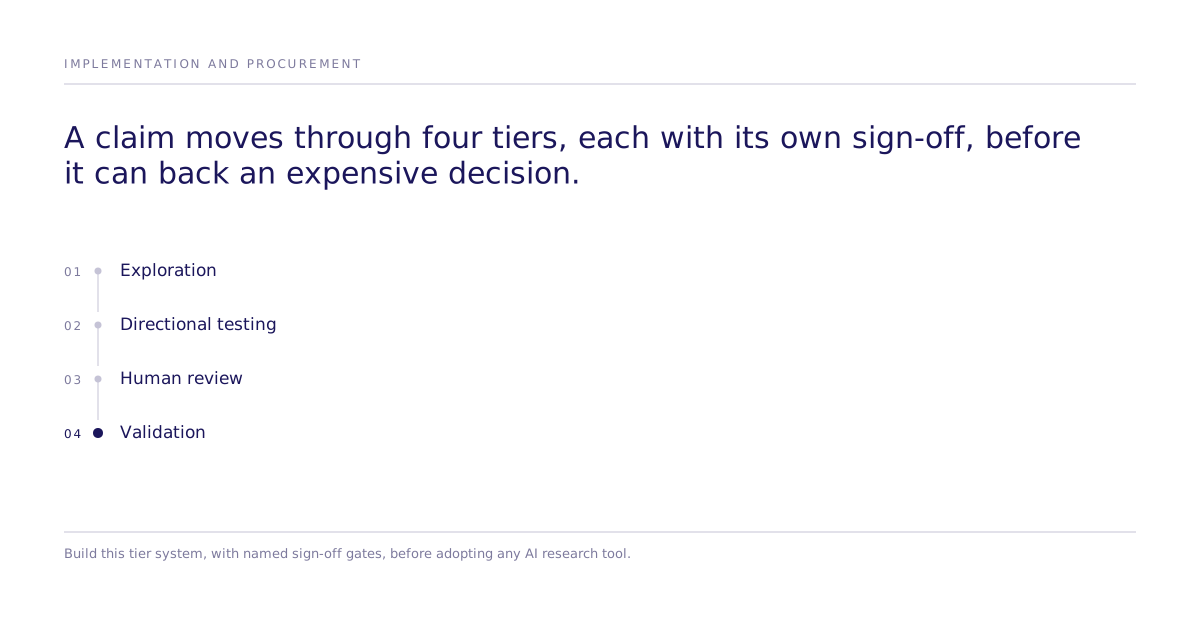
A workable version has four tiers, moving from cheap and fast to slow and defensible:
| Tier | What it's for | Who signs off |
|---|---|---|
| Exploration | Generate hypotheses, objections, alternative framings | AI-assisted, no review gate |
| Directional testing | Run a controlled comparison of concepts, messages, or options before committing budget | Researcher reviews design and output |
| Human review | Check audience definition, prompt or stimulus neutrality, and business context | Required before any external framing |
| Validation | Real respondent data, behavioral data, or fielded research for expensive or public decisions | Research leader approves escalation |
The value in this system is not the AI output. It is the disciplined, labeled path from a question to a decision the business can defend later.
Where Does a Causal Experiment Fit in the Directional Tier?
This is the tier where a platform like Subconscious sits, not as a replacement for the review and validation layers above it but as the mechanism inside it. Subconscious runs controlled, randomized experiments on a simulated audience so a team can test a pricing story, a message, or a feature framing before the slow or expensive part of research begins. Because the test is a controlled experiment rather than a single generated answer, it produces a causal effect with a confidence interval, not just a plausible-sounding read. See how the method works.
Stating plainly what Subconscious does not decide is what lets a research leader check the claim before it reaches a live decision. That still leaves the human-review and validation tiers intact. Subconscious does not decide which claims are safe to leave in the exploration or directional tier versus which require a jump to real humans; that governance call stays with the research leader. And a causal experiment on a simulated audience is a distinct method from open-ended AI brainstorming with generated personas: it does not become a usability session, a clinical trial, or automatic proof of market performance just because the underlying question is causal. When a decision is expensive or public, the same causal question can move to real-human validation without being redesigned.
What Adoption Mistake Actually Sinks Credibility?
Teams get burned when they purchase tools first and only later figure out what success or risk should mean for their work. That error usually comes from pressure: the stakeholder wants an answer tomorrow, the tool produces a fluent one, and the deck needs a conclusion. What keeps research credible is a sharp line between something a tool spit out and something that counts as evidence. Where a tool's authority ends is a fact worth stating in the deliverable itself, so the reader can check it. A tool can produce useful output. It cannot decide on its own whether that output is valid for the decision sitting in front of the business.
The fix is to make the limit part of the deliverable. Spell out where the AI-assisted work applies, where it stops applying, and what still needs validation before anyone treats it as fact. Leaders who do this consistently sound more credible, because they can explain exactly where their confidence has a boundary.
Where Should You Start This Week?
Do not rewrite the whole research function at once. Start with one visible workflow:
- Pick a real project with a live, pending decision.
- Write the business decision in one sentence.
- Define the audience and the risk level attached to getting it wrong.
- Use AI, or a controlled directional experiment, only for the exploratory and directional tiers.
- Route the output through human review before it reaches a stakeholder.
- Present the finding with an explicit caveat and a named next validation step.
Repeat that loop on a second workflow the following week. Within a month, the team has something more durable than a list of approved AI tools: a working evidence system that a stakeholder can trust because its limits are stated out loud. Teams evaluating where a controlled, causal test fits inside that system can book time to walk through a specific workflow.
The Bottom Line
The pressure behind this question is rational. AI is changing what the fast, cheap part of research work looks like. Human judgment in research and strategy is still required; what shifts is the shape a defensible version of that role now takes. The safer position is closer to the decision, explicit about which tier produced each finding, and clear about what still needs a human, or a real respondent, before it becomes a claim.