How to Choose a Customer Simulation Method
Choose a customer simulation method by the evidence the decision requires, then choose how to deliver it. Roleplay can generate hypotheses; a randomized study can estimate a response contrast within its tested setting. A vendor platform or a custom build may support either task. Before funding the work, specify the buyer population, intervention, response measure, validation requirement, and engineering owner.
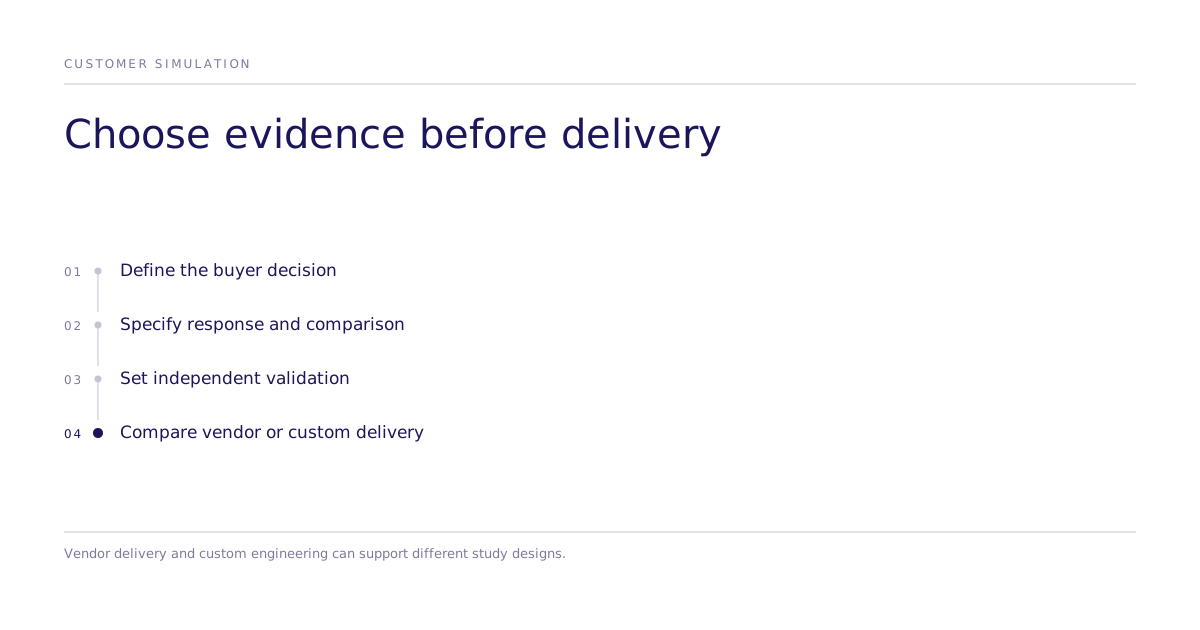
Match the method to the evidence
Delivery alone does not establish evidence quality. Ask what each proposed setup actually measures.
| Approach | Useful question | Evidence boundary |
|---|---|---|
| Ungrounded roleplay | How might a described buyer react? | Produces a hypothesis, not a population estimate |
| Off-the-shelf vendor platform | Can an existing product run the required task and export the evidence? | Check its assignment procedure, response source, analysis, validation, and commercial scope |
| Custom multi-agent build | Does an unusual workflow require integrations or controls unavailable in an existing product? | The team must implement and verify those controls and maintain the system |
| Controlled experiment | Which candidate action changes the measured response within the tested population and setting? | Randomization identifies the tested contrast; transfer to real purchases requires separate evidence |
For a Subconscious study, bring the candidate actions and population definition to a decision review. Agree on which generated choices the study will compare and how the result will be checked against relevant human evidence. The public research record reports aggregate replication results; it does not establish audience reach or predict every new market decision.
If the decision requires recruited participants or live customer behavior, specify that validation separately: eligibility, instrument, outcome, fielding responsibilities, and acceptance criteria. A generated response, a person's hypothetical choice, and a completed purchase provide different evidence.
Define the buyer and action before the study
The study should isolate a choice the team can make. Four inputs keep that choice concrete:
- Demographics. Where the buyer lives and works, what they earn, who they live with, and what stage of life they're in. Include only what plausibly affects the decision being tested.
- Psychographics. Include values or motivations only when the research question or prior evidence makes them relevant. Define them consistently and record whether they come from customer data, a screening item, or an assumption.
- Historical voice. Anonymized excerpts of real reviews, support tickets, sales-call notes, or survey comments. These examples constrain the language used in the study without turning past comments into proof of future behavior.
- The job to be done. State the practical problem in its setting. A hypothetical laptop buyer might need to present a proposal during an unreliable video connection; that context suggests testable battery, connectivity, and support tradeoffs.
Then define the action and assignment. For example, randomly assign eligible respondents or generated draws to two otherwise identical onboarding offers and measure which offer they select. Record whether the selection is generated, stated by a person, or observed during a live purchase.
Set the boundary before reading the result
Simulation narrows a decision. It does not certify that the market will behave exactly as modeled. Four boundaries matter:
- Response fidelity. Bisbee and colleagues found substantial differences between generated and human responses in their ANES survey-replacement tests (Political Analysis, 2024). Test the proposed population and response measure against independent evidence; a plausible answer alone does not validate them.
- Model dependence. Repeated draws can share a model's assumptions and biases. More draws may stabilize a generated estimate while leaving its mismatch with human behavior unchanged. Decide what independent human comparison is needed before reading the simulation result.
- Information currency. Record the dates and sources used to define the audience and context. Some systems incorporate newer data; verify that access and its provenance rather than assume the model reflects a recent market shock.
- Longitudinal and regulated decisions. A simulated trajectory is a modeled forecast, not an observed cohort history. Confirm the applicable evidence requirements and plan actual follow-up or human data collection when the decision requires them.
Confirm the deliverables for the configured Subconscious study: response data, estimator, uncertainty method, validation comparison, and a decision summary where agreed. A confidence interval must name its assumptions; it does not by itself cover population mismatch or transfer to actual sales. Usability observation and moderated human research require their own scope and fielding plan.
Plan scale without turning examples into requirements
Plan the number of profiles, draws, or human respondents around population coverage, the contrasts to estimate, and the precision needed for the decision. There is no universal small-panel count that establishes fidelity. Distinguish repeated model draws from independent respondents and test sensitivity to model and prompt choices.
Scale should follow the decision. A headline choice may need contrast across a few well-defined buyers. A pricing decision may require more segments, stronger controls, and real-human validation. Adding simulated buyers does not correct a vague action, a leading frame, or a missing validation plan.
Before funding a custom build
An exploratory first pass can help write a better study brief:
- Pick one decision already on the table: a campaign headline, a pricing change, a feature launch.
- Describe the relevant buyer groups using demographics, evidence-backed motivations, historical voice with provenance, and the job to be done. Record missing or assumed inputs.
- Use consistent exploratory questions to identify candidate actions and likely misunderstandings.
- Treat contrasts across generated profiles as hypotheses; check them against customer evidence.
- Specify the randomized comparison and independent validation that would justify acting. Compare an existing vendor setup with a custom build on required controls, exports, permissions, maintenance, and total cost.
Bring the decision brief and validation requirements to Subconscious to agree on study scope and deliverables.