How to Not Lose Your Market Research Job to AI in 2026
The job at risk in 2026 is not "market researcher." It is the researcher who only executes: drafting screeners, summarizing open ends, and assembling first-pass reports without deciding what evidence a stakeholder decision needs. The fix is not a new tool habit. It is a rule your team applies before any AI-assisted finding reaches a pricing, positioning, or launch decision: name which evidence tier produced the finding, and require the next tier up before anyone repeats it externally.
Why the pressure is real but the framing is wrong
AI has moved from a novelty layer into daily research work: drafting, summarizing, and assembling first-pass output at a pace no single person can match by hand. That produces a specific anxiety: a stakeholder wants an answer tomorrow, a draft report shows up before anyone has finished going through the data, a manager asks whether the team can skip the slow steps.
The accurate risk is not that research demand disappears. The U.S. Bureau of Labor Statistics projects continued growth for market research analysts from 2024 to 2034, well above the average for all occupations. The risk is being treated as an expensive production layer once a machine can do the mechanical parts of the job. When drafting and summarizing get quick and low-cost, the person doing only that work has to move closer to the decision: better questions, better evidence choices, better caveats, better influence on what the business does next.
What is a four-tier evidence gate?
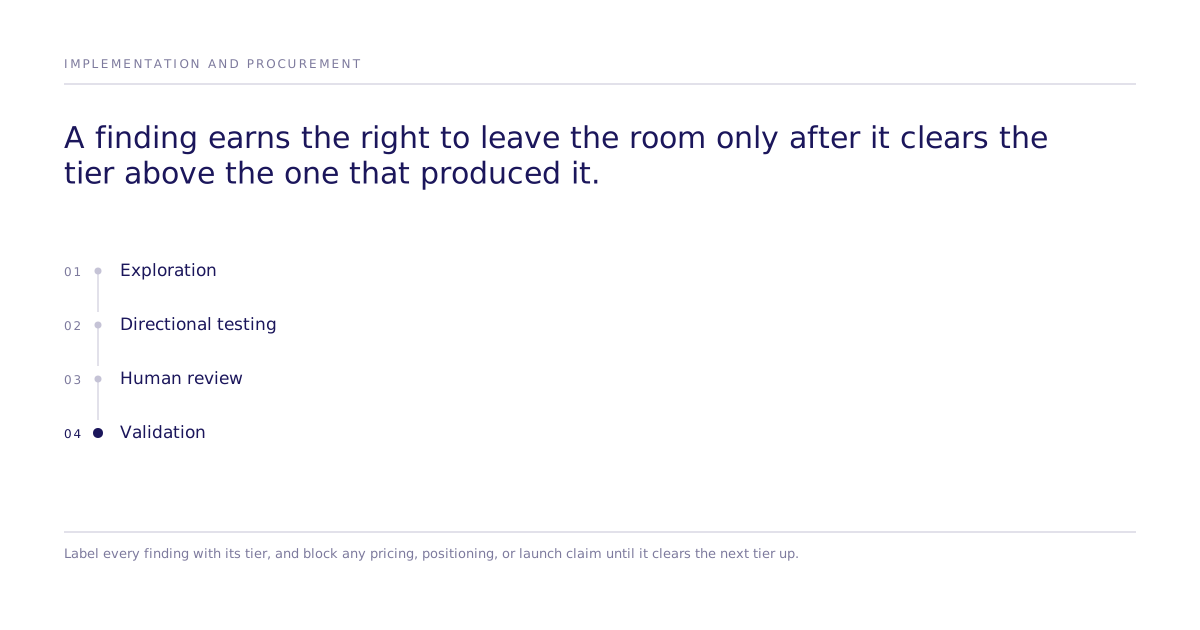
The researchers who hold their ground in 2026 can name, for any finding, which of four evidence tiers produced it, and require the next tier up before a claim leaves the building.
| Tier | What it does | Who signs off | When it's enough on its own |
|---|---|---|---|
| Exploration | Use AI to generate hypotheses, objections, and alternative framings of a problem | Individual researcher | Internal ideation only, never cited externally |
| Directional testing | Run a controlled, randomized study against a modeled audience to compare options quickly | Research lead | Early-stage prioritization, not a stakeholder claim |
| Human review | Check the audience definition, prompt neutrality, source grounding, and business context on the directional read | Research lead and stakeholder | Low-stakes internal recommendations |
| Validation | Confirm the finding with real-human participant data, behavioral data, or fielded research | Research lead and business owner | Any claim that is expensive, public, or hard to reverse |
The output of an early tier is not evidence by itself. It is a hypothesis that has passed one screen. Making that distinction explicit, in the deliverable itself, is what separates a defensible workflow from a fluent-sounding guess.
Where does a modeled-audience read fit?
A causal experiment run against a modeled population is useful for the directional tier: it produces a randomized, controlled comparison instead of a single fluent guess, before a team commits to the slow or expensive part of the research process (how the underlying causal method works).
The workflow starts with the decision, not the tool. Write down what will change if the read points one way or another. Then define the audience precisely: who they are, the situation they're in, what they currently do, the alternatives they weigh, and the goal they're trying to reach. Run the comparison against a focused stimulus: a concept, message, pricing story, or feature idea. Ask for reactions, objections, and what would make the idea more credible, and compare across segments rather than stopping at the first answer.
When the decision behind a directional read is expensive or will be stated publicly, the same causal question can move to a real-human validation study without being re-scoped: the question stays constant, only the evidence tier changes (how a study moves from a directional read to human validation). That escalation path, not the directional read alone, is what makes a four-tier gate defensible in front of a stakeholder who will ask "how do you know."
What mistake breaks credibility?
The mistake is presenting a directional, AI-assisted read as if it were a statistically fielded, validated study. It usually happens under pressure: the team wants an answer, the tool gives a fluent one, the deck needs a conclusion. A researcher's credibility rests on being able to tell an unqualified output apart from evidence a business can act on without caveats.
The correction is to make the limit part of the deliverable, not an afterthought. State what the AI-assisted work was used for. State what it was not used for. State what still needs validation before anyone repeats the number outside the room. A researcher who does this does not sound less confident. They sound like someone whose confidence has boundaries, the more credible position with a stakeholder.
A one-week audit to run now
Do not start by rewriting the whole workflow. Start with one visible project:
- Pick a real project with a live decision attached to it.
- Put the business decision into a single sentence.
- Name the audience and estimate what a wrong call would cost.
- Restrict AI or a directional read to that early exploratory step.
- Read through the output by hand and flag each piece as usable, shaky, or not safe to reuse.
- Present the answer with an explicit caveat and a named next validation step.
Do this weekly across a month. At the end, the payoff isn't a longer list of tools. It's a working evidence gate that demonstrates judgment, not just output.
Limitations to carry into the rollout
A limit stated in the open is what lets a stakeholder check the work instead of just trusting it. A four-tier gate does not remove the need for a validation step on claims that matter; it changes how a team moves from a directional read to a validated one without starting over with a different method. A directional read stays a hypothesis until it clears human review and, where the stakes require it, real-human confirmation. It does not substitute for a researcher's judgment about which questions matter or how to interpret a contradiction between sources. See how teams have staged this kind of escalation in case studies, or read more about the company behind this approach.