How to Spot Bad AI-Generated Consumer Insights Before They Drive a Decision
A fluent AI-generated finding does not fail by looking wrong. It fails by looking finished: a clean narrative, a confident tone, no visible gap where the evidence should be. The question a research operations or consumer-insights lead has to answer before that finding reaches a marketing or product decision is not "does this sound plausible," it is "what would make this wrong, and did anyone check."
Why a checklist beats a gut check
AI-assisted analysis is now part of the daily research workflow: drafting hypotheses, summarizing transcripts, running a first directional read against a described audience. None of that removes the need for evidence discipline; it raises the cost of skipping it, because a well-written answer is easy to mistake for a validated one.
The 2025 ICC/Esomar International Code addresses research conduct, transparency about methods and data sources, fit-for-purpose research, and human oversight. It is a professional standard; citing it does not certify a generated finding or substitute for checking the evidence.
A polished but ungrounded finding gets treated as proof, and a team commits budget or roadmap time to a claim that never had real support behind it. Fixing that does not require rejecting AI-generated or simulated research. It requires a gate before any such finding is allowed to count as evidence.
Four checks before a finding earns trust
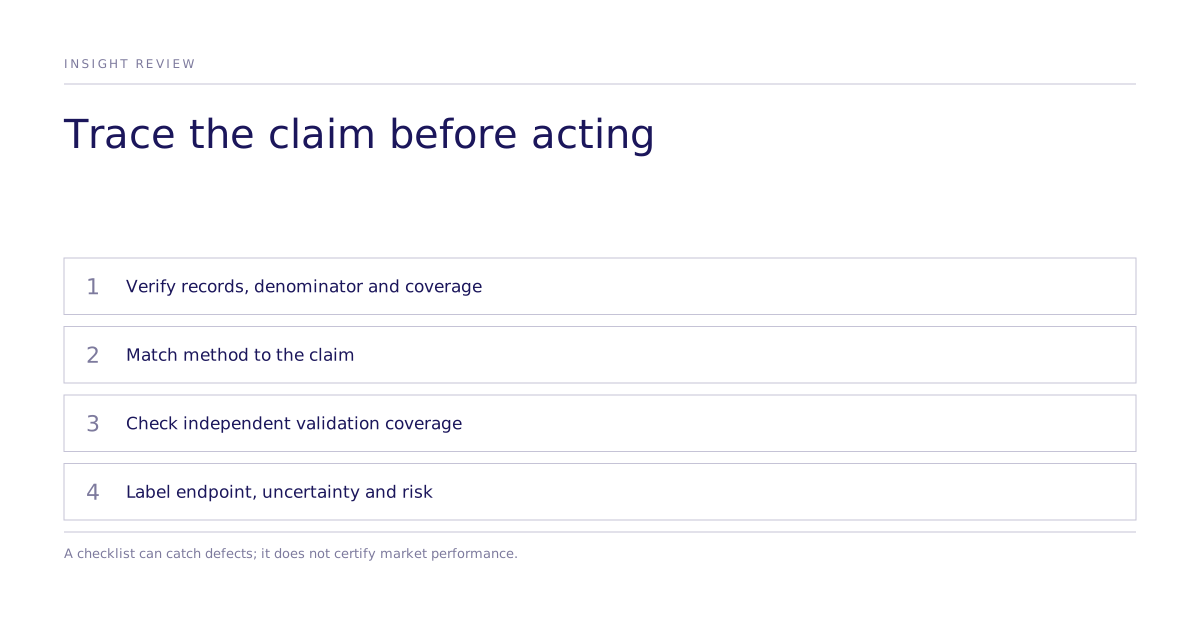
A useful gate has four parts.
| Check | What it verifies | Fails when |
|---|---|---|
| Source and population | The claim can be traced to raw records, dates, denominator, eligibility and coverage | A quotation, count, audience trait or source cannot be verified |
| Method fits the claim | Checked records support a description; an identified comparison supports an intervention effect | A generated narrative is treated as observation, or an uncontrolled association is called a causal effect |
| Validation coverage | Independent evidence matches the population and endpoint required for the action | A general benchmark or expert plausibility review is described as validation of this result |
| Result and risk labeling | Source, endpoint, uncertainty assumptions and unresolved limits accompany the proposed action | A generated choice is reported as actual purchase behavior |
Examples of failure include treating generated explanations as observations and using an intervention estimate beyond its tested endpoint. Inspect contrary responses, alternative explanations, missing groups, and inconclusive results before accepting the narrative.
What does a controlled comparison add that a narrative can't?
A checked summary can accurately describe its source without an experiment. To estimate whether a message, price, or concept changes a response, specify the baseline, alternatives, assignment, population, and endpoint. Randomization supports a contrast on the measured response; it does not establish all facts in the surrounding report.
For a Subconscious study, agree on the generated-choice design, estimator, uncertainty method, and relevant independent human comparison. Document eligibility, grounding sources, and coverage gaps. Scope any recruited or live validation separately, aligning the instrument and population where appropriate and recording differences.
What does this platform not replace?
A tool result does not certify itself. Confirm the configured study's deliverables rather than assume that an interval, ranking, ROI analysis, or decision recommendation is automatically included. A financial model also needs cost, margin, volume, and transfer assumptions beyond a choice-study result.
Put the checklist to work
Apply the checklist to one pending decision. In a hypothetical example, "customers want assisted onboarding" overstates a summary in which 6 of 10 interviewees mentioned setup difficulty. A defensible description would report that count, link the dated transcript excerpts and recruitment criteria, acknowledge the other four responses, and state that the interviews do not estimate market prevalence or prove that assistance increases activation. Test the intervention separately if activation is the decision endpoint. Review aggregate method evidence, then scope the decision and validation.